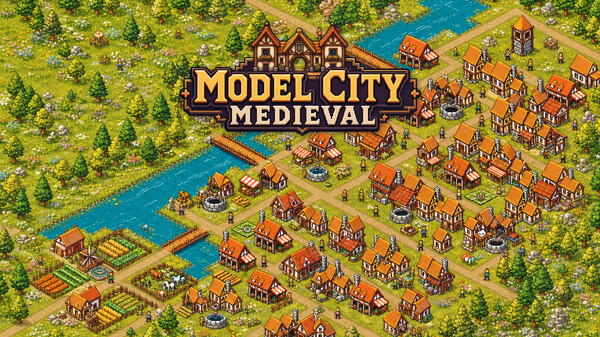
Shape a peaceful medieval town beside winding rivers. Lay roads, zone homes, farms, workshops and markets, then watch them grow as you balance demand, services, resources and land value. A relaxing pixel-art city builder with no combat, fail states or imposed objectives.
Modeled estimate, not a reported figure. How we estimate →
Media
About
Model City Medieval is a relaxing sandbox city builder about creating the conditions for a town to flourish. Begin with open meadow and a winding river, lay the routes your settlement needs, designate land for different uses, and watch a living medieval town take shape.
You do not place every completed private building yourself. Zone affordable plots for homes, farms, workshops, markets and gardens. When demand, road and water access, services and local land value align, townspeople develop those plots on their own.
Well-supported properties can grow from modest tier-one buildings into prosperous tier-three homes and businesses. Shape the town around them and watch neighbourhoods emerge from the choices you make.
Every part of the map has its own strengths. Rivers provide water to nearby land. Roads connect new districts. Wells, watchtowers and healers improve the areas they serve, while gardens reduce local pollution and support advanced development.
Use clear overlays for land value, roads, water, trade, safety, health and pollution to understand why a plot is thriving—or what it still needs.
Manage coin, food and timber while setting the town’s tax rate and planning monthly upkeep. Farms feed residents, workshops produce timber, markets support trade, and every growing district changes demand across the town.
The monthly ledger shows income, expenses, production, population, new construction and upgrades. Shortages can slow growth or leave buildings neglected, but they never end your city. Recover, adjust and keep shaping the settlement.
There are no enemies, battles, countdowns, victory checklists or game-over states. Pause whenever you like, choose from three simulation speeds, inspect every plot in detail, and let each saved city become a long-running project of your own.
Genres
Stats
All-time low is the lowest price we've recorded for this game since we started tracking it.
Languages: English
Reviews
This is a fun "casual" game as described. This is not true city builder game. So when purchasing this game expect it to be very casual. For what you get out of this it pretty good. It runs very smoothly and I like watching the building upgrade. It is worth a try if you like city building games. My only complaint is the price of the game. I find it a tad too high for what you get out of it. Review at: https://www.youtube.com/watch?v=SWILmr5h5do
This.... is not a game. Nothing is explained and all you do is fill in squares and that is it. The controls are just awful, you want to scroll out? Scroll wheel right? Nope, it's the same button as the back button, wtf? Moving forward you are scrolling in if you want to or not unless you look up, so unintuitive! You cannot turn down the music, on or off is it. It took me all of 5 minutes to fill in the squares and that is it, the game is done and gives no explanation at all about what you are doing. There is a video just before the screen shots above, watch it and you have seen the entire game. This is not something I would play even for free.... good thing I got it for free, now I want my time back! I thought maybe this was early access? Nope! I though okay, maybe they just put this out? Nope, it's 2 years old and this is it! Amazing the crap people are allowed to charge money for on Steam...
Once again, steam needs a neutral option for rating games. Is it horrible? No, but I've seen more compelling mobile games. I barely feel like I will get my $ worth even though I got it on sale, so it gets a negative rating. -This is less of a city builder and more like a basic resource-balancing puzzle in the way it functions. -There is no explanation of what to do or why. You just have to click around until you figure it out, which wasn't very engaging. It runs smoothly, so if you're looking for super simple, it might appeal. -Basic game play makes this pretty boring fast, unless you just like a terrarium that looks like a city. It feels very shallow and I don't know how it could have much replay value.
Model City is a compact city-building simulation developed and published by GTGD that embraces simplicity over complexity. Rather than challenging players with intricate economic systems, traffic management, or citizen demands, the game focuses on the pure enjoyment of designing and growing a miniature urban landscape. It presents itself as a digital model-building experience where experimentation is encouraged and failure is virtually nonexistent. This approachable philosophy makes it an appealing option for players who enjoy city builders but prefer a more relaxed and accessible experience. The gameplay revolves around placing different types of zones across a grid-based map. Residential, commercial, industrial, agricultural, and park areas all contribute to the overall value and development of the city. Each placement influences nearby tiles, creating a light strategic layer beneath the game's straightforward mechanics. Players are encouraged to think carefully about how zones interact with one another, balancing different land uses to maximize growth and unlock higher-value developments. While the systems are easy to understand, there is enough depth in the placement mechanics to keep players engaged throughout a play session. One of the most appealing aspects of Model City is its stress-free structure. There are no financial crises to solve, no disasters to recover from, and no strict objectives that force players into a particular style of play. The game allows complete freedom to experiment with layouts and discover the most efficient city designs. This design choice creates a calming atmosphere that feels more like working on a tabletop model project than managing a bustling metropolis. The absence of harsh penalties ensures that every decision becomes part of a learning process rather than a source of frustration. Visually, the game succeeds in delivering the charm of a miniature city display. As players increase land values and improve their layouts, buildings evolve into larger and more impressive structures. This gradual transformation provides a satisfying sense of progression and rewards thoughtful planning. Watching neighborhoods develop from modest beginnings into thriving districts gives the city a feeling of life despite the game's intentionally minimalist approach. The clean presentation and easy-to-read interface further reinforce the title's accessible nature. The game's relatively short length is both a strength and a limitation. Most players can complete a city within a single session, making it ideal for those looking for a relaxing experience that does not require a major time commitment. However, players seeking deep simulation mechanics or long-term replayability may find the content somewhat limited once they have mastered the core zoning strategies. The game's focus is clearly on providing a concise and enjoyable creative experience rather than an endlessly evolving management simulation. What ultimately makes Model City successful is its commitment to a specific vision. It does not attempt to compete with larger city-building franchises that emphasize realism and complexity. Instead, it delivers a peaceful sandbox where players can focus on city design, experimentation, and visual progression. The combination of simple mechanics, strategic zoning considerations, and a welcoming atmosphere creates an experience that is easy to enjoy and difficult to dislike. Model City is a charming and relaxing city-building game that excels at providing a low-pressure creative experience. Its streamlined mechanics and satisfying progression make it enjoyable for casual players and fans of minimalist simulations. Although it lacks the depth and longevity of more ambitious city builders, it succeeds in offering a pleasant and rewarding experience that stays true to its straightforward design philosophy. Rating: 5/10
Its barely a game at all.
This game has little to no substance. There's no tutorial and it does not explain how to get better prices on land squares. I would not suggest buying this game because it is not complete. It has a good initial concept but the developer or developers failed to follow through on the rest of the game. Spoiler: [spoiler] I was able to get the 90k achievement by building the houses out from the middle and putting the other four property types in the corners and filling out each area based on the percentage demand to keep it "balanced". [spoiler]
[h2]Einleitung[/h2] Model City (MC) ist mal eine Städteaufbausimulation der etwas anderen Art. Anstatt sich mit Details rumzuschlagen, wie die Wasser- oder Stromversorgung aussehen muss, sich mit Beratern auseinandersetzen, die gefühlt nur in die eigene Tasche wirtschaften möchten, etc., geht es bei MC einfach darum, den Stadtwert zu erhören, indem ich als Spieler Flächen vergebe bzw. gewissen Sektoren zuweise. Ob das Spaß machen kann oder eher dröge wirkt, sehen wir in den nächsten Kapiteln. [h2]Story[/h2] Willkommen Bürgermeister! So oder so ähnlich beginnen alle Aufbausimulation im Bereich des Städtebaus. Ganz ehrlich, das ist MC zunächst auch noch nicht anders. Wir werden freundlich begrüßt und schon kann es losgehen. In der unteren, linken Ecke sehen wir die notwendigen Maus- und Tastaturbefehle und ab geht es! Wir befinden uns vor einem brachen Acker, der in insgesamt 324 gleichgroße Quadrate aufgeteilt ist. Jedes dieser Quadrate gilt es nun irgendwie zu besiedeln bzw. sinnvoll zu nutzen. Hierfür müssen wir als Bürgermeister entscheiden, wie die Nutzung aussehen soll. Dabei haben wir fünf Schwerpunkte zur Verfügung, zwischen denen wir einmalig für das betroffene Quadrat wählen können. Diese sind [b]Wohnraum, Serviceflächen (Finanz, Geschäfte, etc.), industrieller Raum, Landwirtschaft oder als Parknutzung[/b]. Dabei spielt es keine Rolle, ob wir mittendrin anfangen die Quadrate zu bespielen oder uns vom Rand in Richtung Mitte bewegen. Aber aufgepasst: Einmal dem Sektor bzw. Schwerpunkt zugeteilt, kann dies nicht mehr rückgängig gemacht werden. Im Laufe der Zeit, wenn wir alles richtig machen, steigt der Wert des Quadrats. Das erkennen wir zwar nicht unmittelbar monetär anhand unseres City Values, aber über die Bauten, die sich dort einfinden und im besten Fall weiterentwickeln. Bei jeder Vergabe eines Schwerpunkts wird uns aufgezeigt, wie viel für den jeweiligen Sektor das Quadrat gerade Wert ist. Dieser Wert wird durch die Kombination, aber auch durch die Anzahl der vorhandenen Flächen eines gleichen Schwerpunkts beeinflusst. Nun bedarf es Köpfchen und viel Fingerspitzengefühl, damit wir unserer Quadrate nicht verramschen. Es ist dabei wenig überraschend, dass Wohngebiete neben stinkenden Fabriken nicht viel wert sind, währenddessen ein Finanzdistrikt in schöner Parklage regelrecht preislich explodiert. Wir müssen mit den 324 Quadraten gut haushalten, damit unsere Stadt lebenswert wird und gleichzeitig viel Geld bedeuten würde. [h2]Grafik[/h2] Das Spiel wurde in der unity Engine umgesetzt. Soweit eigentlich in Ordnung. Der Spieler kann pauschal zwischen vier Grafikeinstellungen wählen, die sich in erster Linie durch die Detailanzahl und Auflösung der Objekte unterscheiden. Licht und Schatten werden teilweise auch beeinflusst. Allerdings ist MC mal wieder ein gutes Beispiel, wie schlecht unity sein kann. Trotz der schlechtest Einstellung, kommt meine RTX 3070TI erneut ins Schwitzen. Das müsste nicht sein und zeigt nur, wie un-performant diese Grafikengine ist, leider! Ansonsten hält sich die Grafik starkt zurück. Es ist nicht mit Spiele-Serien wie SimCity oder Cities Skyline zu vergleichen. Darum geht es auch gar nicht. Das Spiel konzentriert sich auf das wesentliche Element und das ist nun mal der Wert eines Quadrats in Abhängigkeit von einigen Parametern. [h2]Sound und Musik[/h2] Hier wurde etwas gespart. Das fängt bei der Musik an und erstreckt sich über die "Sounds". Die Musik ist eine vor sich hinlaufende, in Endlosschleife befindliche Musik, die schnell stört. Zum Glück kann man diese oben rechts im Hauptmenü abschalten. Vergisst man dies, hat man im Spiel selbst keine Chance mehr. Sounds ist so eine Sache. Es gibt nur wenige und diese sind auch sehr einfach gehalten. Jetzt könnte ich wieder sagen, dass der Fokus bei MC auf etwas anderem liegt, dennoch hätte man sich hier mehr Mühe geben können. Vor allem, weil man pro Runde doch schon die eine oder andere Minute mit dem Aufbau zu tun hat. Da hätte eine gute Geräuschkulisse die Verweilzeit versüßen können. Sprachausgaben gibt es nicht. Zudem liegt das Spiel nur in Englisch vor. [h2]Gameplay und Steuerung[/h2] Kommen wir zum größten Knackpunkt des Spiels: Die Steuerung. Wie schon erwähnt, spielt es sich mit (überwiegend!) der Maus und Tastatur. Ein Gaming Controller wird nicht unterstützt. Das Problem der Steuerung ist, dass diese absolut träge ist und sich noch viel träger anfühlt. Das Hin- und Herschwenken auf der Karte oder auch das Zoomen fühlen sich nicht nur extrem langsam an, sondern sind es auch. Das Fokussieren von Quadraten ist manchmal sehr ungenau und es harkt einfach zu sehr. Man kommt in in den "Flow" hinein, der allerdings notwendig ist, was die Navigation über die Karte betrifft. Gerade weil man Quadrate miteinander vergleichen muss und somit über die Karte "springt", ist es umso ärgerlicher, dass die Steuerung so schwerfällig umgesetzt wurde. [h2]Bugs[/h2] Habe ich interessanterweise nicht wirklich gefunden. Ja, es gibt manchmal ein paar Überlagerung von Objekten oder auch ein kurzzeitiges Flackern dieser, wenn man in einem flachen Winkel auf die Karte schaut und recht nah herangezoomt hat. Allerdings ist dies nicht die Regel und völlig verkraftbar. [h2]Spielspaß und Langzeitmotivation[/h2] Nun kommen wir zum Thema: Mal eine andere Aufbausimulation! Wie schon gesagt, verfolgt MC einen ganz anderen Schwerpunkt. Es geht darum taktisch Gebiete zu zuordnen und das meiste an Grundwert herauszubekommen. Ein stupides Platzieren von Schwerpunkten, führt zu keinem Erfolg. Am Ende hat man zwar die Karte vollständig zugepflastert, aber der Stadtwert entspricht der des Detroiter Industriegebiets Anfang der 2000er. Es handelt sich um ein Strategiespiel, was einige Versuche abverlangen muss. In Kombination mit den Steam Errungenschaften (Achievements) ensteht der Ansporn, alle zu erreichen. Dabei gibt es nur fünf Errungenschaften. Aber um an die Höchste zu kommen, muss man richtig gut sein. Ich gebe es zu, ich bin bisher immer gescheitert und liege knapp unter dem geforderten Stadtwert, um die Errungenschaft mein Eigen nennen zu dürfen. Wer nun den Willen und Biss hat, wird mit MC so einige Zeit verbringen können. [h2]Fazit und Empfehlung[/h2] Auch wenn ich nicht alle Errungenschaften erreicht habe, ziehe ich den Hut vor MC. Vielleicht aber auch gerade deshalb. Es ist kein typisches 08/15 Aufbauspiel, sondern verlangt das besagte Fingerspitzengefühl. Die Grafik und der Sound sind keine Meilensteine und auch die Steuerung kann ab und zu schon echt nerven, aber dennoch reizt das Spiel damit, ob ich es denn in der nächsten Runde schaffe, meinen vorhergehenden Rekord zu knacken. Alle Spieler, die nach einem eigentlich simplen Spielprinzip Ausschau halten, dennoch aber Köpfchen einsetzen müssen und gerne mal die eine oder andere Runde drehen möchten, um eine Stadt "schnell" aufzubauen, sind bei MC goldrichtig. Von meiner Seite daher eine Empfehlung und Daumen nach oben!
Simplistic and structured, not immediately intuitive but it grows quickly. Sublime track, promotes a soothing easy-going city tile puzzle builder. My first attempt almost cleared the top hurdle. Just a few thousand short of the needed city value. I am pretty sure I could pick-up this spare. Controls are sparse, it isn't Maxis after all. But they did well for what you have, and for the price it's worth showing the dev some love for putting forth the effort, and producing a meaningful 'polished' product. If I had a gripe it would be the controls, you can't move forward without following the cursor, but I was soon accustomed to using the bound vertical keys. Just move around holding Q and it's good, or look up just above the horizon, so you don't have to back up and adjust every so often. I'd say try it out, and it's easy enough that a young mind can find joy in it, and possibly learn with deeper meaning. It's a good starting point for game exposure. In around 30min I was able to discern some of the patterns, which make them easy to explain and contextualize, and nearly completing the game. But nothing is pushing you forward, you can assume any pace you wish.
Related
Related
Trends
Concurrent players on Steam, sampled daily since tracking started.
Related
| D3D INSIDE | $1K | 69 | 78% | $0.79 |
| Hidden Cats: Japan | $1K | 59 | 92% | $0.99 |
| The Adventures of Elena Temple: Definitive Edition | $1K | 67 | 96% | $0.99 |
| PANIC STATION | $1K | 53 | 42% | $0.77 |
| Muchi Muchi SEX | $1K | 70 | 91% | $0.99 |
| Zombie Pinball | $1K | 80 | 48% | $0.79 |