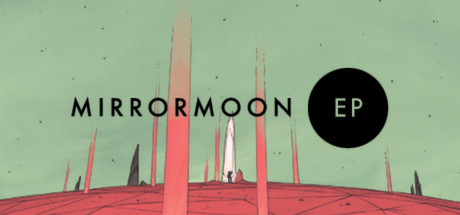
MirrorMoon EP is a game about mystery and exploration set in outer space. These space travels begin on a red planet and its unique moon and extend across galaxies. The single player part of MirrorMoon EP blends adventure and exploration with navigation-based puzzle solving.
Modeled estimate, not a reported figure. How we estimate →
Media

About

Stats
All-time low is the lowest price we've recorded for this game since we started tracking it.
Languages: English
Engagement
Hours played at review time, across 40 reviews with recorded playtime.
Reviews
Themes across 40 recent reviews and how positive each mention is. A keyword signal, not full sentiment analysis.
positive critical· bar length = how often the theme comes up
Reviews
Been playing for years, solo and multiplayer. dont worry about feeling confused. that's part of the puzzle
It's actually not too bad. Very obscure, very hard to figure out what it wants from you. This is a game where you will need a guide for the tutorial to even understand how to play it at all. But it's a rare 3D game which did not make me nauseous (due to absent camera rotation?) and I probably will play it a bit more though ultimately a spatial puzzle is not my kind of game. UPD: Turned out to be surprisingly addictive. Found the anomaly but never found the chair and the horse.
MirrorMoon EP, developed and published by Santa Ragione, is an enigmatic and meditative journey through space that defies traditional gaming conventions. Rather than focusing on combat, survival, or narrative exposition, it invites the player into a universe defined by quiet discovery, abstract puzzles, and a deep sense of solitude. At its heart, the game is about orientation and curiosity—learning to understand celestial systems that operate according to unfamiliar rules. You awaken aboard a mysterious spacecraft with only cryptic controls and minimal instruction. From there, you begin landing on planets, observing how moons cast shadows, and manipulating the environment to unlock hidden structures and secrets. The experience feels less like solving puzzles in a traditional sense and more like deciphering a foreign language made of geometry and light. What immediately distinguishes MirrorMoon EP from other space exploration titles is its striking minimalism. Every element—from the spacecraft’s interface to the alien landscapes—is stripped down to its essential form, creating a stark yet mesmerizing visual identity. Planets are rendered as surreal terrains of sharp angles and saturated colors, and the sparse neon glow that outlines each structure evokes the feel of a digital dream. There is no clutter on the screen, no overwhelming indicators or text, only the player and the strange beauty of the cosmos. This simplicity, far from feeling empty, becomes one of the game’s most effective storytelling tools. It communicates vastness and isolation better than any dialogue could, allowing players to project their own emotions onto the silent expanses of space. Gameplay in MirrorMoon EP unfolds at an unhurried pace that prioritizes observation over action. You explore planetary surfaces, uncover mysterious objects, and gradually gain abilities that let you interact more deeply with the universe—like rotating moons or aligning beams of light to reveal new structures. The puzzles are never explained outright; instead, you learn through experimentation and intuition. At times the logic feels opaque, even alien, but this lack of guidance is deliberate. The developers want you to feel lost at first, to discover meaning gradually as you begin to recognize patterns and relationships between celestial bodies. Every small breakthrough feels earned, and that quiet satisfaction of understanding mirrors the game’s overarching theme of exploration as self-discovery. This structure makes MirrorMoon EP both fascinating and divisive. For players drawn to introspective experiences, the game’s cryptic nature is a strength. It captures a rare sense of wonder—the feeling of being alone in an infinite, unknowable universe, yet still capable of making sense of it piece by piece. The act of aligning moons or triggering hidden mechanisms becomes almost spiritual, a metaphor for learning to read the rhythms of an incomprehensible cosmos. On the other hand, those expecting clear goals, fast progression, or conventional feedback loops may find the game frustrating. It refuses to hold your hand or explain itself, and the slow repetition of visiting barren planets can test one’s patience. Yet even these moments of stillness have a purpose: they emphasize the vastness of space and the perseverance required to find meaning within it. The game’s sound design complements its visual philosophy perfectly. The ambient soundtrack hums softly beneath your actions, a blend of electronic tones and subtle echoes that evoke the loneliness of deep space. There are no bombastic crescendos or dramatic cues—just a hypnotic rhythm that underscores your isolation. Combined with the minimalist visuals, this creates an immersive atmosphere that blurs the line between a game and a meditative art installation. Every moment feels carefully composed to slow your breathing, sharpen your senses, and let your imagination fill in the blanks. As your understanding grows, MirrorMoon EP gradually expands its scope. You discover that each star in the sky corresponds to a planet that other players can also visit and name. This asynchronous multiplayer system creates a sense of shared exploration without direct interaction. Knowing that another traveler has walked these worlds before you—or that you might leave your own mark for others to find—imbues the game with a quiet communal energy. It’s a subtle but powerful mechanic that transforms a solitary experience into a collective one, suggesting that even in a cold, infinite universe, human curiosity connects us across space and time. MirrorMoon EP ultimately thrives on ambiguity. It doesn’t aim to provide closure or answers but to evoke a feeling of transcendence through exploration. Its minimalist worlds, cryptic mechanics, and subdued tone form a cohesive whole that challenges the player to interpret its meaning. It’s a game that rewards patience, curiosity, and introspection rather than reflex or mastery. For those willing to embrace its pace, it offers moments of genuine awe—the kind that lingers long after the credits roll. Santa Ragione has crafted a piece of interactive art that values emotion over explanation, proving that sometimes the greatest adventures are not about conquering space, but about getting lost in it. Rating: 6/10
Weird, I do not recommend it but you can make your opinion in 30m as the first planet / "puzzle" is quite short to do. then you decide if you want more :)
The art direction and premise seems pretty interesting and I wanted to like it. But I found it very frustrating to play, I know it's a puzzle game but you shouldn't have to look up a FAQ after 10 minutes in game on how to progress. Controls are very frustrating too, like you can't fully look around. It's just not very clear at all
What a mess ... A little too convoluted for its own good
The soundtrack for this game is beautiful my gosh...originally came to know this game because a favourite ROBLOX game of mine uses some of the same soundtracks in here As for the gameplay, didn't quite know what to do at first but that's kind of the whole point - and that's what made finally understanding the mechanics really rewarding. The fact that some of the stars don't have anything on them, although sounds bad, is a really interesting take! It makes actually finding different things really exciting and memorable. If I were to suggest one thing, it would be an option to switch through seasons quicker. Having to manually click through 1-124 can be very tiring...especially when having to redo Side A all over again, even if you've already completed it for a season. But apart from that, one of my favourite games so far and a game I actually come back to frequently. Whenever I have any downtime, I usually hop on and explore + name some stars. I think I've actually contributed to season 124 a bit, as the percentage went up from 2% to 4% since I started to play :D
过了第一个星球,蛮有趣的,也很有意境,就是游戏引导很弱,完全不知道可以做点什么。但!有卡!
uzayda keşif ve bulmaca oyunu diyebiliriz, oynanış kısmı zor geldi gereksiz çok detay var herşeyi yavaşlatıyor
(game not complete at .2 hours of gameplay at review time, part of my review all my games effort) (short version) I was really looking forward to this game by just the name alone. However, I 10000% agree with the negative reviews saying "too complex for it's own good". I'm sure I didn't give this game a fair shot however, there's only so many times I can do laps around an asteroid before I want to rip my eyeballs out. (no long version needed)
Related
Related
Trends
Modeled estimate over time, reconstructed from Steam's monthly review histogram.
Momentum
Pace estimated from the game's recent review growth (our daily snapshots) at its own sales-per-review ratio — a momentum signal, not booked sales.
Audience
Estimated from the language of this game's reviews — a proxy for where players are, not official Steam demographics.
Related
| MySims™ Kingdom | $190.1K | 133 | 93% | $39.99 |
| Imagine Earth | $190K | 961 | 82% | $7.49 |
| 女神的贴身男仆 | $190.1K | 705 | 99% | $6.99 |
| Paradiso Guardian | $190K | 325 | 91% | $29.99 |
| Exiled Kingdoms | $190.1K | 1.1K | 90% | $7.99 |
| Zero Stress King: Idle Defense | $190.2K | 1.5K | 87% | $4.99 |