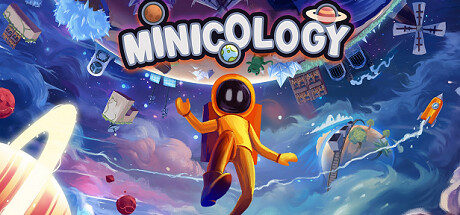
You have crash-landed into a mini-verse of tiny planets. Welcome to Minicology! Embark on an interstellar survival sandbox journey. Use your crafting, combat, and automation skills to survive the many challenges this mini-verse throws at you.
Modeled estimate, not a reported figure. How we estimate →
About


Genres
Stats
All-time low is the lowest price we've recorded for this game since we started tracking it.
Languages: English*, French, Italian, German, Spanish - Spain, Japanese, Korean, Simplified Chinese, Turkish, Dutch*languages with full audio support
Engagement
Hours played at review time, across 40 reviews with recorded playtime.
Reviews
Themes across 40 recent reviews and how positive each mention is. A keyword signal, not full sentiment analysis.
positive critical· bar length = how often the theme comes up
Reviews
The grind, the boss fights, the progression , everything feels perfect! Sue me for saying this but, For me, it’s like a better version of Terraria. Huge respect to the dev behind this amazing masterpiece . well done!
good
Minicology is a 2D sandbox survival experience that blends space exploration, automation, and creative problem-solving into a compact but surprisingly ambitious package. Developed by Isaac Denner and published by Iceberg Interactive, the game places players in a universe made up of countless tiny planets, each acting as a self-contained playground filled with resources, hazards, and opportunities for experimentation. From the opening moments, the game emphasizes curiosity and self-direction rather than scripted storytelling, encouraging players to learn systems organically through exploration, failure, and gradual mastery. Its pixel-art presentation is colorful and readable, striking a balance between charm and functionality, while the upbeat yet understated soundtrack reinforces a sense of wonder as you hop from world to world. Survival in Minicology revolves around familiar genre staples such as gathering materials, managing hunger and oxygen, crafting tools, and fending off hostile creatures. What sets it apart is how these mechanics are layered onto a planetary scale, with each small world presenting its own environmental quirks and strategic considerations. Some planets are resource-rich but dangerous, while others feel calmer yet limited, forcing players to think carefully about logistics and preparation before committing to an expedition. Progression is closely tied to repairing and upgrading your ship, which acts as both a narrative anchor and a practical hub, unlocking access to new locations and technologies as you advance. The sense of forward momentum is steady rather than explosive, rewarding patience and planning over rushed advancement. A major strength of the game lies in its automation systems, which gradually shift the experience from hands-on survival toward thoughtful base optimization. Early on, most tasks are manual and time-consuming, but as new machines, pipes, and infrastructure become available, players can design increasingly complex production chains. Automating farming, material processing, and energy management becomes not just efficient but deeply satisfying, especially once systems start feeding into one another seamlessly. There is a tangible sense of pride in watching a once-scrappy outpost evolve into a self-sustaining operation. That said, the road to automation can feel slow, and the game does not always explain its systems clearly, which may frustrate players who prefer guided progression or extensive tutorials. Exploration remains a core pillar throughout the experience, with procedural generation ensuring that no two planets feel entirely identical. While the visual language remains consistent, subtle variations in terrain, hazards, and enemy behavior keep discovery engaging over the long term. Combat plays a supporting role rather than being the main attraction, serving primarily as an obstacle to overcome rather than a deeply technical system. Weapons and gadgets offer flexibility in approach, and certain encounters encourage creative use of environmental effects, chemistry, or weather manipulation rather than brute force alone. Boss-style encounters and higher-threat scenarios punctuate the pacing, providing moments of tension that contrast nicely with the more meditative rhythm of building and resource management. Minicology is not without its rough edges, and some of its design decisions may test players’ patience. Inventory management can feel restrictive, and the crafting interface sometimes obscures potential recipes unless the correct components are already on hand. These choices add a layer of challenge but can also interrupt the natural flow of experimentation, particularly in the early hours. The learning curve is gentle in theory but uneven in practice, as some mechanics are intuitive while others require trial-and-error or external reference to fully understand. For players accustomed to highly polished sandbox titles, these friction points may stand out more sharply. Overall, Minicology offers a thoughtful and rewarding sandbox experience for players who enjoy survival games with an emphasis on creativity, systems, and gradual mastery. Its blend of small-scale planetary exploration and large-scale automation creates a unique rhythm that feels both cozy and strategic, especially for those who enjoy tinkering and optimization. While it may not appeal to everyone due to its slower pacing and occasional interface frustrations, it provides a deep well of content and experimentation for players willing to invest the time. For fans of indie survival sandboxes who value freedom and emergent gameplay over hand-holding, Minicology stands as a distinctive and worthwhile journey among the stars. Rating: 6/10
awfull controls and overall balance of the game.
I usually love these survival crafting games, but this one just isn't for me. I think the rotating map in particular is annoying as I sometimes get stuck while transitioning underground right where the world rotates.
+ combat feels both fair and fun. Enemy attack patterns are logical and varied, and their tactical immunities and vulnerabilities require at least some thought to defeat them efficiently. + individual weapons feel distinctive and perform differently, even within classes. + weapon modification is impactful. + movement feels good, not floaty. The stamina limit on running is annoying at first, but can be increased. Improving maneuverability with dash, double jumps, flight, and hover capabilities is both beneficial and satisfying. + the required grind is reasonable and stops well short of being annoying, at least up to the early midgame, which is where I think I am. + a comprehensive settings menu, and rebindable keys for everything. This should be the standard, but far too many games fail to live up to it, so it must be counted as a positive. + the crafting menu has a useful search function. + automation is easy and helpful rather than fiddly and overcomplicated. + very few crashes and mostly harmless bugs, all of which are quickly addressed by... + ...a [i]fast,[/i] communicative, receptive, and friendly developer :) = the central conceit of mini-planets doesn't really add anything beyond making the game look and feel unique. I don't think it makes the gameplay better, but it doesn't detract from it much either. It does limit what can be reasonably done with the underground areas, but there's enough to do above ground that I don't care all that much. I do miss the genre convention a little. - the minigame of navigating to other star systems isn't fun for me; I don't like mazes and I'm hopeless at steering. This is mitigated somewhat by the fast travel system. - gravity sometimes interacts awkwardly with liquids and the square tiles; don't try to build your base on a diagonal. This con can be mostly ignored.
흐음~ 재밌는데 재미없음.. 인터페이스도 불편하고.. 신박하긴한데.. 그냥 테라리아 하는걸로..
JE NE RECOMMANDE ABSOLUMENT PAS C'EST TROP BRUILLANT MAL EXPLIQUER MANQUE UN WIKI POUR NOUS AIDER
你要我说实话?打折19.72买的,我觉得我亏得慌
très bon jeu mais peut être assez répétitif, je recommande pour les personnes ayant aimé satisfactory
Related
Related
Trends
Concurrent players on Steam, sampled daily since tracking started.
Audience
Estimated from the language of this game's reviews — a proxy for where players are, not official Steam demographics.
Related
| Trappist | $37.3K | 72 | 90% | $14.99 |
| Lust Mansion 🔞 | $37.3K | 108 | 81% | $9.99 |
| RUN: The world in-between | $37.3K | 180 | 93% | $9.99 |
| 江华号 | $37.3K | 180 | 77% | $9.99 |
| My Escort Company | $37.3K | 120 | 48% | $9.99 |
| Jury - Episode 1: Before the Trial | $37.3K | 213 | 86% | $5.99 |
Related
| 7 Days to Die | $425.3M | 403.6K | 87% | $44.99 |
| Euro Truck Simulator 2 | $421.6M | 932.3K | 97% | $19.99 |
| Mount & Blade II: Bannerlord | $309.8M | 294K | 88% | $49.99 |
| The Forest | $254.8M | 678.6K | 96% | $19.99 |
| Project Zomboid | $239.1M | 461K | 94% | $19.99 |
| No Man's Sky | $230.9M | 412.2K | 85% | $23.99 |