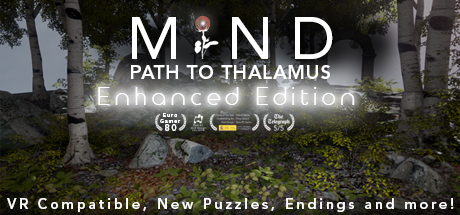
MIND: Path to Thalamus is a First Person Puzzler that throws you into a fantastic and surreal environment. You will bend the natural elements to your will in order to progress in this emotive, mindbending tale. Now also in Virtual Reality!
Modeled estimate, not a reported figure. How we estimate →
Media

About
Wrapped in a mind-bending tale, the gameplay of “MIND” focuses on changing the very weather in order to solve puzzles: the player will cycle between day and night, modify the levels of fog and rain and even travel in time between seasons, changing the environment to advance the gameplay-driven story —indeed, the mechanics are directly related to who the protagonist is, what has happened to him and everything he is doing: a man trapped in his own mind, he must use all the tools at his disposition to escape to reality. Accompanied by the snarky yet heartfelt narration of this comatose patient, the player will guide him through fantastical forests, dark caverns and deceptive worlds of water and ice that directly relate to his emotional state at each point in his journey.
Play the game in Virtual Reality for a full immersive experience. VR support only for motion controllers (HTC VIVE and Oculus Rift + Oculus Touch).
Powerfull new Unreal Engine 4 engine gaining even 70% more performance in almost every level.
Steam controller, keyboard, gamepad and VR controllers 100% supported and configurable.
4 secret levels, redesigned interactive ending, narration and also an alternative ending.
More than 40 different, creative puzzles seamlessly integrated into the environment.
6 ways to affect the environment in order to solve the puzzles.
More than 25 distinct landscapes into with which you will be able to interact.
Turn day to night, make it so everything is covered by a blinding fog, summon incredible storms, travel to the past and make use of even more as of yet unknown mechanics.
More than an hour of voice acting that, while integrated into the gameplay itself, will tell you a whole story that is not about saving the world but about living through the pain of a father broken by his mistakes.
Face down imposing enemies by using your creativity and everything you have learnt along the way.
22 achievements full of Easter eggs and references.
OST and Artbook included.
Genres
Stats
All-time low is the lowest price we've recorded for this game since we started tracking it.
Languages: English*, Spanish - Spain, German, French, Italian, Japanese, Korean, Portuguese - Portugal, Russian, Simplified Chinese, Norwegian*languages with full audio support
Engagement
Hours played at review time, across 41 reviews with recorded playtime.
Reviews
Themes across 41 recent reviews and how positive each mention is. A keyword signal, not full sentiment analysis.
positive critical· bar length = how often the theme comes up
Reviews
Nie dziwę się, że ta gra wzbudza aż tak mieszane uczucia. Lokacje często są przepiękne, pomysł mechanik nie jest zły, choć przydałoby się ich więcej. A przykładowo motyw z elektrycznymi kulami, które otwierają drzwi, powinien być więcej wykorzystany niż tylko raz. Ogólnie zagadki należą do tych bardziej frustrujących, w których nie liczy się logiczne myślenie, a bieganie po dużych przestrzeniach z nadzieją ze na coś się trafi. Najbardziej frustrujące jest bieganie przez mgłę, nic wtedy nie widać i miałem wrażenie, że dodano tę mechanikę na złość. Nic ona nie wnosi, tylko irytuje i niepotrzebnie wydłuża czas gry. Szczerze wolałbym, gdyby ta gra miała krótszy czas przejścia, ale była lepiej dopracowana. Muzyki brak, fabuła niby jest, ale tak naprawdę jej nie ma, lokacje ogromne puste i przez tę cholerną mgłę okropnie irytujące. Nie raz zdążyło mi się zostawić kulkę we mgle, z nadzieją że jakoś to pomoże rozwiązać zagadkę, tylko po to, żeby przez pół godziny szukać gdzie ją zostawiłem. Zmusza to, do zapamiętania budowy map na pamięć, a tak nie powinno być. Same mechaniki pozwalają na tworzenie ciekawych zagadek, tak samo widać, że twórcy umieją tworzyć ładne widoczki. Mam nadzieję, że w następnej grze oprócz widoczków, zrobią też ładne zagadki i dużo ciekawsze, które zmuszają do myślenia, zamiast irytować. Ogólnie widać tu spory potencjał, który jest okropnie zmarnowany. I ten klimat, który wywołuje momentami niepokój. Czy to błądzeniem w półciemnych lokacjach, czy to we mgle lub nagła sytuacja, gdy w jaskini pojawia się kula i nie wiesz, czy coś ci grozi, czy nie. Ogólnie mam takie poczucie, że twórcy nie wiedzieli, co chcą stworzyć i dla tego tak się skończyło. Gra najwięcej by zyskała solidnymi zagadkami, wypełnieniem przestrzeni, usunięciem mgły i niby fabuły. Obecnie daje łapkę w dół, ale czekam na następne dzieła tej ekipy, bo mają potencjał.
Crashea
omminnus (slītlee buggee). unable too adjust briteness so kant see where i'm going.
bom jogo
в 2026 не стоит внимания
gg
Mind: Path to Thalamus — The Ghost of a Great Game There's a version of Mind: Path to Thalamus that would be genuinely remarkable. A one-man indie project, visually stunning, built around the grief of a father processing the loss of his daughter through a surreal dreamscape — on paper, this is exactly the kind of personal, atmospheric puzzle experience that the genre occasionally produces at its finest. The bones are there. The execution is where things quietly come apart. The world itself is the game's strongest argument. Carlos Coronado has a remarkable eye for atmosphere. Dense, fog-threaded forests, desolate desert plains stitched through with impossible architecture — these environments convey the psychological weight of guilt and loss better than anything the game explicitly tells you. Walking through them, you occasionally feel something real: the loneliness of a mind turning inward on itself. That is no small achievement for a solo developer. The trouble is that these spaces are asked to carry too much, because the game's two other pillars — its puzzle design and its narrative voice — can't hold their share of the load. The puzzle concept is genuinely interesting: manipulate weather phenomena to alter the environment and unlock new paths. In practice, though, "weather manipulation" resolves into placing a branch-ball into a socket, which clears some fog. The mechanic never grows into itself. What could have been a layered, thematically resonant system — control over natural forces as a metaphor for the protagonist's attempt to control his own grief — remains surface-level switch-pulling. The levels themselves compound the problem by being generously, sometimes exhaustingly, large for the density of puzzles they contain. You walk a great deal. You find very little. The few moments near the end that hint at what the design philosophy could have been make the rest of the game feel like a longer, more tentative draft. The narrative is harder to forgive, because its ambition is visible. The story of a man confronting his failures as a father — watching the consequences of his absence — deserves to be told with care. Instead, it's delivered almost entirely through the protagonist's voiceover: discursive, occasionally sarcastic, prone to winking at its own philosophical pretensions. There's a version of this device that works — a character whose ironic distance from his own pain is itself a symptom of his condition. But the execution here never quite commits to that reading. The result is a narrator who undercuts the emotional stakes at the moments they most need support, leaving the story feeling remote when it should be intimate. None of this makes Mind: Path to Thalamus a failure in any simple sense. It is, in many places, a beautiful game made by someone with a clear aesthetic vision and genuine ambition. The atmosphere alone places it above many better-funded efforts in the genre. But a puzzle game built on understuffed levels, and an emotional game narrated at arm's length from its own emotions, can't fully deliver on either promise. What remains is something melancholy in the wrong way — not the intended grief of its story, but the quiet frustration of watching a strong concept stop short of becoming what it should have been.
MIND: Path to Thalamus Enhanced Edition is a thought-provoking first-person puzzle adventure developed by Pantumaca Barcelona together with Carlos Coronado, Dani Navarro, and Luka Nieto, and published by Talking About Media. Rather than focusing on action or traditional gameplay systems, the title invites players into a surreal psychological world where environmental manipulation, symbolism, and emotional storytelling take center stage. The Enhanced Edition rebuilds and expands upon the original release with improved visuals, redesigned areas, additional content, and virtual reality support, making it the definitive version of the experience. At its core, the game is a journey through a dreamlike landscape that represents the subconscious mind. Players travel through vast forests, desolate plains, frozen environments, mysterious caverns, and other fantastical locations that constantly blur the line between reality and imagination. The environments are visually striking and serve as more than simple backdrops. Every area feels crafted to communicate emotions, memories, and personal struggles, creating a strong sense of immersion that remains one of the game's greatest strengths. The artistic direction successfully transforms ordinary natural settings into places that feel both beautiful and unsettling. The gameplay revolves around solving environmental puzzles by manipulating elements of the world itself. Players gain the ability to alter weather conditions, change the time of day, summon rain, create fog, and transform the surrounding landscape in order to uncover paths and progress through the adventure. This mechanic distinguishes the game from many other first-person puzzle titles, as the puzzles are closely tied to the atmosphere and themes of the experience. Discovering how different environmental conditions affect the world provides a rewarding sense of experimentation and exploration, while also reinforcing the game's dreamlike tone. One of the most ambitious aspects of MIND: Path to Thalamus Enhanced Edition is its narrative. The story follows a man confronting painful memories, regret, and personal loss while traveling deeper into his own subconscious. Rather than presenting its plot through conventional storytelling, the game relies heavily on narration, symbolism, and emotional interpretation. As players move forward, fragments of the protagonist's past are gradually revealed, encouraging them to piece together the meaning behind both the environments and the events unfolding around them. The result is a narrative that aims to be introspective and emotionally resonant rather than straightforward. The storytelling approach is likely to divide audiences. Players who appreciate philosophical themes and psychological narratives may find themselves deeply invested in the protagonist's journey. The game explores concepts such as grief, guilt, and self-discovery with sincerity and ambition. However, some players may feel that the narration occasionally becomes overly dramatic or too eager to explain its themes. Because much of the story is delivered through reflective monologues, the experience demands patience and a willingness to engage with abstract ideas. Those seeking a simple or action-driven plot may struggle to connect with its presentation. The pacing reflects the game's overall design philosophy. There is no combat, no character progression system, and very little emphasis on fast-paced challenges. Instead, the experience encourages careful observation and thoughtful problem-solving. The slower tempo allows players to absorb the atmosphere and appreciate the environmental storytelling, but it can also result in moments where progression feels less intuitive. Some puzzles require experimentation and close attention to environmental clues, which may occasionally lead to frustration. Nevertheless, players who enjoy exploration-focused adventures will likely appreciate the deliberate rhythm. Technically, the Enhanced Edition demonstrates a clear effort to improve upon the original game. The upgraded graphics engine allows for richer lighting, more detailed environments, and greater visual fidelity overall. Combined with the redesigned content and VR support, the improvements help strengthen the immersive qualities that define the experience. The visual enhancements are not merely cosmetic; they contribute significantly to the emotional impact of the journey by making the dreamlike environments feel more vivid and believable. The audio design deserves recognition as well. Atmospheric sound effects and a carefully crafted musical score complement the visuals beautifully. Weather effects, ambient sounds, and emotional musical cues work together to create a strong sense of presence within the game's surreal world. The soundtrack supports the emotional tone without overwhelming it, allowing the environments and narrative to remain the primary focus. MIND: Path to Thalamus Enhanced Edition is not a game designed for everyone. Players looking for action, combat, or highly structured objectives may find its slow pace and abstract storytelling difficult to embrace. However, those who appreciate artistic experimentation, environmental puzzles, and emotionally driven narratives will discover a memorable and distinctive adventure. Its imaginative use of weather-based mechanics, striking visual design, and willingness to tackle complex psychological themes help it stand out within the puzzle-adventure genre. While not flawless, it succeeds as a compelling exploration of the human mind and leaves a lasting impression long after the journey concludes. Rating: 6/10
It's... really not a good game, but there's something charming about jumping into a bad puzzle game full of beautiful landscapes. The puzzles are mostly nothingburgers that don't interrupt the experience much, while the final puzzle is actually fairly good. So it gets a tentative thumb's up, if you're intimidated by all the 10/10 puzzle games in your backlog, and can tolerate the impressively bad combination of "painfully self-serious edgy voiceactor" and "achievements that smugly beat you over the head with the themes of the game". But I enjoyed my time with it.
No consigo jugar, a los dos minutos se para y cancela la ejecución sin ningún mensaje. ¿Hay alguien que la pasa lo mismo?
Related
Related
Trends
Modeled estimate over time, reconstructed from Steam's monthly review histogram.
Audience
Estimated from the language of this game's reviews — a proxy for where players are, not official Steam demographics.
Related
| Sexbot | $132.9K | 730 | 87% | $11.24 |
| Half Minute Hero: The Second Coming | $132.9K | 560 | 92% | $9.99 |
| Circus Electrique | $133K | 275 | 75% | $19.99 |
| Garden In! | $133K | 428 | 86% | $9.99 |
| Apostle: Rebellion | $132.9K | 341 | 82% | $19.99 |
| MDK 2 | $133K | 237 | 81% | $19.99 |