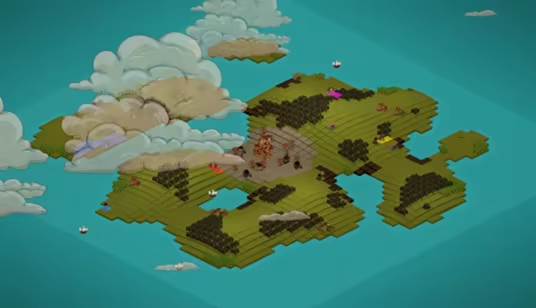
Start as a humble commoner and guide your family through generations in this family sim meets city builder. Climb the ranks of society to become the most influential family in the land. With wit, strategy, and a bit of luck, build your legacy - just try not to trip over your ambition!
Modeled estimate, not a reported figure. How we estimate →
Media

About
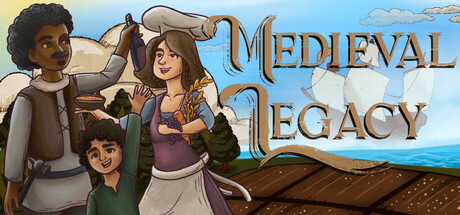
Medieval Legacy is a unique blend of family simulation and city-building strategy, where every decision shapes your legacy. Start as a humble citizen and guide your family through generations. Climb the social ladder to become the most influential family in the land. With strategy, wit, and a bit of luck, you can build a lasting legacy - but beware, as unchecked ambition may lead to your downfall!

Manage your family's health and hunger to ensure their survival. Interact with the other families of the world, forging powerful alliances and destructive rivalries. Encounter strange creatures and collect magical artifacts. Defend your family and fight off bandits or maybe join them in their raids. Claim ownership of the land, expand your home and build new structures.

Live in a world that evolves with your choices. Choose to specialize your family into successful farmers, skilled blacksmiths, or fearless soldiers - or allow them to follow multiple paths freely. A dynamic market system reacts to supply, demand, and world events, ensuring that every decision has meaningful consequences.

Work your way from peasant to king, cementing your family's place in history.

Randomized world that makes each attempt unique
Status system that rewards honorable acts and punishes dishonorable ones
200+ unique events
100+ unlockable skills to power up your play through
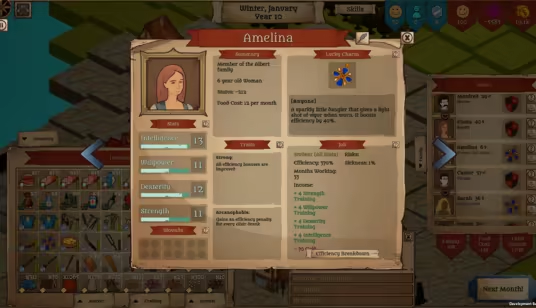
50+ traits that influence each character's strengths and weaknesses
40+ jobs separated into 4 distinct classes for your family member's to work and master
Rival families and king who will expand and build alongside you as the game progresses
Dynamic market system with prices and stock influenced by the game world
In game guide to give a more in-depth look at certain mechanics
8 different starting scenarios each with their own unique mechanics
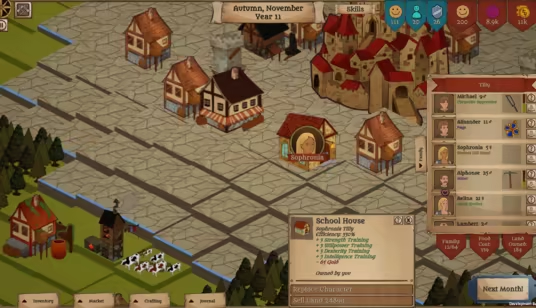
20+ structures to build and expand your kingdom
20+ traits for the king that shape gameplay for as long as he reigns
Genres
Stats
All-time low is the lowest price we've recorded for this game since we started tracking it.
Languages: English, German, Spanish - Spain
Engagement
Hours played at review time, across 40 reviews with recorded playtime.
Reviews
Themes across 40 recent reviews and how positive each mention is. A keyword signal, not full sentiment analysis.
positive critical· bar length = how often the theme comes up
Reviews
Let me start off by saying that I'm sad to not recommend this game. I love the idea, and I've been a big fan of the "The Guild" games, which this game kind of reminds me of. The first 20-30 minutes of playing felt challenging and I felt like every month was a puzzle on how to survive. However, the balance feels off and apart from the initial few years, the game loses any type of challenge. At some point, I was just slamming the next turn button and the game played itself. I had unlocked most of the tech tree and had no idea what I could still aim for. There are different occupations that I could start my next run with, but seeing the rate at which my family expanded in my first game I don't think it'll give me enough variation to keep me engaged, especially knowing that the balance falls apart at some point. I would recommend this game if it was +/- 5-10 euros cheaper, but 15 was too much.
Good game, my newborn baby got imprisoned for 14 months for crimes against the King and had to do hard labor. At least I don't have to feed them. Edit: They did it again when they turned 2 and got 26 months in prison
Great game
The early game is very fun and punishing. The price is worth it for the early game alone
A progressive strategy game where you plan for long-term survival and discover the path your family’s legacy will take.
Medieval Legacy is an ambitious indie strategy and management title that sets itself apart by placing lineage, survival, and long-term planning at the very heart of its design. Developed and published by NineToPlay, the game blends elements of family simulation, city building, and turn-based strategy into a cohesive experience that emphasizes generational growth rather than short-term conquest. Instead of casting the player as a king or omnipotent ruler, Medieval Legacy begins on a far more grounded note, asking you to guide a single struggling family through the harsh realities of medieval life and slowly carve out a place of influence in an unforgiving world. The early hours of the game are defined by survival and scarcity. Food, health, morale, and shelter are immediate concerns, and every decision feels weighted by the fragility of your household. Assigning family members to jobs is not just a matter of efficiency but of necessity, as poor planning can quickly lead to starvation, illness, or social decline. This focus on the mundane realities of medieval existence gives the game a strong sense of authenticity and tension, especially in the opening stages where progress is slow and mistakes are costly. The sense of accomplishment that comes from stabilizing your household and securing basic needs feels earned rather than automatic. What truly defines Medieval Legacy is its deep family simulation system. Each character possesses distinct traits, skills, and attributes that influence how effective they are in different professions. Over time, these traits can be passed down to future generations, creating a genuine sense of inheritance and continuity. The game offers a wide range of professions across multiple social classes, encouraging players to think carefully about education, marriage, and long-term role assignment. Rather than treating characters as disposable units, the game encourages emotional investment, as losing a capable family member can have lasting repercussions on both productivity and lineage. As your family grows in strength and reputation, the scope of the game gradually expands outward. Settlement development becomes increasingly important, with building construction and upgrades unlocking new economic opportunities and strategic options. Markets fluctuate based on supply and demand, seasons affect production, and unexpected events can disrupt even the most carefully laid plans. This dynamic system ensures that progress is never entirely predictable, forcing players to adapt to changing circumstances rather than relying on static optimization strategies. The broader world of Medieval Legacy is reactive and alive. Rival families compete for resources and influence, alliances can be forged or broken, and moral choices shape how your household is perceived. A reputation system tracks honorable and dishonorable behavior, subtly influencing events and interactions over time. Randomized world generation and a large pool of unique events help ensure that no two playthroughs unfold in quite the same way, reinforcing the game’s emphasis on emergent storytelling rather than scripted narratives. City building and expansion are handled with a balance of clarity and depth. Structures serve practical purposes tied directly to food production, craftsmanship, defense, or cultural development, and watching your modest homestead evolve into a thriving settlement is one of the game’s most satisfying arcs. Unlike many city builders, growth here is inseparable from family progression, tying infrastructure directly to personal decisions rather than abstract population numbers. This design choice reinforces the game’s core identity as a legacy-focused simulation rather than a pure city management title. Medieval Legacy also stands out for its deliberate pacing. Progress is intentionally slow, encouraging thoughtful decision-making and patience rather than rapid expansion. For some players, this measured tempo is one of the game’s greatest strengths, allowing time to reflect on choices and appreciate long-term consequences. For others, especially those accustomed to faster or more action-oriented strategy games, the pace may feel restrained. However, this slower rhythm aligns closely with the game’s thematic focus on generational growth and enduring legacy. Visually and technically, the game presents a clean and functional interface that prioritizes readability over spectacle. While it may lack the polish or visual flair of larger studio productions, it compensates with clarity and consistency, making complex systems approachable. Some rough edges remain, particularly in tutorial clarity and interface responsiveness, but these issues are generally overshadowed by the strength of the underlying mechanics and the ambition of the design. Ultimately, Medieval Legacy succeeds by offering a distinctive take on medieval strategy that emphasizes people over armies and time over immediacy. It is a game about building something lasting through careful planning, adaptability, and personal investment, rather than domination through force. For players who enjoy deep simulation, emergent storytelling, and the satisfaction of watching a single family grow into a lasting dynasty, Medieval Legacy provides a rich and rewarding experience that feels both thoughtful and refreshingly personal within the genre. Rating: 7/10
It's a good game
Kleines aber Feines Indie Game das mich sehr fesselt, weil es mich an Gilde erinnert (als es noch Gut war). Bei der Deutschen Übersetzung im Skilltree gibt es ein paar Fehler, aber das ist Maginal. Auf jeden Fall eine Kaufempfehlung von mir.
Very enjoyable, Aside from the Ridiculous amount of bad rolls and bad events that can befall you. But aside form that its good fun
Good enough small game for 5$. I was skeptical at first but somehow it dragged me in so much that once I started playing I played for almost 5 hours straight. Of course it could be improved with more content. But it is what it is. One negative - it lacks some quality of life features. Like marking things to happen automatically once you have 20+ people in the family. It starts to take too long to give medicine when needed, repair tools, change tools, buy things from market, sell excess food... it is not a problem for most of the game, but the last one hour or two can drag a little.
Related
Related
Trends
Modeled estimate over time, reconstructed from Steam's monthly review histogram.
Momentum
Pace estimated from the game's recent review growth (our daily snapshots) at its own sales-per-review ratio — a momentum signal, not booked sales.
Audience
Estimated from the language of this game's reviews — a proxy for where players are, not official Steam demographics.
Related
| Real Dive World | $40.1K | 87 | 78% | $19.99 |
| Memories Off | $40.1K | 247 | 93% | $9.99 |
| My Neighbor's Lonely Wife | $40.1K | 196 | 70% | $6.99 |
| Sex Gym 3D | $40.1K | 129 | 48% | $9.99 |
| MoonQuest | $40K | 107 | 74% | $19.99 |
| Hasbro's BATTLESHIP | $40.1K | 967 | 82% | $1.87 |