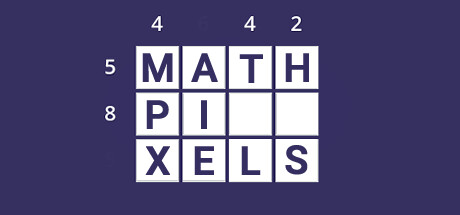
A minimalist puzzle where every correct sum brings the grid to life. Solve the numbers to reveal the artwork piece by piece.
Revenue comes from in-game items and microtransactions, which our price-based model doesn't estimate. Copies below reflect the player base, not paid sales.
Media

About

Genres
Stats
Languages: English
Reviews
[h2] Общие впечатления [/h2] Прекрасная математическая головоломка в пиксельном стиле, которая позволить скрасить не один вечер, решая интересные задачи, и визуализируя решения. Разработчики - титаны мысли, которые смогли не просто объединить математику, судоку, и пиксель-арт, а сделать шедевр. [h2] Плюсы / минусы [/h2] +бесплатная +интересная +красивая +достижения (но нет +1) есть паззл генератор - можно в дальнейшем делать свои уровни -нет карточек -не дает +1 -уровни бывали оч не простыми [h2] Выводы [/h2] Если вам нравится разгадывать судоку, а вашему мозгу давно никто не бросал вызов, то вот же он! Забирайте, бесплатно же. Если любите пиксель-арт, но не захотите заморачиваться - есть информативный гайд, где нарисовано решение всех задач (помогает, когда тупишь). Точно понравится под чашку чая, когда не охота ни убивать, ни строить, ни от маньяков убегать. Прекрасный продукт, я считаю.
A marvelous original logic puzzle that's very reminiscent of Picross. Each color is assigned a number. Use the clues to deduce the locations of each color. You're rewarded with a picture. There are 200 custom puzzles to play, and if you want more practice, there's a random-level generator to create levels of any size and difficulty!
Related
Related
Trends
Concurrent players on Steam, sampled daily since tracking started.
Sweet little puzzle game, perfect to spend some spare minutes now and then. The trailer shows you basically the whole gameplay loop. If you like what you see, you get plenty more of it with the 200 levels and the random level generator. The developer is also very ambitious, listens to feedback and suggestions, delivers quickly updates with some nice improvements. From quality of life (more settings, level selector), bug fixes but also more content (random level generator). For that low price, you can't go wrong.
各問題にて、いくつかの色がそれぞれ数値を持っている。 各行列のマス外に書かれた数値と、色の持つ数値合計が一致するように色を配置していく。 >()付きの数字はその行(列)の前半の合計値となる。 >{}付きの数字は、その行(列)の3マスめまでの合計値となる。 というルールで、ひたすら計算しながら色を塗っていくシンプルなロジックパズルです。完成するとイラストになっていてちょっと嬉しかったです。 ほんのすこしの補助があるだけで別解なく解いていけるので、数字ってすごいな~という気持ちが湧きました。 全200問。問題数が物足りない場合には問題をランダム生成する機能もあるので、ずっと遊べそうです。
Piksel stratejisini kullanın: Satırları ve sütunları renklendirmek için toplamları hesaplayın. Hassasiyet ve hesaplama gerektiren minimalist bir mücadeleye dalın.
I want to like this game, I really do. It feels like an interesting twist on the nonograms formula. Some of the puzzles are great, and some are easy but relaxing. However the reason I can't, in good faith, recommend this game to people who like pure deduction in their logic puzzles is because some of the puzzles have multiple solutions. In a game where the result is supposed to be an image, the puzzles which allow for multiple solutions can result in the art not looking like anything at all. If you're the kind of person who doesn't mind logic puzzles with multiple solutions, you might enjoy this one. I will probably still finish all the levels since some of the levels are actually fun, but I'd recommend to the dev in a future update perhaps having some of the cells filled in at the start to ensure unique solutions.
Fun, relaxing and somewhat addicting! Had a fun time trying to solve each puzzle and finding out what the image is as I go on. Tried setting a limit to how many puzzles I'll do a day and often times not noticing that I've been doing more. Tried doing a max settings no hint puzzle on the Puzzle Generator mode and had such a challenge doing it that I'd want to go back to. A very nice first game from this developer.
It's a good game. There are a few rough edges here and there that can get annoying at times, but in general this game has been a nice little brain twister while it lasted. Very math-heavy, but that is to expected from the title. The basic concept is simple: It's paint-by-numbers, where each color has a value to it, and you get hints at the edge of the canvas about the totals you have to achieve in the respective rows, columns, or parts of those. Apart from that you get to know exactly how many pixels of each color are in the final picture. Occasionally single pixels have been filled in already, like in a Sudoku. If you follow those hints, you slowly put together the image that has been prepared. There are 200 levels, in sizes 4x4 to 12x12, including a couple rectangular ones, and with anywhere between 2 and 6 colors. Once you are done with those, there is a level generator, where you can specify size, color count and pre-placed pixel count, and get a randomly generated level to solve. In general, I really like the concept. The hints are for the most part kept as minimal as possible, and you have to actually do some math if you want to know the numbers for certain sections. There are a lot of rules you start to realize bit by bit, some more obvious (e.g. "[spoiler]Here is a hint for 3 squares summing to 3, so these pixels all have to be color 1.[/spoiler]"), some rarer ones needing a good eye (e.g. "[spoiler]I have a few pixels of color 3 left to fill in, and all other missing pixels have even numbers. Therefore those 3 pixels have to be at the only spots that have hints with odd sums left.[/spoiler]" or "[spoiler]My highest-value pixel left is a single 5, and there is a hint for a sum of 13 from three pixels, so those pixels have to be 4-4-5 in some order, [i]and[/i] since I know roughly where the 5 is, I can view the rest of the puzzle as having 4's at the highest already.[/spoiler]"). Sadly, there are a few points I have to critique about the hint system. For one, the different kinds of hints are kept apart by the brackets around them, with the options being no brackets, (parenthesis) and {braces}. The meaning of these only gets explained once, in a single level each. If you need a couple levels to grasp the concept (like I did for the braces), then you'd have to leave the current level, find the one that had the introduction, and open that one again. BTW: Numbers without brackets are the sums of [spoiler]the entire row/column they are attached to[/spoiler], (parenthesis) sum [spoiler]only the first half of those lines[/spoiler], and {braces} sum up [spoiler]exactly the first 3 pixels from the edge[/spoiler]. Secondly, while the hints count along as you fill in the pixels, disappear once they drop to zero, and turn red when the count drops negative because your painted pixels sum to a too high number, this whole counting system is a little too simple for my taste. If you have all the space covered by a hint used up, but haven't reached the sum yet, the hint will stick around with the missing amount on display, which can lead to confusion about which pixels this hint is actually counting. On the flipside, if you haven't filled all the pixels in yet, but their sum already matches what the hint wants, then the hint disappears, despite the empty pixel(s), which will raise the sum even more once filled in. In this second case, since there are various levels where single lines are missing one type of hint from the get-go, it can happen that you forget there was a hint for that section in the first place, and later on you get surprised by a sudden negative hint number appearing out of nowhere. Both cases have happened to me a couple times, and in both cases I had to clear out a good portion of the solution in order to account for my false assumptions. Thirdly, and sadly, the whole idea behind the hint system is inherently flawed. Other reviews have already mentioned that the hints can leave quite some ambiguity, allowing for multiple solutions. And the game actually contains a level that is a prime candidate to check for such ambiguity: a checkerboard. While the actual checkerboard pattern is a valid solution to the puzzle, you can also pick from a rather wide selection of 2x2 sections within the pattern, flip only those 4 pixels to the opposite colors, and the hints will still deem the solution valid. And once more colors join the mix, the possibilities only get more numerous. I had it happen several times where I thought a portion of the image to be solved, because the hints were all matching up, only to later on get into trouble because the total number of pixels per color wouldn't match up properly. Finding the wrongly filled-in section can then become quite a hassle, because there is no indication where it may be. There have been other levels as well, where I didn't get into trouble with the counts, the level got declared as solved because all the hints were satisfied, but the image itself was grossly disfigured, to the point where several times even with the reveal of the image caption afterwards, I couldn't make out what it was supposed to represent. And this whole problem gets a whole magnitude worse in the generated levels, because in those there is no discernable picture to discover to begin with, and I hazard to say that ambiguities like these are as good as guaranteed to crop up. The selection of images is... a little predictable. After the tutorial levels at the very beginning, each time the canvas size grows the first couple levels are a few national flags, making it easy to get comfortable with the new size and the regions specific types of hints cover. Common themes apart from that include fruits & vegetables, food, animals, and vehicles, to the point where I can barely remember images that don't fall into those categories (apart from "The Earth", "Futuristic City", "Tree", and the aforementioned checkerboard). It is nice to have simple motives to work with, as in the later levels I caught myself several times finishing the painting by looks instead of looking at the actual hints. The resolution of the images was usually a bit too low to get to see any kinds of "pixel masterworks", but in general the art was neat and appreciable. (At least in the cases where I found the correct solution.) In the end I have to say that when the puzzles work as they should, they work really well. Puzzles that seem unsolvable for a while can suddenly fall right into place after one hidden insight, and seeing the image itself take shape as you go feels incredibly satisfying. The upgrade over Nonograms/Picross from just black and white to multiple colors is definitely a benefit to the range of pictures available as puzzles. 2/5 for a good basic idea with a sadly quite big flaw in the rules, 4/5 for the basic but fully functional (and seemingly bug-free) technical execution, and 4/5 for the simple but tasteful and overall well-executed selection of images for the solutions. All in all, for a free game, I can't really complain.
ААААААААААА ЦИФЕРКИ upd: если слишком быстро стирать много циферок, уровень ломается и приходится начинать сначала
เล่นเพลินดีครับ มีให้ generate random เล่นเองได้ แต่อยากให้มีด่านตามเลเวลเยอะกว่านี้หน่อย
Momentum
Pace estimated from the game's recent review growth (our daily snapshots) at its own sales-per-review ratio — a momentum signal, not booked sales.
Related
| House Flipper | $65.8M | 111K | 94% | $24.99 |
| Soulmask | $17.8M | 22.1K | 77% | $23.99 |
| Awesomenauts | $16.5M | 26.9K | 85% | $19.99 |
| Rhythm Doctor | $13.9M | 26.8K | 98% | $19.99 |
| Brotato | $7.4M | 117.1K | 96% | $2.99 |
| Soundpad | $5.3M | 103.1K | 96% | $4.99 |