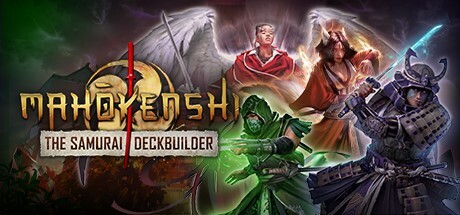
Begin your journey to become a mighty samurai mage! In a blend of adventure, strategy and deckbuilding gameplay, choose how you will follow the way of the Mahoken. Explore the Celestial Islands, build your deck, battle challenging demons, and protect the land from the forces of corruption.
Modeled estimate, not a reported figure. How we estimate →
Media

About


Wielding both blade and magic, it is your duty to protect the floating Celestial Islands from powerful opponents who seek to corrupt them. Challenge your fate and build your card deck to defeat foes and complete missions. Evolve your character with every playthrough, and become the Mahokenshi the world needs.

Where will you start your journey? Will you hail from the sturdy House of Sapphire? The cunning House of Topaz? The fierce House of Ruby? Or the secretive House of Jade? Each house draws its strength from a different elemental spirit and allows you to create different playstyles.

There are more than 200 lovingly illustrated cards to discover. Begin with a basic set of cards and choose how to build your deck as you defeat formidable foes, uncover treasures, and find remote locations. Be careful, as each terrain offers different advantages, so plan your actions with the surroundings in mind. Evolve your playstyle and strategy in every mission and leverage the strengths of your samurai house to create powerful combos.

Travel a vast array of vibrant and beautifully designed 3D maps. Meet the different people of the Celestial Islands, save villages, discover shrines and defeat deadly demons. See your battles brought to life with fully animated characters. Perform magical maneuvers, fiery attacks, strong defensive moves, and swift counterattacks on your way to restoring peace to the world.

Genres
Stats
All-time low is the lowest price we've recorded for this game since we started tracking it.
Languages: English*, French, Italian, German, Spanish - Spain, Japanese, Korean, Polish, Portuguese - Brazil, Portuguese - Portugal, Russian, Simplified Chinese +2 more
Engagement
Hours played at review time, across 41 reviews with recorded playtime.
Reviews
Themes across 41 recent reviews and how positive each mention is. A keyword signal, not full sentiment analysis.
positive critical· bar length = how often the theme comes up
Reviews
I need to preface this review and say that this is actually a great game. I played the whole story, enjoyed the game play, the uniqueness of each character, the art style... With that said, I can't recommend this game. Many, many years after release this game is still riddled with catastrophic, time wasting, or infuriating bugs everywhere. Forum posts were raised years ago with no response from the devs. I've received no response via email, and the Discord server is dormant. The devs clearly abandoned this game very quickly after release, and have no intention of maintaining or improving the quality of life, so they absolutely don't deserve your money.
I immediately fell in love with this game... too bad it's so BUGGY. And I'm not just talking little annoyances, like the fact that the "back to menu" button is mostly covered by the "character select" button, or that the game will sometimes get stuck on the new character introduction screen. Those (while irritating) are at least fixable with a game restart. No, I'm talking about game-breaking bugs which can end an entire campaign, such as the fact that your unlocked skill trees can LITERALLY JUST TURN OFF, leaving you at endgame levels with starting-game progress. It is truly ludicrous for a two-year-old PAID game to still have game-breaking bugs, much less bugs as simple as "remove X card from your starting deck" not working. Yeah, I'd steer clear of any deck-builder which can't even implement card removal properly. Concept: 10/10 Execution: 1/10
The game looks great and plays great. There are some interesting mechanics. However, I can not recommend this game because of the time pressure in missions and how fast the difficulty ramped up. The game started great but the missions started to dissapoint pretty fast.
A turn-based deckbuilding strategy game with samurai-themed classes and a light map progression system. The core gameplay is enjoyable at first, with a satisfying deckbuilding loop and thematic combat encounters. However, the game offers limited build diversity, which leads to repetition once the basic systems are understood. The strategic map layer is functional but does not significantly enhance long-term engagement. Difficulty is moderate but not especially challenging, which reduces the need for deep optimization or adaptation. After a short playtime, the experience loses its novelty and becomes less engaging. Overall: Strong short-form deckbuilder experience that runs out of depth quickly (2.7/5)
Mahokenshi is a mixed bag of a game. On one hand it's a solid deckbuilder with workshop support for custom missions, great visual design, and has built in challenges to test you in case the base game is too easy for you. On the other hand you have a game with very little gameplay variety, poor sound design, occasionally unsteady performance and a not all that interesting story. If you are desperate for a deckbuilder, it's actually a decent purchase on sale. Otherwise, I can't really say it's something I recommend. The gameplay is the major thing I want to actually talk about. You have 4 characters. A swift glass cannon, a spiky tank that can charge at enemies, a stealthy poison ninja, and a ranged spellcaster. There are very few cards that are shared between characters, so you'll almost always be stuck with the character's unique cards for the entire mission. Also, you read that right, mission. Not run. Every time you play this game the map, enemies, and objectives are set in stone. The only things that are randomized are the cards you find on the map and the order you draw them in. That wouldn't matter much if the gameplay of those missions was fun. The missions are a slog that not only tend to be far too easy but you spend half that time traversing maps the size of an small nation. Every time you attack, you sit through a slow animation of your character pulling out their weapon and attacking. Some tiles cost more stamina to traverse you you're often moving maybe 2 to 3 tiles at a time unless you invest in movement cards, but given your base draw of cards is 4 you really need to not invest in many movement cards. Enemies though, they don't care about that, because their attacks always cost 0 energy/stamina. So they can traverse a bunch of tiles and attack at the end even without energy remaining. Enemy variety isn't very good either. You have goblins, weak enemies that swarm. Oni are tough tanky enemies with lots of health. Bandits run on low health to call for backup. Sorcerers run from you and cast debilitating spells. Peasants charge at you to explode. That's it, those are your 5 enemy types. Every time you load in, you'll have a mix of these enemies and they have very small movesets, so you deal with them basically the same time every fight. It's not like the tile bonuses matter enough to make you want to use them, not until you've already fully gone through the upgrade tree to make them useful. But by then you've literally beaten the game. The game has a good foundation but it really fails to build anything worth playing [i] upon [/i] that foundation. It's a shame, but unless you really like deckbuilders I would skip this one.
There is good reason to argue for either rating, but I'm coming down positive because despite the multiple frustrating, experience-ruining, time-wasting bugs that prevent quest completions from triggering after load, I still want to keep playing the game. A worse game gets put away after 1 strike. Still should be fixed, but the core loop is a very satisfying deckbuilding snowball.
Buggy. Game crashed during a long mission. I had to kill four pursuers. Killed two of them before game crashed. They were still dead when it loaded the most recent save, but when I killed the other two, it still showed that I had to kill the two that were already dead. Long mission was a waste of time. Quit playing game.
Mahokenshi – The Samurai Deckbuilder is a distinctive blend of turn-based card combat, tactical board-game movement, and Japanese mythological style, resulting in a hybrid strategy experience that stands apart from most modern deckbuilders. Developed by Game Source Studio and published by Iceberg Interactive, the game places you in the role of a Mahokenshi—one of four magical samurai sworn to defend the Celestial Islands from corruption and invading Oni forces. Its foundation lies in a unique marriage of systems: building a deck, traversing expansive hex-based boards, and adapting your strategy to handcrafted mission objectives. Instead of relying on the endless procedural runs common to roguelike deckbuilders, Mahokenshi takes a more curated, scenario-based approach, emphasizing deliberate planning, map awareness, and the measured evolution of your character. Each mission unfolds on a floating island rendered as a large hex grid, and the board-game influence becomes apparent immediately. Movement plays a key role in the gameplay flow—you’ll spend cards to advance across terrain, seek out villages for healing or supplies, ascend hills for damage bonuses, hide in forests for defense, or sprint across open land to confront enemy forces before they overrun settlements. Terrain matters as much as your deck: a smart route through forests might save your life, while lingering too long on corrupted land can punish you severely. Every objective—defending towns, sealing demonic portals, hunting elite enemies—feels like a tactical puzzle that asks not only what cards you play, but where and when you choose to stand your ground. The four Mahokenshi houses offer strong identity and variety, giving players distinctive playstyles to experiment with. Ayaka excels in precision and mobility, darting across the board with powerful strikes; Kaito is a tank-like warrior built around durability and raw damage; Misaki leans into stealth and preparation; while Sota combines magic and ranged versatility. Each character comes with their own unique card pool, special abilities, and progression paths, ensuring that replaying missions with different samurai genuinely changes how you approach the map. Building your deck becomes an ongoing process of balancing attack, defense, movement, and special mechanics unique to your chosen house. The interplay between deck composition and spatial navigation adds a refreshing level of depth that distinguishes Mahokenshi from its more linear cousins. Visually, the game delivers a serene and attractive aesthetic. The Celestial Islands float among clouds, villages glow warmly in the distance, and the card art is stylized with a blend of traditional Japanese motifs and fantasy embellishments. While the narrative itself is light—more of a framing device than a deeply developed story—the theme is felt strongly throughout the presentation. The music leans toward atmospheric, meditative tones, reinforcing the sense of being a lone protector journeying across isolated lands. The handcrafted nature of each mission map also gives the game more personality than the generic node-based pathways seen in many deckbuilders, making the world feel more alive and intentional. However, Mahokenshi’s strengths are also the source of its constraints. Its handcrafted missions offer a more structured and polished experience, but they also limit overall replayability. Once you have completed the campaign and tried out the characters, there is little additional content or randomization to keep long-term players engaged. Unlike roguelike deckbuilders that thrive on endlessly variable runs, Mahokenshi’s scenarios play out largely the same on repeat attempts. The deckbuilding system, while well-designed, is not as deep or complex as genre heavyweights, and the talismans and side-progressions feel lighter than they should, leaving the meta layer somewhat underdeveloped. Difficulty balance also fluctuates from mission to mission—some scenarios may feel punishing due to strict objectives or tight turn limits, while others allow you to overpower enemies quickly once you establish a strong deck. Likewise, certain mechanics can feel underutilized, and a handful of card types lack the impact or synergy needed to stand out. For players who crave heavy theorycrafting, deep combos, or extensive customization, the game may feel more streamlined than expected. Despite these limitations, Mahokenshi succeeds in offering a fresh and engaging twist on a well-worn genre. It invites you into a world where positioning, movement, and spatial strategy matter just as much as the cards in your hand. The combination of tactical traversal and deck-driven combat creates a satisfying rhythm—explore, upgrade, prepare, and strike—that remains compelling throughout the campaign. It’s a game that rewards careful thought and long-term planning rather than brute force or blind luck, making victories feel earned and failures an opportunity to refine your approach. Mahokenshi may not rival the infinite replay value of its roguelike peers, but it stands out as a thoughtful, elegant, and visually charming strategy experience. For players who appreciate deckbuilders but desire something more grounded, structured, and tactically rich, it offers a memorable journey across the Celestial Islands—one where every step, every card, and every decision contributes to the path of a true samurai mage. Rating: 7/10
On the surface it's almost as if Mahokenshi was made for me, yet after a few hours of gameplay it's fallen quite flat. The theme of samurai combined with deckbuilding and board game strategy is sweet, but the deckbuilding mechanics are mostly nothing new. It also feels a little uneven. Some aspects are pretty neat, but then there are other aspects that barely work (or not at all). For example the save function lets you return to where you were, yes, but it resets your hard earned setup and bugs the mission progress to an unfinishable state. There are other better games either in the samurai theme, or deckbuilding/strategy-style to give your time and attention to.
Pretty fun variation on the roguelike deckbuilder genre. The voice acting with it's fake Japanese accent was off-putting, and I encountered a couple of glitches that forced me to restart the level. But overall it was rewarding, balanced and challenging.
Related
Related
Trends
Modeled estimate over time, reconstructed from Steam's monthly review histogram.
Audience
Estimated from the language of this game's reviews — a proxy for where players are, not official Steam demographics.
Related
| Black Myth: Wukong | $1B | 874.8K | 96% | $59.99 |
| ELDEN RING | $973.5M | 824K | 93% | $59.99 |
| DARK SOULS™ III | $467M | 437.9K | 94% | $59.99 |
| 7 Days to Die | $457.9M | 275.4K | 87% | $44.99 |
| Mount & Blade II: Bannerlord | $413.7M | 227.5K | 88% | $49.99 |
| Hogwarts Legacy | $323.6M | 369.9K | 90% | $59.99 |
Related
| Police Tactics: Imperio | $300.6K | 422 | 62% | $19.99 |
| The Crush House | $300.4K | 471 | 74% | $16.99 |
| Warbanners | $300.4K | 610 | 71% | $19.99 |
| The Fabulous Fear Machine | $300.3K | 572 | 90% | $17.99 |
| OPPAI Academy Big, Bouncy, Booby Babes! | $300.3K | 569 | 92% | $39.99 |
| Formata | $300.3K | 949 | 64% | $9.99 |