Lingo 2, developed and published by Brenton Wildes, is a bold and intricately constructed sequel that takes the conceptual foundation of its predecessor and expands it into something far more ambitious, cerebral, and structurally daring. At a glance it appears to be a first-person puzzle game built around words, but that description barely scratches the surface. What Lingo 2 truly delivers is an expansive, nonlinear world where language itself becomes architecture, progression system, and philosophical underpinning all at once. It is a game about discovery in its purest sense—discovery of rules, of patterns, of spatial relationships, and ultimately of how knowledge reshapes the environment around you.
The most immediate and striking aspect of Lingo 2 is its commitment to rule discovery rather than instruction. The game offers little in the way of direct tutorialization. Instead, players are placed within a surreal, abstract environment and encouraged to observe, experiment, and deduce how its systems function. Word puzzles are scattered throughout interconnected regions, but they are not isolated minigames. Each solved word has consequences: doors shift, pathways open, colors gain meaning, or entirely new mechanics reveal themselves. Words act as keys, switches, and sometimes even metaphors. This design philosophy creates an experience that feels deeply intellectual without ever relying on overt exposition. Progression comes not from leveling up or unlocking arbitrary upgrades, but from genuine understanding.
Exploration plays a central role in shaping the experience. The world of Lingo 2 is larger and more labyrinthine than one might initially expect. It is structured almost like a conceptual maze, with areas looping back into one another and secrets tucked behind layers of logic rather than simple locked doors. The sense of spatial cohesion is remarkable; every corridor and chamber feels intentionally placed, even when the geometry leans toward the surreal. At times the environment bends perception, creating subtle illusions or architectural impossibilities that reinforce the game’s abstract tone. Because progression is nonlinear, players often find themselves encountering puzzles they cannot yet solve, only to return hours later armed with new insight that transforms previously opaque spaces into clear solutions. This creates a powerful feedback loop of curiosity and revelation.
Mechanically, Lingo 2 refines and expands upon the linguistic logic that defined the original game. Word-based puzzles demand careful attention to structure, letter placement, and hidden patterns. Some challenges hinge on recognizing semantic relationships, while others rely on spatial positioning or color-coded logic. The variety within the word systems is impressive; just when you believe you have mastered a particular rule set, the game introduces a subtle twist that reframes your understanding. Rather than escalating purely through difficulty spikes, the sequel evolves through conceptual layering. Each new mechanic builds atop previous knowledge, weaving together language and environment in increasingly sophisticated ways.
One of the game’s most compelling qualities is the emotional response it evokes through intellectual accomplishment. The “aha” moments in Lingo 2 are profound because they emerge organically from observation and reasoning. When a previously confusing system suddenly clicks into place, it feels earned rather than handed to you. The absence of heavy-handed guidance means that breakthroughs belong entirely to the player. This design can be demanding, but it also fosters a rare kind of immersion—one where your own thought process becomes the central gameplay mechanic. Few puzzle games manage to make cognition itself feel so tangible.
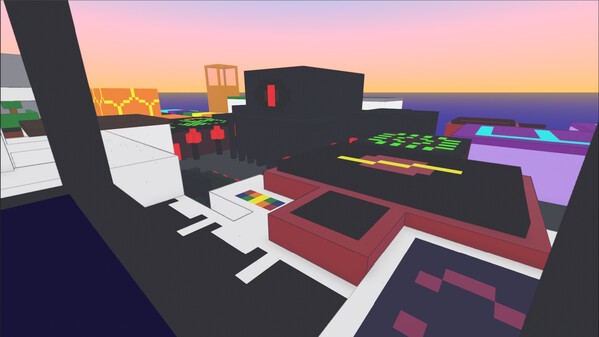
Visually, Lingo 2 embraces minimalism without sacrificing atmosphere. Its environments favor clean lines, bold color contrasts, and uncluttered geometry. This aesthetic choice serves both style and function. The simplicity ensures that important visual cues stand out, reinforcing the game’s emphasis on observation. At the same time, the starkness of the world gives it an almost dreamlike quality, as though you are wandering through a conceptual space rather than a physical one. The soundtrack complements this tone with subtle, ambient compositions that enhance concentration while deepening the sense of mystery. Sound is used sparingly but effectively, reinforcing moments of discovery and transition.
The game’s ambitious openness is both a strength and a potential hurdle. Because there is no traditional map system or overt guidance structure, navigation can at times feel disorienting. Backtracking is often required, especially after unlocking new linguistic tools or environmental interactions. For some players, this lack of navigational assistance may lead to temporary frustration, particularly when attempting to relocate a specific puzzle or area. However, for others, this very quality enhances the sense of authenticity in exploration. The world does not revolve around convenience; it demands attention and memory, reinforcing the idea that understanding the space is as important as solving its word problems.
What ultimately distinguishes Lingo 2 from other puzzle-adventure titles is its refusal to separate gameplay from theme. Language is not merely the subject of puzzles—it is the fabric of the world. Words shape reality in a literal sense, turning abstraction into architecture. This cohesion between concept and mechanics gives the game a philosophical undertone. It quietly explores how meaning is constructed, how systems are learned, and how knowledge transforms perception. The player’s journey mirrors the act of learning itself: confusion gives way to pattern recognition, which evolves into mastery.
In the broader landscape of puzzle games on Steam, Lingo 2 stands as a deeply thoughtful and uncompromising experience. It does not aim to appeal through spectacle or accessibility alone. Instead, it challenges players to engage fully with its systems, to think critically, and to embrace moments of uncertainty as part of the process. For those who appreciate intellectually demanding design and nonlinear exploration, it offers an experience that is both mentally stimulating and uniquely memorable. By expanding its world, refining its mechanics, and doubling down on rule-based discovery, Brenton Wildes has crafted a sequel that feels confident, cohesive, and daringly original.
Rating: 9/10