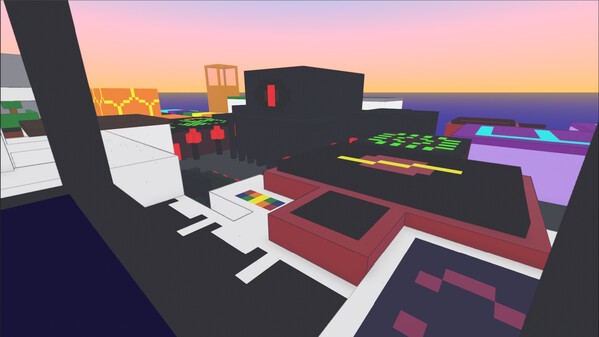
Lingo 2 blends word puzzles and impossible geometry, with brand new puzzle mechanics and a large, colorful world to discover. Welcome back!
Modeled estimate, not a reported figure. How we estimate →
Media
About
Welcome back!
The game nobody expected is getting a sequel no one's ready for - bigger and more chaotic than the last.
If you have not played the first game - feel free to start here. Lingo 2 has a totally new rule structure, so you can play them in either order.
If you did play the first game and only enjoyed solving the word puzzles - you might want to let a friend try this first. There's always Scrabble!
Featuring...
New Puzzle Mechanics - A complete overhaul to the system you had finally figured out. Beginner friendly!
Wandering - A large, winding, interconnected world to get lost in.
Music - Soundtrack by Icely!
Jumping - You can jump! Who doesn't love to jump?
Minimal Linearity - An open world that unfolds as you explore it.
Ominous Questions - Nothing scary; just making sure you remembered to switch the laundry.
Cubes - I didn't count or anything, but there are a few more cubes this time.
Stats
All-time low is the lowest price we've recorded for this game since we started tracking it.
Languages: English
Engagement
Reviews
My recommendation for this comes with a big asterisk; I have a love hate relationship with this game. On one hand, it's everything I've ever wanted in a game like this, from the presentation to the way rules and locations are set up and open outwards On the other hand, it's an intensely frustrating experience at times, for a number of reasons. The game falls into the same trappings as anything based on rhymes and such, being that it focuses on a specific accent (somewhere in America I believe) and so these were the words I had the most trouble with, nearly yelling at the screen "THAT DOES NOT RHYME WHAT ARE YOU TALKING ABOUT." I genuinely believe the game would be improved by removing the rhyming rule entirely. On the same thread it does also use American spellings for words, but that's not a big issue once you realise that. Additionally some puzzles require some pretty ridiculous context and I vehemently disagree with some of the word associations and synonyms being suggested, and again a few things rely on distinctly American concepts, which isn't a HUGE issue but I did have to look up a few terms that just don't get used in Europe. Other than that, this is a beautifully constructed and confounding experience that I do not regret my time with, despite the problems. The soundtrack is perfect for the game itself and some puzzles are absolutely astounding in their cleverness.
Related
Related
Trends
Modeled estimate over time, reconstructed from Steam's monthly review histogram.
Hours played at review time, across 40 reviews with recorded playtime.
This game, on paper, is one of the most enjoyable games I've ever played. It does not work the way you'd assume it would in a way that will make you furious and exhausted. The notes are fun to take. Deciphering codes is fun when your understandings of the codes make sense within the puzzle. It feels clever and has wordplay that ends up relevant to what you need to do. Early on in the game, you are given ample opportunity to understand what each of the symbols mean. Later on, the puzzles become straight bull, to the extent that I believe the creator just got fed up with trying to make some of them work. First, you get access to a room where you are not allowed to solve most of the puzzles and half of the ones you are allowed to solve have a million technically correct answers but only one that works, then once you trial-and-error them all, go find the letters you hope you need, and wander back into the area to finish it all, you'll be rewarded with absolutely nothing (to your knowledge). No sound cue, no camera pan so that you can see what happened, just some board that says 0 left to solve, and you're left to hope you did something actually useful. This is EXTREMELY problematic game design when Lingo 2 will make you pull something out of your arse like walk backwards through the wall in order to find your reward, if there even is one. Just keep looking, bro! A couple hours after the game's beginning, all sense of linearity or direction dwindles into nothing (save for the Hinterlands, but those hints have their own problems- some seem like genuine misdirection). It is perpetually unclear whether you've finished all that you can finish in a room for now or whether you can find something random there that will make the rest possible. There were rooms where I walked around for way too long trying to figure out where a potential letter or a new secret doorway was. I took a significant portion of my time with this game walking from room to room, finding that each still had no more solvable puzzles even after I had assumedly progressed. Even when you finish a room, sometimes it will open a door to one singular puzzle you're not even allowed to try at. Like "Dang, that was pointless until later. Guess I gotta turn around and go find something else to do." That's just disheartening, and it happens a lot. First it's addicting, then that addiction ends up convincing you to roam around for much longer than needed because you have access to way too much of the map at once. This encourages you to just keep running back to the Hinterlands like a checklist (which feels like player failure), and even that strategy won't get you very far without a healthy dose of wandering. The mind ♥♥♥♥ ery in the game is cool until it takes you even longer to get to a still-useless room that you thought might seem promising to return to. When I said the puzzles can be straight bull, I meant it. You will find yourself on the other end of a puzzle that, when finished, says something like, [spoiler] "the opposite of act is think," and you're like "sure man, whatever," because you already spent a good portion of time trying out wrong answers. The game even conditions you to hope and try for such randomly correct answers through the straight up non sequitur solutions like typing LEFT when it asks you to type RIGHT when you had already typed RIGHT into the same exact puzzle and got a correct solution beforehand. One of my least favorite moments was solving the puzzle "M----- is smaller than small," and despite MINUTE working even better, the answer was MODEST. Bro pulled out the thesaurus and just picked one. My last straw was "a face is found on the ears," [/spoiler] which is literally backwards from what it should be because the developer forgot to leave an environmental indicator. Puzzle games should be a healthy exercise in patience with yourself. This game ends up being an exercise in your patience with the game. The difference there is the amount of satisfying moments vs unsatisfying moments. Even where the player should feel satisfaction, there tends to be none, and even when the game is supposed to be difficult, it tends to be difficult in a way that is not fair, rewarding, or respectful of the player's time. I went from dying to finish this game to having that slowly bleed out of my heart, and now I just don't wanna do it anymore. Got the deliberately unsatisfying false ending, and I ended up rolling with it in order to feel free. I am sad. Could've been a goat. So close, but so far.
EDIT: much further in now, have all the letters and found a few of the achievements, I can say that i'm enjoying myself a lot more now. I now understand how things are different, and although my criticism of puzzle unlocks being arbitrary still stands (there was even an area where it felt like that was the entire gimmick), I do think later on they make it more clear when you've finished an area. I'd say its on par with 1 and both are really good games. Original review still below- I'm very much enjoying myself 8 hours in, but there's always a nagging feeling in my head that it's not as good as Lingo 1. If you haven't played either game, think of it as a combination between "The Witness" and "Antichamber", but entirely about word puzzles. You go through non-euclidean labyrinths and worlds to solve puzzles which require you to learn the rules of them via world-based tutorialization. A word is displayed on a monitor, you are given the number of letters the answer is, and you must type the answer based on both context clues and rules you've learned from previous puzzles. Both games are very fun and addicting if that sounds like your sort of thing, very exploration and curiosity driven. I would recommend both of them in a bundle, but start with 1 for sure! The music is a welcome addition, even if I sort of like the original game's strange atmosphere of silence. The graphics are better, the puzzles twist in different ways, and I am still being constantly amazed at the creativity required to pull off this series. Both Lingo 1 and 2 are quite large, so much so that I couldn't tell you which one is bigger since I haven't 100%'d either- but 2 definitely doesn't disappoint in the size department. I said this in my review of 1, but you kind of fall down a rabbit hole of delving further and further into nested secrets and puzzles, scouring the labyrinths for new places to go and things to explore. The non-euclidean nature was toned down from 1, but still heavily exists... this sounds like a negative, but 1 definitely went too far sometimes and some puzzles were really hard to get back to. You can also teleport to a few key locations at any time, which really really helps and makes the game feel a lot smoother. You can see the technical progression and gameplay considerations evolve from 1 to 2, with lots of small quality of life features like this making it a nicer game to play! My main issues with Lingo 2 don't even feel like the developer's fault, as they kind of come from the problem of Lingo 1 having so much content already that making new puzzles was probably pretty difficult. Am I saying Lingo 2 feels like a repetitive or stale rehash of 1? Not at all- it's a very, very different game. However, the differences don't feel as satisfying to play, even if they're still fun to experience. One major example of this is the progression at the start of the game. I don't think its a spoiler to say this as it literally starts as soon as you boot the game, but you need to find all 26 letters to be able to use them in the word puzzles. At first this is novel, but very quickly it makes the game feel a lot more linear as you know exactly the solution to three or four puzzles but cannot complete them because you couldn't find Q or something. You get hints at some point, but I found myself heavily relying on them since I just wanted the ability to solve more puzzles without being progression gated. Speaking of hints, I find myself using the caps-lock first letter hint a loooooooooooot more in this game, since there's more, er... "conceptual" puzzles in this game. Trying to word it carefully so I don't give anything away, there's a ton of puzzles where there's 2-4 totally valid solutions, and also require thinking in a way that can vary completely differently depending on how your region of the world uses the english language. This was a problem in Lingo 1 too (and honestly something unavoidable in a linguistics riddle game), but since this game focuses more on "concepts" I feel like its something I use way more often, and the second I use it I instantly know what the answer is. It doesn't feel as much like "cheating" as Lingo 1 though, only because the game actually teaches you about it directly and has a few minor mechanics around it. The last problem I have and honestly maybe the largest issue with the game in my eyes, is that completionism feels a lot less satisfying. That might sound dumb and like i'm only thinking about this from a "trophy hunter" viewpoint, but there are still plenty of puzzling steam achievements to collect and I don't have an issue with that. My problem is that there is no clear indicator in this game when you are done with an area, and what you get for finishing it. There are counters that tell you how many puzzles you have left- in Lingo 1 there was also something similar, without spoiling too much. But Lingo 1 had a clear sense of finality, clearly telling you that you could move on and not worry too much about that section anymore, and to look elsewhere. If you finish one of these indicators in 2 you don't get anything of the sort. Sometimes it does something right next to it which is ideal, sometimes it does something across the map and doesn't tell you, sometimes it might even do nothing but I have no actual clue since there's no clue for this sort of thing. You go through a huge room and solve 12+ puzzles then you kind of just think to yourself "okay so did I get anything from that?". It's a problem in the sense that I am never sure if the reward was learning more info from the puzzles, unlocking a random door somewhere, or simply for the enjoyment of it. The steam achievements aren't really tied to these like they were in 1... I think its interesting how they use them now, but it makes the game a lot more confusing. Despite these things, I still really like the game- I want to stress again that this is me comparing it to Lingo 1 rather than a game as a whole. Honestly if Lingo 2 was the only Lingo, I'd probably not even have some of these issues! So legitimately, I highly recommend you pick both of these games up. If the developer can't think of more puzzles to make that's fair, but I will also keep buying every game in this series as long as it goes on. It's less about the word puzzles and more about the raw exploration, excitement of discovery, and slow learning of new skills. Those things I think both Lingo 1 and 2 do fantastically, and are the biggest reasons I will recommend these games to anyone proficient in english and willing to solve puzzles.
chess battle advanced
i am a victim of lingo 2
This is, without question, the best puzzle game I have ever played. It is plain evil in its geometry, clever in its wordplay, and gives you just enough continuous progress to always feel like you're moving forward. This was my game of the year in a stacked 2025. Grab a thesaurus, maybe bookmark WordHippo, and get ready for a great ride.
I feel changed
One of the best "rule learning" games I've ever played. In the style of games like "The Witness" and something called "Lingo", your primary task is to activate little plinths by solving simple puzzles, in this case by typing in the answers to word riddles, some much more complex than others. The game starts out somewhat straightforward, with the goal being to collect the letters necessary to write the word "hi" in the first plinth and open the first door, and that gameplay loop will continue for numerous hours from then on. Gather letters to activate plinths to open doors to access rooms and gather letters. It's actually as simple as that from start to finish. But some doors require more than one plinth and some plinths are not what they seem and some rooms are more than the sum of their parts. It's a brilliant game and my only regret with it is that I cannot forget how to navigate its world so that I can relearn all the rules all over again.
Lingo 2 is one of the most brilliant puzzle games I ever played, a shining gem in the "metroidbrania" genre. Don't let yourself skip this masterpiece even if the word puzzle aspect doesn't sound like your cup of tea, it is used as a medium for some incredible epifany moments. If you are stuck on a puzzle you can always use the "insert" key on your keyboard to get a hint or just leave it be and return to it later, but don't be afraid of googling "synonyms of X word" if you don't feel like you would know it. Also, take notes, you will be rewarded with some of the best moments a puzzle game can offer you.
A much more polished and completely different Lingo with as much if not more charm than the first one It's still a hell to navigate sometimes but since all the areas are nicely separated and distinct, it's a way better time making a mental map. The map itself looks better and opens up in a very satisfying way. I'm not near completion yet but there is quite a lot of content, and man it's such a blast! If you are looking to get started in the Lingo franchise, I would suggest starting with this one :)
Momentum
Pace estimated from the game's recent review growth (our daily snapshots) at its own sales-per-review ratio — a momentum signal, not booked sales.
Audience
Estimated from the language of this game's reviews — a proxy for where players are, not official Steam demographics.
Related
| Hover | $81.8K | 2.2K | 80% | $1.99 |
| Next Up Hero | $81.7K | 182 | 54% | $19.99 |
| Demon Hunter 2: New Chapter | $81.7K | 306 | 74% | $14.99 |
| Circadian Dice | $81.7K | 600 | 94% | $5.99 |
| スペルトナエル | $81.8K | 360 | 98% | $8.99 |
| Dragon Eclipse | $81.7K | 249 | 65% | $12.99 |
Related
| 7 Days to Die | $425.3M | 403.5K | 87% | $44.99 |
| Euro Truck Simulator 2 | $421.6M | 932.1K | 97% | $19.99 |
| Mount & Blade II: Bannerlord | $309.8M | 293.9K | 88% | $49.99 |
| Palworld | $279.6M | 445.8K | 94% | $20.99 |
| The Forest | $254.8M | 678.5K | 96% | $19.99 |
| Clair Obscur: Expedition 33 | $243.3M | 273.2K | 95% | $47.99 |