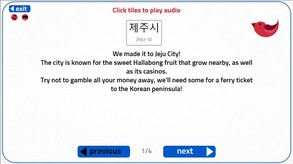
Let's Learn Korean! Hangul, developed and published by Dr. Cyril Splutterworth, is an educational title on Steam designed with a very clear and focused goal: to teach players how to read the Korean writing system, Hangul, from the ground up. Rather than attempting to be a full language-learning suite, the game narrows its scope to literacy, guiding absolute beginners through the structure, sounds, and logic of Hangul in a way that is approachable, interactive, and surprisingly effective. Its design philosophy prioritizes clarity and retention over spectacle, making it feel more like a guided learning tool than a traditional video game, yet it still manages to remain engaging through thoughtful use of interactivity.
The learning structure is carefully paced, beginning with the fundamentals of Hangul’s consonants and vowels before gradually introducing how these components combine into syllable blocks. Instead of overwhelming the player with information, the game breaks lessons into digestible segments, ensuring that each new concept builds naturally on the previous one. This step-by-step approach mirrors how Hangul is often taught in classrooms, but the interactive format allows players to actively participate rather than passively memorize. Seeing, hearing, and interacting with characters repeatedly helps reinforce recognition, and the game places strong emphasis on understanding the logic of Hangul’s design rather than treating it as an arbitrary set of symbols.
A core strength of Let’s Learn Korean! Hangul lies in its use of mini-games to reinforce lessons. These activities range from matching characters with sounds to assembling syllables from individual letters, encouraging active recall rather than rote repetition. While the mini-games are simple, they are purposeful, designed to reinforce specific learning outcomes rather than pad out playtime. Some activities may feel easier or more intuitive than others, but this variation helps prevent the experience from becoming monotonous and allows different learning styles to benefit from different forms of interaction. The repetition is intentional and educational, reinforcing memory rather than testing reflexes or problem-solving skills.
The game also makes a conscious effort to contextualize learning within a light cultural framework. Lessons are framed as part of a journey through Korea, with references to everyday objects, places, and cultural touchstones that subtly ground the alphabet in real-world usage. These elements are not deeply explored, but they add warmth and personality to what could otherwise feel like a sterile training program. By associating Hangul with familiar imagery and situations, the game helps demystify the script and makes it feel immediately usable rather than academic.
Visually, the presentation is clean and unobtrusive, clearly designed to minimize distractions. The interface favors readability, with clear typography and simple layouts that keep attention focused on the characters being learned. Audio support plays an important role, providing pronunciation cues that help learners associate written forms with spoken sounds. While some users note that certain audio elements could be clearer or more consistently emphasized, the inclusion of spoken examples significantly enhances the learning process compared to text-only methods. The overall aesthetic supports the game’s educational purpose rather than competing with it.
In terms of limitations, the game is very upfront about what it does and does not aim to teach. It does not cover grammar, sentence construction, or conversational Korean, and players hoping to speak or understand Korean fluently will need to use additional resources. However, this narrow focus is also one of the game’s strengths. By concentrating solely on Hangul literacy, it avoids the dilution that often affects broader language apps and delivers a more confident and effective introduction to reading Korean. For many learners, being able to read signs, menus, and simple words is a major psychological milestone, and the game excels at guiding players to that point.
Community reception on Steam reflects this clarity of purpose. Many players praise the game for helping them learn Hangul faster than expected, often reporting noticeable progress within just a few hours. It is frequently recommended as a supplementary tool alongside textbooks or spaced-repetition apps, but many users also find it valuable as a standalone introduction. Criticism tends to focus on minor technical issues or the limited scope, rather than on the quality of instruction itself, suggesting that expectations are generally well-aligned with what the game offers.
Taken as a whole, Let’s Learn Korean! Hangul succeeds by embracing its role as a focused educational experience rather than trying to masquerade as a traditional game. Its interactive lessons, thoughtful pacing, and learner-friendly design make it an excellent entry point for anyone curious about Korean writing. While it won’t replace comprehensive language study, it serves as a strong foundation, transforming Hangul from an intimidating script into a readable, logical system. For beginners, casual learners, or anyone looking to finally understand how Korean text works, it is a practical, accessible, and genuinely helpful tool that delivers exactly what it promises.
Rating: 8/10