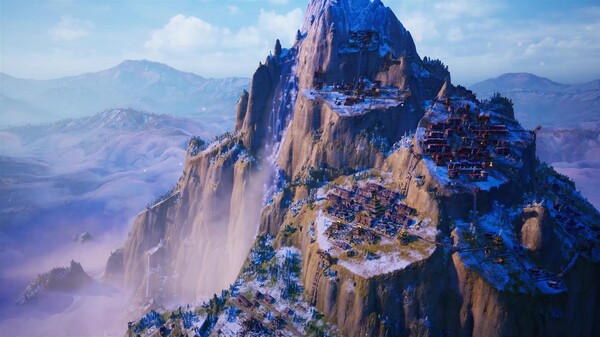
Build and expand your very own settlements in high mountains! Carefully plan production chains and satisfy various needs of your three-caste society while dealing with mountain hazards such as weather breakdowns and avalanches. Are you skilled enough to make your town thrive?
Modeled estimate, not a reported figure. How we estimate →
Prices
Each in the currency that store quoted — not converted: the gap between two rows is the publisher's pricing, not an exchange rate.
Discounts
Every price cut of more than 20% we have observed, in each market that quoted one, with this game's chart position on either side of it. These are episodes, not a model: a sale is one event, and one event cannot tell you what the next one will do.
Reviews, worldwide (the counter carries no country): 0.71/day in the week to Sep 8 → 0.43/day in the week after.
About
Laysara: Summit Kingdom is a challenging city builder which tasks you with creating a new home for your people forced out of the lowlands. During a campaign or sandbox playthrough, you will establish multiple towns, each on a unique mountain with its own traits. All your towns co-exist in symbiosis, creating a trading network, which you can then adjust to your needs by revisiting already developed settlements. The Kingdom of Laysara has to be rebuilt!
Each mountain comes with a new set of challenges. Mounts differ in shapes, vegetation zone layouts, resource availability and weather conditions. Sometimes you will have plenty of room for farming in green lowlands, sometimes you will need to rely on breeding and extracting valuable minerals from regions dangerously close to peak glaciers. If you find yourself in dire need of a certain resource, you can always try to establish a trading route with another town.
One of the ever-present dangers you will have to deal with are mighty avalanches. You can’t stop them, but you can take precautions and be prepared. Afforest the key areas to create natural barriers, build artificial ones to redirect rushing masses of snow, or trigger the avalanche early, while it’s still manageable. Create a deliberate and reliable strategy and you might even be able to use the power of snow to your advantage; fail to do so and find your city buried and devastated!
So, transporting goods is easy, right? Well, not if your destination lies on the other side of the mountain, a few hundred meters higher, behind cliffs, ridges, canyons and rivers. You will need to create a vast, complex transport network consisting of roads, bridges and shafts to ensure reliable delivery chains. As demand for resources will grow alongside the town’s population, always look for opportunities to optimise your transportation network, be it by building paved roads, using more advanced lifting constructions, or aiding your carriers with glamorous yaks.
If you manage to endure all mountain dangers, build a network of efficient production chains and satisfy all needs of your people, there is only one more thing to be done: conquering the mountain peak! To succeed in this great endeavour you’ll need to reach the summit and establish safe routes for your carriers to bring in enormous amounts of building resources, but beware! Weather at this height is as deadly as ever. The final effect is well worth the effort though, as raising the summit temple is an act of total triumph of human courage (and your logistics skills!) over the elements.
Final note: the game is a pure city building experience solely focused on the economy, resource management and surviving despite the inhospitable environment. Therefore, the game doesn’t feature combat or any other military aspects.
Sums Steam only; PlayStation, GOG, Nintendo publish no volume signal, so the true total is higher by an unknown amount.
| Store | Price | Audience | Score | Chart | Est. revenue |
|---|---|---|---|---|---|
SteamYou are here | $17.49−30% | 1.5Kreviews | 82% | — | $1.4M |
| $25.49 | 51ratings | 83% | — | not modelled | |
Engagement
Reviews
Themes across 81 recent reviews and how positive each mention is. A keyword signal, not full sentiment analysis.
Reviews
DNF. Got softlocked on the final level of the campaign. Because, for some insane reason, the game does not have a "restart mission" option, and does not set aside the save for when you start a new level so it cannot be accidentally overwritten by you when you save manually; why would I want my manual save to be under "Mission 13 Completed" instead of my own name, game? This is all a problem for the campaign because building a town and completing a level is all about reaching certain resource benchmarks, and since you are building on the side of a mountain your space is extremely limited. But the levels introduce new game mechanics and resources and objectives in the middle of levels. So you'll be progressing, building a nice town, and the game will order you to build a giant building. So you destroy a bunch of houses since, as stated before, space is extremely limited, and the game complains about a lack of workers and penalizes you by completely draining your funds, resulting in a game over. In a game all about limited space it could do more to at least make it easier to move buildings arounds at least. This problem is compounded by a lack of information and overlays. Which expensive roads are draining my coffers? What building is demanding so many of from the middle-class caste? Which transport buildings have a surplus of supplies? These problems all combine into one big problem in the campaign when it starts levels on mountains where you already built towns. Now it wants you to farm for new resources, but doing so would require rearranging the entire town, which you get penalized for. And since the game doesn't put aside a save at the start of the level and is you can dig yourself into an inescapable financial hole where disturbing anything will penalize you without any way to undo your mistakes. Which is what happened to me. The three autosaves were too far into the level that I couldn't fix my mistakes, I had accidentally overwritten my manual save, the level itself was doomed from the start because the town I built before couldn't handle any changes. The only way to fix it would be to go back several levels to when I first built the town and rebuild it while remembering all the objectives that would occur in a later level. I was so frustrated after putting in 65 hours for nothing that I couldn't even bring myself to try the other game modes, so I just quit. It's a shame, because I really was digging the basic concept of building a town on a mountainside with limited space.
Media

Related
Related
Price dynamics, follower growth, revenue and sales trajectories with interactive tooltips
This and every other Pro feature is free until October 20, 2026. A free account is all it takes.
Every market we collect.
Reviews, worldwide (the counter carries no country): 0.88/day in the week to Jul 21 → 0.8/day in the week after.
For scale, across Steam · Top Sellers · Brazil over the last 30 days: the 25 chart moves that followed a price cut of more than 20% went a median of 10 places towards #1, and the 2,413 moves with no price cut behind them went 2 away. One store, one chart, one country — it is the only place we have enough observations to say even that.
Prices outside the United States have been collected since 6 August 2026 and chart positions since 19 July 2026, so a cut older than that has no market to compare and a market that joined later has no history yet. Nothing here is converted between currencies.
Genres
Stats
All-time low is the lowest price we've recorded for this game since we started tracking it.
Languages: English*, French, German, Spanish - Spain, Polish, Ukrainian, Simplified Chinese, Japanese, Portuguese - Brazil, Traditional Chinese, Italian*languages with full audio support
| $12.49−50% |
| 29ratings |
| 90% |
| — |
| not modelled |
| $25.00 | — | — | — | not modelled |
Matched by title — a reused name can pair the wrong games. * is a critic aggregate. Prices and positions are each store's United States storefront; Epic charts worldwide. Audience and Score too, except Steam's, which is worldwide.
Hours played at review time, across 81 reviews with recorded playtime.
positive critical· bar length = how often the theme comes up
There's a lot to like about this game, and for a long stretch I genuinely enjoyed it. But by the end I'd stopped having fun and started grinding through it out of stubbornness, which is never a great sign. The biggest issue is how punishing it gets in the later stages. You're given less and less land to work with right when the game starts demanding more complex production chains, and it stops feeling like a puzzle to solve and becomes a management nightmare of constantly tearing down and reshuffling everything you've already built. For me, it crossed the line from challenging to exhausting, and in the end I just gave up.
Charming but very tedious puzzle game (because it's no city builder at all) Economy and trading are messed up in so many ways...it becomes a matter of moving entire districts a few steps away to allow anything to happen. I was so excited for this game! A wasted potential imo. Just go for Anno or Town to City if looking for a chill city builder with campaign
Laysara: Summit Kingdom is a city builder where the player must build settlements on the slopes of a mountain, with the ultimate goal of constructing a huge temple at the mountain’s peak, which the people believe will please the gods enough to dispel a strange mist which has covered the lower lands. Each town contains three castes of civilians – lowlanders, artisans, and monks, who work in different types of buildings, with some other jobs being performed by yaks. You’ll need to build houses to increase the number of available workers, and then support their needs by supplying multiple types of food, commodities, and enlightenment. Houses which have multiple needs fulfilled can be upgraded several times, to further increase their capacity. Each type of food or commodity has its own production chain with separate buildings responsible for gathering raw materials and converting into finished goods. In addition to this you’ll need buildings relating to storage and distribution, research, gathering taxes from civilians, and buying or selling goods to a trader. And you’ll need to protect buildings by creating barriers to block snow avalanches which can fall from higher up the mountain. Most buildings have a limited effective range when providing a service to houses, or sending goods to the next building in the production chain. This can be extended slightly by improving road quality, but trying to place everything efficiently often feels very puzzle-like, especially as the available building space is limited by mountains and cliff edges. This is made more difficult by the fact that you can’t rotate buildings. So for example, you can’t fit a building that is 4 tiles tall and 2 tiles wide into a gap that is 2 tiles tall and 4 tiles wide. I remember reading that the main reason players don’t have this option is because the developers didn’t want to redo the artwork for each building. Fortunately you can freely move any building at any time with zero cost and instant build times, which at least makes it a bit easier when you have to rearrange everything. However, I also think the game lacks detailed menus to quickly show how many of a specific resource are being produced, if there’s spare capacity, and quickly locate specific buildings on the map. As my towns grew larger, I sometimes found it difficult to remember exactly where I built things. Some of the production chains feel overly complicated, where the final product combines two or three raw materials, and one of those might be produced by combining two other resources, with every individual thing being gathered or combined by a different building. And sometimes the quantities don’t match up exactly, which is where distribution adds a further layer of complication. For example, a yak shack produces 9 milk and a butter beater requires 6 milk, so to be most efficient you’ll want 2 yak shacks and 3 butter beaters to produce and use 18 milk. But you can’t tell a yak shack to supply 2 butter beaters (with 6 and 3 quantity). You have to use a carrier post building as an intermediary, receiving from both yak shacks, then supplying all 3 butter beaters. But then, each butter beater produces 6 butter, and a butter tea brewer requires 9 butter. So again, you’ll have 3 buildings producing enough quantity to support 2 others, which means you’ll need another carrier post as an intermediary (because each carrier post can only handle 1 type of product). Meanwhile, each butter tea brewer also needs 3 herbs, and a herbalist produces 6 herbs, so that needs to be split by another carrier post. Many production chains are like this. Some are even more complex. And just to add another complication, some buildings produce more or less quantity depending on their elevation level, with each mountain having three different elevation levels. There are four difficulty levels. After completing the tutorial I tried the third difficulty (“professional”), however I couldn’t complete the first real mission so I started again on the second difficulty (“adept”). Even this was very challenging on a couple of missions. Some mission objectives, which technically only require adding one building or supplying one new product, eventually lead to you almost doubling the size of the town. For example, the monastery, which is a research building, needs something like 60 monks to function. But it also requires a resource which is generated from a complicated production chain, whose buildings also need monks. So really you need an extra 80-100 monks. Which means either building or upgrading more houses, which means getting lots more food/commodities, which means needing more lowland workers, who might also need more houses/food/etc, and maybe because of limited space you’ve got to produce the food on the other side of the mountain and transport it over to the monks, so you need more artisans, so they need more houses or higher tier houses, and they need more food, and so on, so adding this one building turned into a two hour project. If you don’t have enough workers, buildings will still function, but you suffer a massive financial penalty because you’re paying for external labour. Same with house needs, if you suffer a shortage of goods, the houses don’t downgrade, you have to pay them compensation instead. So ultimately any problem will result in a financial crisis. Some missions are easier, for example when you’re sent to a different mountain to build a smaller colony with the goal of exporting a specific resource back to the main town. When returning to the main town for the next mission, I found that I could tick off some mission objectives immediately because I’d already built what was required. However, the final mission has such a limited amount of build space that it feels like every building has to be in the exact optimal position. I’m on the last objective and I only need to supply one more type of resource to finish building the temple, but I need to build about 5 more production buildings and there’s simply no space left. Just a few tiles scattered around the map. Even if I found a way to fit those in, I’ve got 100 less workers than I need so I only just barely have a positive cashflow. I can’t be bothered spending any more time trying to optimise further. In addition to the campaign, there are several scenario and challenge maps. I’ve played a couple of them, which are much easier than the campaign because there’s much more space to build stuff. But I’m also at the point where the constant cycle of building up a town and starting again on an empty map to do it all again is starting to feel a bit repetitive. I’ll admit that I haven’t played many city builder games, so its possible that some of my complaints might not be huge problems for more experienced players, and this is why I’ve still given Laysara a positive review. However, Laysara feels much more complicated than Wandering Village, which I played recently, and I didn’t enjoy Laysara as much as I thought I would.
Manually clicking on 16 buildings to upgrade individually is what drove me over the edge. It has great potential but needs more efficient user interface and more creative challenges. Satisfying basic production chains like any city builder doesn't give the game a unique selling point.
It's a beautifull and relaxing game. Would recommend if you like this, and don't mind the puzzle it is to place everything you need in a tiny space. Still I stopped playing it, because I hate the concept op having to ga back to previous mountains/levels because in the current mountain/level you lack a recourse. Then if you are back you have to detroy/rebuild a lot. I just like to go foreward, and not doing things again. The further I got, the more frustrating the game became. So just not my type of game, to much a puzzle for me.
There is no building. There is no city. There is no simulation. Only a puzzle game dressed as a city builder. It's like barebones ANNO.
There might be a good game in here b ut considering it crashes on every loading screen and I have not been able to play, I can't actuall say. Refunded.
Very fun, very challenging. There's many production chains to learn and figuring out the layouts were so satisfying. It's like a mountain focused Anno with a lot of min maxxing. There's also sandbox and easier difficulties if relaxing is more your thing. I had a friend say the music was very peaceful and she never had played the game before. I do not understand the review bombing this game is receiving as it used to have overwhelming positive. A lot of them sound like skill issues. It reminds me when Anno 1800, a lot of new players were struggling with the steel production. It just takes a lot of learning of what is efficient. I was happy with my time spent. Whether I was wanting some peace after work. Or challenging scenarios on my days off.
Challenging. Don't start with the campaign, instead start with some of the standalone scenarios. The missions in the campaign are interlinked and your previous built cities carry forward each mission, which means your beginner mistakes will be with you forever until and unless you take the time to tear up everything you'd previously built to fix it. That said though, it's charming, engaging and fun. Expect a rocky start that rewards you for sticking it out.
Active players
Estimated daily and monthly active players (DAU/MAU) modeled from peak concurrency.
Players by region
Where this game's players are, estimated from review languages.
Players also reviewed
The games this title's players most often review too — audience affinity.
Related
| Game | Estimated lifetime revenue | Reviews | Review score | Price |
|---|---|---|---|---|
| $1M | 1.1K | 67% | $29.99 | |
| $34.3M | 24.2K | 87% | $34.99 | |
| $6.7M | 8.3K | 76% | $24.99 | |
| $1.4M | 1.4K | 78% | $22.49 | |
| $104.4K | 257 | 66% | $13.99 | |
| $10.8K | 53 | 60% | $5.99 |
Related
| Game | Estimated lifetime revenue | Reviews | Review score | Price |
|---|---|---|---|---|
| $1.4M | 2.9K | 95% | $19.99 | |
| $1.4M | 4.9K | 76% | $9.99 | |
| $1.4M | 1.8K | 78% | $24.99 | |
| $1.4M | 4K | 93% | $12.99 | |
| $1.4M | 1.8K | 88% | $29.99 | |
| $1.4M | 9.9K | 93% | $4.99 |