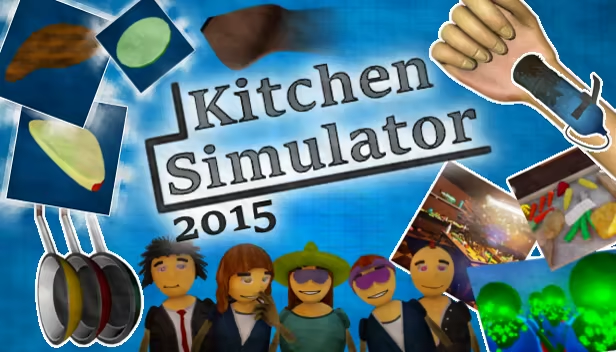
Kitchen simulator, The game that turns you into the chef. As the owner and chef of your very own restaurant, you now have the responsibilities to keep your place clean, serving quality meals to your hungry customers, Impressing the high class to get to that fancy five star restaurant,more…
Modeled estimate, not a reported figure. How we estimate →
Media
About

Genres
Stats
All-time low is the lowest price we've recorded for this game since we started tracking it.
Languages: English*, Russian**languages with full audio support
Engagement
Hours played at review time, across 40 reviews with recorded playtime.
Reviews
El peor juego de simulador de cocinar que he jugado nunca, da tanto sida que he decidido dejar de jugarlo y ocultarlo en mi biblioteca porque me avergüenzo de el.
Cards Simulator
Looks terrible and runs worse. The gameplay makes little sense and the game does nothing to try to teach you what to do. There is a tutorial button on the main menu, but it's just a one page graphic that isn't very informative. Clicking it will require you tab out and close the game as there is no way to close the popup. Spending a few minutes trying to figure out how to prepare orders led nowhere. All I could do was flip a spatula and the bird. If you want to spend 30 minutes trying to teach yourself how to play a low effort game, go ahead and get it. Otherwise avoid.
lel
Kitchen Simulator 2015 is an indie cooking and restaurant management game developed by WhackAKey Games and published by Conglomerate 5. The game attempts to simulate the chaotic environment of a working kitchen by placing players in charge of cooking meals, handling customer orders, and maintaining a functioning restaurant. While it falls within the cooking simulation genre, its design is much simpler and more experimental compared to more polished culinary games. Instead of focusing heavily on realistic recipes or detailed restaurant systems, the game emphasizes basic cooking mechanics and sandbox-style interaction within a small kitchen environment. This approach results in an experience that is equal parts cooking simulator and chaotic physics playground. The central premise revolves around running a small restaurant and attempting to transform it into a successful five-star establishment. Players are responsible for preparing meals for incoming customers while also managing the kitchen environment. Orders arrive from patrons with different food preferences, and the player must assemble the requested dishes quickly before customers lose patience. Each successful order increases both earnings and the reputation of the restaurant, gradually pushing the establishment closer to achieving higher ratings. Although the progression system is relatively simple, it provides a sense of purpose as players attempt to maintain efficiency and satisfy a steady stream of hungry customers. Gameplay is presented from a first-person perspective, allowing players to freely move around the kitchen while interacting with appliances, ingredients, and utensils. Various tools are available to prepare food, including grills, storage areas, and preparation counters. Players must pick up ingredients, cook them using the available equipment, and serve them in a timely manner. The process sounds straightforward, but the confined space and multiple tasks often create moments of frantic multitasking. Players may find themselves juggling several orders at once while attempting to keep track of cooking times and ingredient placement. A large part of the gameplay challenge comes from maintaining organization within the kitchen. Ingredients can easily end up scattered across counters or even fall to the floor if handled carelessly. Because customers expect their food quickly, players must move efficiently between different stations while making sure their workspace remains functional. Dropped items, misplaced ingredients, and poorly timed cooking attempts can lead to delays that affect customer satisfaction. These small details attempt to mimic the stressful environment of a busy kitchen, though the mechanics remain simplified compared to more advanced cooking simulations. Customer management plays a major role in determining the success of the restaurant. Each patron arrives with a specific request, and fulfilling that request correctly increases both income and reputation. However, customers also have limited patience, meaning delays or mistakes can cause them to leave unsatisfied. Occasionally, a special visitor such as a restaurant critic may appear. Impressing this critic can significantly improve the restaurant’s standing and accelerate its progression toward higher ratings. These moments add a small element of tension to the gameplay, encouraging players to perform their best when important guests arrive. As players earn money through successful service, the game offers limited customization options that allow them to modify their kitchen. New equipment and decorative elements can be purchased to improve the appearance or functionality of the restaurant. Players can also obtain alternative cooking tools such as different spatulas or visual themes for the kitchen environment. Although these customization features are not particularly extensive, they add a small sense of progression and allow players to personalize their workspace over time. Visually, the game uses a simple 3D style that reflects its indie development scope. The kitchen environment is filled with interactive objects such as counters, appliances, and food items, but the models and textures are fairly basic. The focus is clearly on functionality rather than visual detail, and the graphics prioritize clear interaction with objects rather than realistic presentation. While the overall aesthetic lacks the polish of larger simulation titles, it still provides a functional environment where players can experiment with cooking mechanics. One of the more unusual aspects of the game is its physics system. Many objects in the kitchen respond dynamically when moved, dropped, or thrown. Ingredients can roll off surfaces, utensils may behave unpredictably, and various items can collide in unexpected ways. These physics interactions occasionally create amusing moments, particularly when objects scatter across the kitchen during rushed cooking attempts. At the same time, the unpredictable behavior of the physics engine can make precise actions more difficult, sometimes turning routine tasks into chaotic situations. The audio design is relatively minimal but serves its purpose within the gameplay. Background music plays during the cooking process, helping create a sense of activity in the restaurant environment. Basic sound effects accompany actions such as placing ingredients, cooking food, or interacting with appliances. While the audio does not stand out as a particularly memorable feature, it helps reinforce the feeling of working inside a busy kitchen. Despite its ambitions to simulate restaurant management, the game has several limitations. The gameplay loop remains quite repetitive, with most activities revolving around preparing food and serving customers in the same environment. The lack of deeper systems such as advanced recipes, staff management, or expanded restaurant upgrades may leave players wanting more variety. Additionally, the unpredictable physics system can sometimes interfere with basic tasks, making the cooking process feel awkward rather than challenging. However, the game does have a certain charm that comes from its experimental design. The combination of simple cooking mechanics and chaotic physics interactions creates moments of unexpected humor. Watching ingredients bounce around the kitchen or accidentally dropping food during a rushed order can produce entertaining situations that feel almost like a sandbox experiment. While these moments are not always intentional, they add a degree of unpredictability that keeps the experience from feeling completely rigid. Overall, Kitchen Simulator 2015 is a small indie simulation that offers a quirky take on running a restaurant kitchen. Its straightforward mechanics and sandbox-style interactions provide a casual experience that focuses more on experimentation than realism. Although it lacks the depth and polish found in larger cooking simulators, it still offers a brief glimpse into the hectic environment of food preparation. For players interested in unusual indie simulation games or curious about experimenting with chaotic kitchen physics, the game can provide a short and sometimes amusing experience. Rating: 5/10
纯粹的一坨,能把这么屎画面的游戏做的如此卡顿 完全就是骗钱,愿这种开发者早日暴毙
[strike] симулятор женщ [/strike]
говно
missing so much
buggy and no sense game... with bad graphic...
Related
Related
Trends
Concurrent players on Steam, sampled daily since tracking started.
Momentum
Pace estimated from the game's recent review growth (our daily snapshots) at its own sales-per-review ratio — a momentum signal, not booked sales.
Audience
Estimated from the language of this game's reviews — a proxy for where players are, not official Steam demographics.
Related
| Who's Hungry? | $7.3K | 56 | 100% | $4.99 |
| Nocturia The Game | $7.3K | 55 | 76% | $4.99 |
| See No Evil | $7.3K | 278 | 65% | $0.99 |
| Bunny Guntz | $7.3K | 177 | 76% | $1.99 |
| Coloring Game: Girls 2 | $7.3K | 63 | 92% | $6.49 |
| Phoenix Force | $7.3K | 655 | 84% | $0.49 |
Related
| Planet Coaster | $109.4M | 72K | 91% | $44.99 |
| House Flipper | $65.8M | 110.8K | 94% | $24.99 |
| SPORE™ | $45.8M | 72.2K | 93% | $19.99 |
| Train Simulator Classic | $29.3M | 29.3K | 72% | $5.99 |
| Golf With Your Friends | $23.7M | 74.7K | 87% | $14.99 |
| Jurassic World Evolution | $18.8M | 55.2K | 87% | $12.49 |