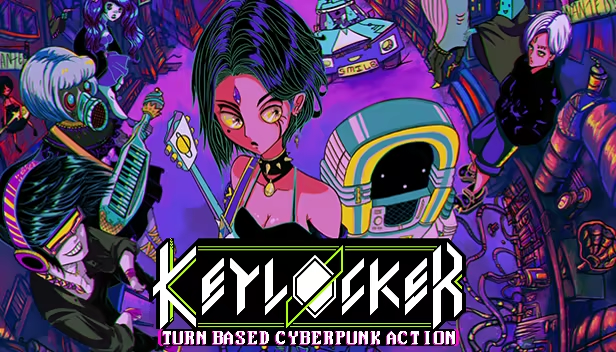
In a silent world where music is outlawed, play as a singer to shatter the strings of fate and sing the melody of freedom in this unforgiving Turn Based Rhythm JRPG.
Modeled estimate, not a reported figure. How we estimate →
Media

About

Keylocker is a Cyberpunk turn based rhythm JRPG inspired by the Mario&Luigi RPG series and Chrono Trigger, in which you play as the singer and songwriter, B0B0. Fuel your moves with the electric power of music in this unforgiving planet by using real-time execution of moves in rhythm game style! Battle the authorities, unlock the secrets of Saturn, play on your own bands' concerts and hack into the network to bring an end to this corrupt system, for better or worse.
Choose your path as a cyberpunk rebel, each with its own unique skill tree and storyline.
Control Electricity with your own music! Transform it into attack or defense as needed, swapping between different movesets and tactics.
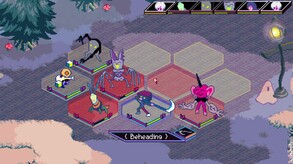
Classic Turn Based Combat with a twist: Real Time execution of moves in rhythm game style, aim your shots, time your attacks, parry and block your enemies in this unforgiving planet.
No Random-Encounters; fight your enemies head-on with seamless in world battles inspired by Chrono Trigger.
Befriend the citizens, or betray them: gift them to earn their favor and make choices that change the course of the story with multiple endings.
Play with your band to the friends you made at the Music Show minigame, featuring compositions by Elektrobear (Momodora, Virgo Versus The Zodiac), voiced by Psamathes.
But watch out on the Danger Meter! The all-ears church-police will certainly come after devious denizens who do not respect the Law of Silence.
Completely customize your characters with a great variety of equipment; unlock special Talents using the Keys harvested from enemies you DELETE in combat.
Unique interactions with every object of the world: exploring Saturn can lead to secrets, rewards or entire pieces of knowledge about the planet.
| Saturn, Anno 801. |
| Music is banned for 141 years now. |
B0B0 is one of the Doppelgangers, twins born as perfect human beings fit to obey the purpose of the caste they were assigned to. Her purpose is to serve in the lowest caste for the prosperity of Saturn, but B0B0 doesn't quite agree to that. Amidst a revolution against the Saturnian Satellites, the ultimate form of law, B0B0 hears news of a newfound music robot that'll fit right in her illegal band as a drummer. Rebelling against the corrupt system using music is the only thing she knows how to do well and she only needed a drummer to join her pack of misfits. With every piece in place, she's out to break some laws, and discover the truth behind the essence of music, the Keylocker.
Stats
All-time low is the lowest price we've recorded for this game since we started tracking it.
Languages: English, Japanese, Korean, Portuguese - Brazil, Simplified Chinese, Traditional Chinese
Engagement
Hours played at review time, across 41 reviews with recorded playtime.
Reviews
Themes across 41 recent reviews and how positive each mention is. A keyword signal, not full sentiment analysis.
positive critical· bar length = how often the theme comes up
Reviews
First, I have to give praise to the soundtrack, which is so good that I think this game is worth it for that alone. I loved the soundtrack so much that I bought the digital album [i]twice[/i] so I could have it on two services. Check out this sample: https://www.youtube.com/watch?v=w8l-qIYsoNI So the first thing that amazed me was how much thought was put into the game. Near the beginning of the first chapter, I found a random piece of machinery that looked like a big AC unit or something, and saw I could analyze it. Now, in most games, you're lucky to get a generic description, but here I got a humorous description, which surprised me. Then I found another one, and tried gain, and got a [i]different[/i] humorous description. And it was like that for [i]almost every decoration in the game.[/i] Of course, this doesn't make or break a game, but I think it gives you an idea of how much thought and effort went into the game. While the game advertises itself as Cyberpunk, I think it's more accurate to call it "Surreal Sci-Fi" instead. Sure, it has cyberpunk elements, like a high-tech dystopia, but the artstyle is very trippy and the story mixes in Greek and other mythologies, and overall Keylocker felt sort of colorful and unreal rather than the gray and gritty style I think of with cyberpunk. The story has a lot of twists and turns, and slowly morphs from a kind of silly and light vibe to pretty dark near the end, and classism becomes a common theme. Yes, the game is pretty political in that way. Overall I found the story most fascinating near the end, where you start getting a lot of lore dumped and you and learn about the world of Keylocker. One other thing is that I absolutely loved all the character designs, which all look like they walked off of a fashion runway (except for the monsters of course). I was taking screenshots constantly because of how cool they all looked. [hr][/hr] So, with all this praise I'm giving, it might be surprising that, according to the Steam achievements stats, very few people actually made any significant progress, not even making it to the first boss. Besides how I said the story was much more interesting near the end, based on my personal experience I think there are two reasons, both related to the combat. First, the developers obviously tried to avoid typical RPG tropes. Instead of HP, MP, STR, INT, etc., you have LP, EP, Dissonance, Resonance, etc. The new terminology and overall style means that your knowledge from other games doesn't completely translate to this game, and it can take a while to learn. I'll describe the overall concept of combat and progression as I understood it, and hopefully this will explain why it might be hard to pick up, and also hopefully better prepare you to enjoy this game if you buy it. So there's LP and EP. When LP reaches 0, you die, so that's pretty easy, it's just another name for HP. So what's EP? Well, there are 4 types of combat moves: L-ATK, E-ATK, L-DEF, and E-DEF. E-ATK makes the target lose EP, and if they run out of EP then they lose LP instead. So EP is a shield against E-ATK? Yes, but also you spend EP to charge up L-ATK and L-DEF moves. So EP is both a shield [i]and[/i] like magic. Since you spend your shield to perform L-ATK and L-DEF moves, which both directly attack enemies' LP in different ways, there's a risk/reward thing going on. That risk/reward also extends to weapons and unlockable skills: a powerful weapon might make you [i]lose[/i] health each turn, and many skills boost two stats at the expense of reducing one stat. Finally, I think L-ATK and E-ATK are easy to understand now, but what about L-DEF and E-DEF? E-DEF is pretty straightforward: you raise EP for yourself and your allies. L-DEF charges a counterattack, and AFAIK its power depends on how successfully you defend against an attack. This leads to my second observation. Every time you attack or defend, you are given a QTE. The QTE result might be Perfect, OK, Early, Late, or Miss. It might be as simple as pressing the interact button when the character flashes, or you might need to press 6 directions with the right timing, or something else. And some of these QTEs can be pretty unforgiving: the 6-direction-press QTE, for example, counts as a Miss if you just fail just 2. It depends on the difficulty, but, on normal difficulty, perfect blocks mean 0 damage, perfect attacks deal pretty big damage, but anything less-than-perfect feels pretty punishing, meaning taking a ton of damage or dealing very little damage. On just the normal difficulty, just failing to get a Perfect defense twice was enough for my support characters to die. Of course, it depends on how you decide to level up your characters. Overall, this combat system can be very satisfying when you're doing well, but frustrating if you fail a lot. Personally, I noticed that I'd experience a sort of "fatigue" after playing for a while, and start making more and more mistakes after playing for an extended time, so I had to take frequent breaks to play this game well. Honestly, it took a while for the gameplay style to really start making sense to me. I wasn't having much fun before then, but once I started to really comprehend it, I started having a lot of fun. So, if you don't like the game at first, I recommend trying to "power through" because, for me, it was definitely worth it, and I loved the game by the end. FWIW I think the game allows you to skip any fight, since I was given the option to give up and lose rewards if I died a few times. So if you're really struggling and want to just explore and experience the story, I think you can do that. [hr][/hr] Overall, I think this game is a major hidden gem. I'd recommend it if you want a turn-based RPG that feels unique and new rather than safe and familiar. One last thing: the dev has been very responsive on discussions, and has helped me out with some questions, which I was pretty impressed with.
Writing this review was a painful for me. I tried to give it a chance so many time. However, no matter how many chances I give this game, I only ended up feeling bored. The only positive things about it are the art work and music. Everything else was not so great. The worst part was the combat system and the UI. Navigating through the UI during gameplay was clunky and confusing such as changing equipment or using items. The combat didn't feel exciting and learning about it was confusing. The UI and most of the gameplay was confusing to learn. I could forgive most of that if the plot and characters were engaging, but they didn't capture my interests and some of the characters feel bland to me. The world and story feels convoluted and empty at the same time. Playing though the game felt like a chore.
This game was something special. It takes every system and thing that was great in Virgo vs The Zodiac and made it dramatically better in every way. There is a class system that changes story paths and sidequests, 4 separate endings with different events in the final chapter, basically tons of replayability in this game. Game is a good 25-30 hours for a single playthru, has a NG+, and packed with fun content. OST is amazing , characters and villains are charming and the story is especially poignant and interesting as a commentary on everything happening in our world today. Trust me, this game is an absolute gem
呃啊,总之就是无聊。强迫自己都打不下去了,角色也不是很吸引我。不打了 引导为0先不说了,没有打过这么憋屈的qte战斗,毫无成就感。 有一种作者早已沉浸在自己的艺术品中不知天地为何物了。
The soundtrack is AMAZING, the runtime was a longer than I expected from an indie RPG, the combat system was really satisfying once I got the hang of it, the lore is deep, I liked the cast of weirdos that followed you through the events of story, and the humor worked for me. But this game isn't going to be for everyone. In particular there is a lot that the game is bad at communicating to the player. Everything from small details like exits from rooms that don't look like they're exits to key mechanics being easy to miss (e.g. I was three chapters in before I realized some characters sold items if you pressed a different button to talk to them, and I rolled credits without even REALIZING that there was a gifting/romance mechanic), to big things like me not having any idea what I could have done differently to not get one of the bad endings. But despite its rough edges, I stuck with it and really enjoyed the ride,
This game is janky as hell. Artwork is ok, combat is not good
The parrying is preventing the enjoyment for me.
Baller art style, engaging combat, charming as hell dialog, and as you'd expect from a game all about music, TRANSCENDENT soundtrack. Game has such a strong identity and it uses the thing excellently
Keylocker | Turn Based Cyberpunk Action immediately stands out as one of the more ambitious and stylistically bold indie RPGs in recent years. Set on a dystopian Saturn where music has been outlawed for more than a century, the game uses its premise as both narrative backbone and thematic rebellion. You play as B0B0, a young musician born into a world where artistic expression is a crime and electricity is rationed under the watch of an authoritarian regime. From the opening moments, the game makes it clear that sound, rhythm, and resistance are inseparable. Keylocker doesn’t simply use music as decoration; it treats it as a weapon, a political statement, and a symbol of identity. The cyberpunk setting amplifies this tension through neon-soaked streets, rigid social hierarchies, and oppressive surveillance, delivering a world where the smallest spark of creativity can ignite revolution. The combat system is where Keylocker most decisively separates itself from traditional turn-based RPGs. Instead of passive menu commands, every action requires timed button presses, rhythmic cues, or input sequences that make battles feel like a hybrid of RPG and rhythm game. Successfully timing attacks isn’t just a bonus—it’s essential, influencing everything from damage output to energy management. Because electricity is the core resource powering abilities, the game cleverly merges thematic and mechanical logic: stealing EP from enemies, redirecting currents, and turning charged attacks into shields make battles feel dynamic and purposeful. Positioning matters as well, since the field is grid-based, adding tactical considerations to what could have been a purely reflex-driven system. The resulting combat loop demands attention and precision while still allowing strategic thinking, creating a blend that can feel exhilarating once mastered. Exploration outside of combat reinforces the game’s rebellious spirit. The environments are vibrant, chaotic, and filled with personality: markets buzzing with eccentric characters, industrial zones humming with electronic decay, stark caste-specific districts, and neon-lit back alleys where illegal music still thrives underground. NPC interactions add humor, cynicism, melancholy, and outright absurdity, creating a living world where resistance simmers beneath every fluorescent light. Instead of overly expansively designed areas, the game opts for dense, thematically packed locations, each dripping with visual style. The art direction embraces a mix of sprite-based character models and colorful cyberpunk backdrops, lending the world a retro-futuristic identity that feels fresh rather than nostalgic. The soundtrack—true to the game’s theme—is bold, catchy, and expressive, using synths, rock energy, and punchy electronic beats to reinforce the emotional and thematic stakes at every major turn. The customization and progression systems deepen the experience further. The Skeyll Tree allows you to shape your team’s abilities by using “Keys” obtained from enemies, encouraging experimentation and specialization. Whether leaning into offensive electric combos, defensive manipulation of EP, or quirky utility abilities, the game gives players enough freedom to craft a playstyle that suits their rhythmic skills. Equipment, allies, and optional encounters further flesh out the RPG systems, making progression feel meaningful even when the moment-to-moment gameplay leans heavily on timing and reflexes. These layered systems help the game maintain momentum across its chapters, giving a sense of growth that complements the narrative’s rising tension. However, Keylocker’s ambition also introduces unevenness. The constant demand for rhythmic precision can be overwhelming for players not accustomed to timing-based combat, and missing cues can turn otherwise straightforward battles into prolonged struggles. The density of lore, factions, and political structures—while rich—can feel overwhelming in the early hours, especially when jargon-heavy dialogue arrives faster than the story can establish its foundation. Navigation can occasionally be confusing due to limited mapping tools, leading to moments of backtracking that interrupt pacing. The danger meter, which spawns enemies based on stealth failures or exploration choices, sometimes escalates too quickly, causing sudden bursts of encounters that may feel more disruptive than challenging. Despite these imperfections, Keylocker is undeniably memorable. It captures the rebellious heart of cyberpunk storytelling, not through sleek guns or corporate espionage, but through rhythm, energy, and artistic expression. It paints a world where music is both contraband and salvation, and where combat feels like performance. Its aesthetic confidence, mechanical creativity, and thematic cohesion make it stand out in a genre often saturated with predictable takes on dystopia. For players willing to adapt to its rhythm-driven combat and embrace its loud, defiant personality, Keylocker offers a daring and invigorating experience. It may not be flawless, but it is unmistakably alive—charged with electricity, art, and the spirit of defiance. Rating: 8/10
Чуваки, поиграйте в эту игру она шикарна This game bring me everething i needed. Thank you Moonana, that's was beautiful!
Related
Related
Trends
Modeled estimate over time, reconstructed from Steam's monthly review histogram.
Audience
Estimated from the language of this game's reviews — a proxy for where players are, not official Steam demographics.
Related
| Space Invaders Extreme | $120.3K | 268 | 87% | $19.99 |
| PAC-MAN MUSEUM+ | $120.3K | 619 | 87% | $9.99 |
| Teenage Mutant Ninja Turtles: Mutants Unleashed | $120.4K | 140 | 54% | $39.99 |
| STAR WARS™ - X-Wing Alliance™ | $120.3K | 507 | 83% | $9.99 |
| Black Hole Fishing | $120.4K | 522 | 88% | $5.99 |
| Project: Snowblind | $120.3K | 761 | 76% | $5.99 |
Related
| 7 Days to Die | $425.3M | 403.5K | 87% | $44.99 |
| Mount & Blade II: Bannerlord | $309.8M | 293.9K | 88% | $49.99 |
| Palworld | $279.6M | 445.8K | 94% | $20.99 |
| Clair Obscur: Expedition 33 | $263.7M | 178K | 95% | $47.99 |
| Project Zomboid | $239.1M | 460.8K | 94% | $19.99 |
| Terraria | $187.5M | 1.5M | 97% | $9.99 |