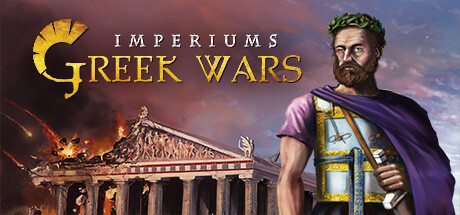
Unique combination of turn-based 4X and historical grand strategy with a mythological twist. Explore the ancient world and build a world leading civilization. Survive, expand, conquer... and win!
Modeled estimate, not a reported figure. How we estimate →
Media

About


Genres
Stats
All-time low is the lowest price we've recorded for this game since we started tracking it.
Languages: English*, French, German, Spanish - Spain, Czech, Russian, Japanese, Polish, Italian, Simplified Chinese*languages with full audio support
Engagement
Hours played at review time, across 40 reviews with recorded playtime.
Reviews
Themes across 40 recent reviews and how positive each mention is. A keyword signal, not full sentiment analysis.
positive critical· bar length = how often the theme comes up
Reviews
I caught the bug, quite skeptical at first, bought on sale. But I like supporting niche games, especially historical ones. -There's a real interplay between the Greek cities, spear stabs in the back can happen quickly, the side missions force the player to move their heroes around the map. - The game doesn't reinvent the wheel, but that's not what we're asking of it. I was looking for a historical civilization, centered around a real and dynamic map. However ! Its quite different than Civilization : - Political choices (land reform, slave management, game organization) directly impact the economy, social stability, and population growth, unlike others more simplified games. - The Military logistics (morale, supplies) and mine/quarry management force to move cautiously on the map and take the time to develop and planifed. - You also have the ability to conquer cities through influence rather than force. In brief, you must have a fine management of populations (loyalty, demographic growth) and resources in addition to balance your territorial expansion, internal stability and external pressures (barbarians, Persians). The aspect centered around a single region, a single era helps to create meaning, and it's truly a historical 4X game I haven't seen elsewhere. In the end, I spent the weekend on it and I'm going to continue. I haven't even mentioned the DLCs that bring new regions. In short, a small studio and a developer worth supporting. Let's hope one day an "Imperiums II" game that lives up to its ambitions and will be all the more profound, with for example the whole mediterranean world, we hold a nugget in our hands ;)
OK, I have only played this game for 5 hours but after years and years (yes I am old :)) of playing other games so far I am impressed with this game. It has enough balance between building cities and attacking and diplomacy to make the game fun. Oh and they actually have a manual in PDF form plus their tutorial works and gives you a good background on how to play the game.
must have for 4x players. great diplomacy and trade, and better AI than any civ title.
A very very good, in depth and accurate 4X game with great DLC offerings and very deep layers of mechanics. One of my absolute favourites and only wish that it was more well known!
This game is fatally flawed on some of the DLC... For instance the Britain Isle if you decide to play one of the british tribe it wont let you win. I took over entire britain had towers in that totally destroyed the romans took the city on their mainland and then I run out of money even without very many troops. yet they dont. Your troops turn grey wont move cannot get off boats its flawed game not sure who decided to make it where you cannot win or beat rome...
I recommend this game with caution. It is interesting, and the tactical elements of warfare are very deep and good, but I just can't get into this game. The presentation layer is very bare-bones in my opinion. I would like to know why my cities are losing loyalty with high happiness, why my general is revolting, or the predicted income for the next round of my resources. The pressure is always high on the player; every border has always had some war. The empire is going to be very hard to manage if you have something like 60% conquered of your objective. I'm not going to play this game further. I had a lot of fun in my short time, but the accessibility is just not good enough for me.
33 hours for my first game (following on from the tutorial). Complex, in-depth, and well thought-out; scratches the ancient world strategy itch. Graphics are good enough, music is good, and I am enjoying the game-play so far (I think with 33 hours I have my money's worth already). Lots of different nations to try; looking forward to giving Sparta a go.
The good: - Resources and economy matter, the resources may run out and player needs to plan ahead for potential shortages - Diplomacy is pretty great, trade with someone longer and they maybe more friendly, get mor epowerful and other countries/city states will flock to help you - Combat is very interesting as lots of factors are being taken into consideration, morale, unit upgrades - AI can coordinate attacks, and sometimes even transport units by boats to backstab you far away from your main war front - Additionally can cut supplies from enemy armies to starve them, same with besieged cities - Barbarians can create new factions, or preciously destroyed one may reemerge after a rebellion - Devs answer the questions really fast and are very friendly The bad: - UI is a bit of janky, cities could have a view like Civ3, all information is there on the UI but sometimes it;s hard to find Overall, very unique and really well put together game. More on a wargame side, as sitting and building stuff is a way to lose game fast. Overall, strongly recommend.
Auf dem Weg zu einem Griechenland Hier geht’s zu meinem Waetsch's Play: https://youtu.be/1f8kq8QhEbg Ein feines Runden-Strategiespiel mit Abstrichen bei Grafik und Benutzerführung, aber viel Spielspaß. Mit Imperiums: Greek Wars haben wir ein Runden-Strategiespiel, in dem wir im Civ-Stil Städte bauen, unser Land entwickeln, Armeen ausheben und versuchen, andere Staaten zu unterwerfen oder mit Diplomatie auf unsere Seite zu ziehen. Die Grafik kann nicht mit einem Civilization oder Total War (Kampagnenkarte) mithalten, ist aber dennoch ganz hübsch anzusehen. Damit man zu Beginn nicht komplett in den zahlreichen Mechaniken verloren geht, erklärt ein Tutorial in sehr ausführlichen Textboxen, was zu tun ist. Dabei sind die Texte alle auf Deutsch, nur vereinzelt hat sich mal ein kleiner Fehler eingeschlichen, der aber kaum auffällt. Das Tutorial hätte ich mir gerne etwas interaktiver gewünscht, ist aber sehr ausführlich und lässt keine Fragen offen. Wer also mit ein paar Abstrichen in der B-Note leben kann, findet hier ein sehr umfangreiches und mit Liebe gemachtes Runden-Strategiespiel. Folgt mir auch gerne bei Steam: https://store.steampowered.com/curator/41912197-waetschs-play
Imperiums: Greek Wars is a dense and ambitious strategy experience that aims to capture the political complexity, military uncertainty, and cultural richness of the ancient Mediterranean world. Developed and published by Kube Games, the game positions itself at the crossroads of traditional 4X design and grand strategy, offering a slower, more contemplative take on empire building. Set around 359 BC, during a period of immense upheaval and opportunity, it invites players to guide a faction through an era where city-states rise and fall, alliances are fragile, and power is as much about diplomacy and economy as it is about armies on the march. From the outset, the scope of the game is immediately apparent. Players can choose from a wide array of factions scattered across Greece, the Balkans, Anatolia, and surrounding regions, ranging from famous powers like Athens, Sparta, and Macedon to lesser-known tribes and emerging states. Each faction starts with a distinct geographical position, political situation, and set of challenges, ensuring that no two campaigns feel the same. Expansion is not simply a matter of claiming empty territory; it requires navigating contested lands, managing relations with neighbors, and understanding how geography, resources, and culture shape long-term strategy. The strategic layer is where Imperiums: Greek Wars truly distinguishes itself. Empire management goes far beyond simple city placement and production queues, delving into infrastructure development, population happiness, trade routes, and resource logistics. Decisions made in peacetime often have consequences that only become clear decades later, reinforcing the game’s emphasis on foresight and planning. Diplomacy is equally nuanced, allowing players to negotiate treaties, form alliances, manipulate rival states, or destabilize enemies through indirect means. The political map is in constant flux, and a stable alliance in one decade can easily dissolve into open conflict in the next. Warfare, while important, is treated as a tool rather than the sole path to success. Military engagements account for terrain, supply, morale, unit experience, and leadership, making battles feel consequential rather than routine. Victories are rarely clean, and even successful campaigns can strain an empire’s economy or destabilize internal politics. Naval combat adds another strategic dimension, particularly for factions controlling key coastal regions or trade routes. Rather than focusing on flashy animations or cinematic battles, the game emphasizes the strategic consequences of war, encouraging players to think carefully about when conflict is truly worth the cost. One of the more distinctive aspects of Imperiums: Greek Wars is its optional integration of mythological and legendary elements. Players can choose to engage with quests and stories inspired by ancient myths, such as seeking legendary artifacts or attempting famous feats rooted in Greek lore. These elements are designed to complement rather than dominate the historical framework, adding flavor and unique decision points without undermining the game’s strategic seriousness. Importantly, they can be adjusted or disabled entirely, allowing players to tailor the experience toward a more grounded historical simulation if they prefer. Customization and replayability are central to the game’s long-term appeal. Beyond historical scenarios, players have access to random map generation and editing tools that allow for the creation of entirely new worlds and strategic challenges. This flexibility, combined with mod support, greatly extends the game’s lifespan and encourages experimentation. Campaigns can unfold in dramatically different ways depending on initial settings, faction choices, and player priorities, making each playthrough feel like a fresh strategic puzzle rather than a repetition of familiar patterns. Visually, Imperiums: Greek Wars adopts a functional, map-focused presentation that prioritizes clarity over spectacle. The interface is information-dense, and while it can feel intimidating at first, it is designed to support the game’s complexity rather than simplify it. Tooltips, data panels, and contextual information gradually reveal their usefulness as players grow more familiar with the systems. The learning curve is undeniably steep, and the game demands patience and attention, but those willing to invest the time are rewarded with a deep sense of control and understanding over their growing empire. Ultimately, Imperiums: Greek Wars is a strategy game that values depth, historical atmosphere, and long-term decision-making over immediate gratification. It is not built for quick sessions or casual play, but for players who enjoy carefully weighing options, managing interconnected systems, and watching the consequences of their choices unfold over many in-game years. For fans of ancient history and complex strategy, it offers a rich and rewarding experience that stands out as a thoughtful and demanding entry in the genre, capable of providing dozens—if not hundreds—of hours of engrossing strategic play. Rating: 8/10
Related
Related
Trends
Modeled estimate over time, reconstructed from Steam's monthly review histogram.
Momentum
Pace estimated from the game's recent review growth (our daily snapshots) at its own sales-per-review ratio — a momentum signal, not booked sales.
Audience
Estimated from the language of this game's reviews — a proxy for where players are, not official Steam demographics.
Related
| My Lust Wish | $107.5K | 184 | 55% | $19.99 |
| 1428: Shadows over Silesia | $107.5K | 276 | 78% | $19.99 |
| PlayForm: Human Dynamics | $107.5K | 184 | 90% | $19.99 |
| HELLBREAK | $107.6K | 279 | 80% | $14.99 |
| Ancient Farm | $107.6K | 186 | 62% | $14.99 |
| Demonheart | $107.5K | 756 | 91% | $4.99 |