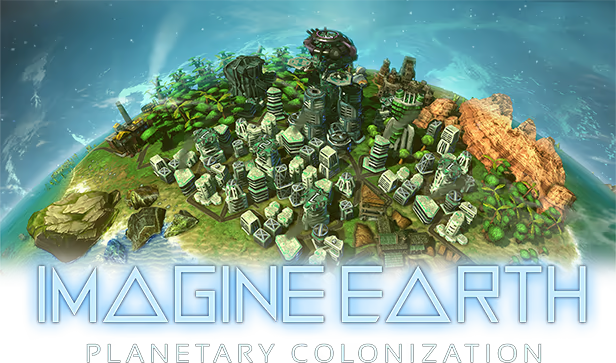
Imagine Earth is a planetary city-building and economic simulation developed and published by Serious Bros. that blends classic management mechanics with a thoughtful focus on environmental sustainability and corporate expansion across the galaxy. Instead of building a city on a flat map like many traditional strategy games, the game presents fully simulated spherical planets that players can rotate, zoom into, and colonize from multiple angles. In this futuristic setting, humanity has begun colonizing distant worlds through corporate initiatives, and players take on the role of a colony manager responsible for developing profitable settlements on newly discovered planets. The central challenge lies not just in expanding infrastructure and population, but in doing so responsibly, since aggressive industrialization can destabilize the planetary ecosystem. This underlying theme gives the game a distinctive identity, transforming it from a standard city builder into a broader simulation about the consequences of unchecked growth.
The core gameplay revolves around constructing and managing a thriving colony on alien planets. Players begin with a small landing zone that acts as the foundation of their settlement, gradually expanding outward by building residential districts, agricultural facilities, energy plants, mining operations, and manufacturing industries. Each structure contributes to the colony’s economic and logistical network, requiring players to carefully balance resources such as food, energy, minerals, and consumer goods. Citizens must be kept satisfied with adequate housing and services, while industries need access to raw materials and infrastructure to maintain efficiency. The placement of buildings plays a major role in the overall success of the colony, as certain structures perform better when located near resource deposits or in proximity to complementary facilities. Strategic planning becomes essential when deciding how to distribute industries, residential zones, and ecological protection measures across the planet’s surface.
One of the most distinctive aspects of the game is its environmental simulation system. Industrial growth comes with consequences, and excessive pollution gradually alters the climate of the planet. If players rely too heavily on fossil fuels or large-scale manufacturing, carbon emissions increase and begin to trigger environmental disasters such as rising sea levels, extreme weather, and ecosystem collapse. These effects can flood coastal settlements or disrupt food production, creating serious challenges for long-term survival. To counter this, players must invest in sustainable technologies like solar arrays, wind farms, geothermal power plants, and ecological restoration projects. The environmental mechanics encourage players to consider long-term planetary health rather than pursuing short-term economic gains, adding a layer of strategy that is rarely emphasized so strongly in the genre.
Beyond basic colony management, the game also incorporates economic competition between corporate factions. Rival companies may establish their own colonies on the same planet, creating a competitive environment where financial strategy becomes just as important as infrastructure planning. Players can manipulate markets, buy shares in competing corporations, or acquire control of rival settlements through economic dominance. This financial system introduces a layer of corporate strategy reminiscent of economic simulations and light 4X games, where influence and capital can be used to shape the development of entire planets. As the campaign progresses, players encounter increasingly complex scenarios involving multiple corporations, limited resources, and escalating environmental risks.
The campaign mode provides a structured narrative that follows humanity’s attempt to rebuild civilization after environmental decline on Earth. Each mission takes place on a different planet with its own environmental conditions, terrain features, and resource distributions. Some worlds may contain vast oceans that limit available land, while others feature harsh deserts or frozen environments that complicate agricultural development. These planetary variations keep the gameplay fresh by forcing players to adapt their strategies to different ecological conditions. Alongside the campaign, the game includes sandbox and endless modes that allow players to freely experiment with planetary colonization without strict objectives. Custom planet generation tools also provide additional replayability by letting players design unique worlds with different climates and resource layouts.
Visually, the game adopts a colorful and stylized aesthetic that emphasizes clarity and accessibility. Entire planets appear as detailed rotating globes populated by forests, oceans, deserts, and sprawling urban districts. When zoomed out, players can observe the global distribution of their colonies and industries, while zooming in reveals animated structures and bustling settlements. The visual design prioritizes readability and charm rather than hyper-realistic graphics, making it easier to track infrastructure networks and environmental changes across the planetary surface. The interface is designed to support large-scale management, providing clear indicators for resource production, pollution levels, and citizen happiness.
The audio design complements the relaxed yet strategic tone of the game. Ambient music tracks create a calm atmosphere while players plan their next development steps, and subtle sound effects highlight the construction of buildings and industrial activity across the planet. While the sound design is not particularly elaborate, it effectively reinforces the sense of overseeing a living planetary colony. Combined with the smooth planetary camera system, the audiovisual presentation contributes to the game’s immersive feeling of managing an entire world.
Despite its originality and strong thematic focus, the game does have a few limitations. Some missions may feel somewhat self-contained, as progress from one planet does not always carry over significantly to the next. Additionally, while the environmental systems add meaningful depth, they can sometimes feel unforgiving if pollution spirals out of control before players have access to advanced green technologies. Nevertheless, these challenges also contribute to the game’s strategic complexity, forcing players to carefully plan their development rather than relying on rapid industrial expansion.
Overall, Imagine Earth stands out as a unique entry in the city-building and simulation genre by merging planetary colonization with environmental responsibility. Its combination of globe-based construction mechanics, corporate economic competition, and dynamic ecological systems creates a layered strategy experience that encourages thoughtful planning and long-term sustainability. The game successfully delivers both engaging management gameplay and a meaningful message about the balance between technological progress and environmental stewardship. For players who enjoy complex simulation titles and creative city builders, it offers a refreshing perspective on what it means to build a civilization not just on a map, but across an entire planet.
Rating: 8/10