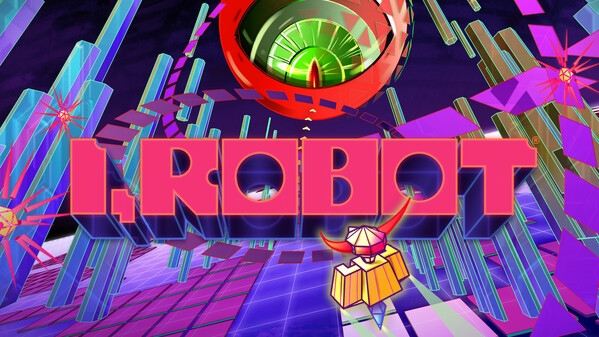
Jeff Minter is back with another unique take on a 1980s Atari arcade game: I, Robot. Reimagined in Minter’s signature assault of colors, shapes and sounds, this new take on the eclectic arcade title is built from the ground up with new challenges, new twists, and a whole lot of llamas.
Modeled estimate, not a reported figure. How we estimate →
About
Jeff Minter is back with another unique take on a 1980s Atari arcade game: I, Robot. Reimagined in Minter’s signature assault of colors, shapes and sounds, this new take on the eclectic arcade title is built from the ground up with new challenges, new twists, and a whole lot of llamas.
The premise of I, Robot is simple: You take control of an ox-headed robot on a mission to outwit the all-seeing eye. In each level, you’ll navigate across tiles, flipping each tile to proceed to the next. Make sure you don’t jump while the eye’s watching, or you’ll be zapped away in a flash. If you make it across the tiles, you’ll race down a tube blasting away any enemy shapes that move into your path and try to stop you. And you have to do all this inside of the 3D space of Minter’s kaleidoscopic visualizer.
Don’t get too comfortable, Minter has also thrown in some arena levels that challenge you to pick out and blast an onslaught of lethal enemies.
At its core it is a game that only Llamasoft could have made. A cacophony of colors dazzle your eyes as the music gradually builds up based on your progress. If you want to take a break from the arcade action, jump into the ungame, where you can channel your inner Jeff Minter and play around with all the sights and sounds from the game.
55 levels with a variety of challenges to conquer in each
Unique tube-shooter bonus stages between each level
Llamasoft's unique brand of mind melting visuals
Procedural music that builds as you rack up a high score
Earn your bragging rights in the online leaderboards

Stats
All-time low is the lowest price we've recorded for this game since we started tracking it.
Languages: English, French, Italian, German, Spanish - Spain
Engagement
Hours played at review time, across 37 reviews with recorded playtime.
Reviews
Huge disappointment. It's not a bad game but it just fails to capture what made the original so much fun, which is a shame because the updated Tempest games were always able to do that. Everything is just a little bit too small on screen, the sounds feel weak, the pace feels slow, the controls feel blunt and the bonus rounds just aren't fun. It could have so easily have recreated the look, pace and sounds of the original and then expanded the levels to include all the new stuff, but instead it seems to be trying to fix something that wasn't broken.
You're High and the Cashier at the 7/11 Knows You're High: The Game You smoked a bowl of that super kush and you're touching the moon. You're buddy decides to go to the 7/11 to get munchies and you tag along. Then, it hits you. The overwhelming sensation that the woman behind the register knows that you are blitzed six ways from Sunday. She is the all-seeing eye that will land you in jail. You need to leave with your snacks and your life while the world ungulates in colors around you. It hits you: there was something a little stronger in that bowl. Objective: Survive That is the vibe of this game in a nutshell.
I, Robot is an arcade-style action experience developed by Llamasoft Ltd. and published by Atari that takes one of gaming history’s more unusual concepts and rebuilds it with modern technology and a bold artistic identity. Inspired by Atari’s original experimental arcade release from the 1980s, this version does not simply recreate the past. Instead, it reinterprets it through vibrant visual design, rhythmic gameplay systems, and the unmistakable creative direction associated with legendary designer Jeff Minter. The result is a game that feels nostalgic in foundation while remaining completely unconventional in execution. At its core, I, Robot revolves around movement, timing, and survival. Players control a rebellious mechanical figure attempting to overthrow an oppressive force represented by a giant all-seeing Eye. The premise sounds simple, but the mechanics quickly establish a strong gameplay rhythm built around precision and awareness. Players move across floating structures and geometric landscapes while flipping tiles and avoiding deadly observation from the Eye itself. One mistake at the wrong moment can instantly end progress, creating tension that keeps even simple actions engaging. The central gameplay loop succeeds because it relies on mastery rather than complexity. Controls remain approachable, allowing players to understand the fundamentals quickly, but true success requires practice and familiarity. Timing movement correctly becomes essential. Learning stage layouts gradually improves performance. Small improvements naturally transform into stronger runs as players begin understanding how environments function and how to manage risk more effectively. One of the game's most memorable strengths comes from presentation. Jeff Minter’s design philosophy has always embraced visual experimentation, and I, Robot fully commits to that creative approach. Environments explode with shifting colors, abstract patterns, and constantly changing visual effects. Geometry twists and pulses while particle effects flood the screen with movement and energy. Rather than aiming for realism or restraint, the game embraces sensory overload as part of its identity. That visual intensity helps create an experience that feels distinct from traditional arcade action titles. Every level carries a surreal atmosphere where the environment itself becomes part of the challenge. Stages often feel unpredictable not because mechanics constantly change, but because presentation creates a constant sense of motion and instability. The result feels almost dreamlike at times while maintaining the fast reactions and precision expected from classic arcade design. Variety also contributes heavily to long-term engagement. While tile-flipping platform sections provide the central gameplay structure, additional gameplay sequences help prevent repetition from becoming an issue. Different challenges introduce shifts in pacing that force players to adapt rather than rely entirely on one approach. Certain moments emphasize careful movement while others demand stronger reflexes and faster decision-making. The arcade structure naturally supports replayability. Like many strong score-focused games, I, Robot encourages improvement through repetition rather than progression systems built around unlocks or extensive upgrades. Stronger performance feels rewarding because success comes directly from personal growth. Early failures eventually become cleaner runs as familiarity increases and confidence develops. Audio design works exceptionally well alongside the visual direction. Music responds dynamically during gameplay, helping reinforce momentum and intensity as players perform more effectively. Sound becomes tightly connected to player actions rather than functioning purely as background atmosphere. Combined with the constantly evolving visuals, the presentation creates a surprisingly immersive arcade experience. One particularly unusual feature allows players to step away from traditional gameplay entirely and experiment more freely with audiovisual systems. Rather than focusing purely on objectives and scoring, the game occasionally encourages creativity and interaction with its artistic side. This reinforces the idea that I, Robot values expression and experimentation just as heavily as competition and mechanical mastery. The game's origins also make the modern release more interesting. The original arcade version stood out decades ago because it experimented with technology and ideas that were highly unusual at the time. This modern interpretation honors that spirit not by playing safely, but by remaining equally willing to take risks creatively. Instead of simply preserving history, it builds upon it. Of course, I, Robot will not appeal equally to every player. Those looking for heavy narrative content or large progression systems may find the arcade structure more limited than expected. The experience remains focused heavily on reaction speed, repetition, and score improvement rather than storytelling or customization. However, players who appreciate arcade design and games built around skill development will likely find substantial value in its approach. Llamasoft and Atari deliver something refreshingly confident with I, Robot. It embraces strange ideas rather than avoiding them. It pushes visual style aggressively rather than settling into familiarity. Most importantly, it understands that arcade games succeed when gameplay remains immediately engaging while offering enough depth to reward improvement. I, Robot ultimately succeeds by transforming a historically important concept into something that feels exciting and distinctive today. It captures the spirit of classic arcade design while layering it with enough personality and creativity to stand comfortably on its own. Rating: 8/10
Played this game in the Arcade in 84 - Good to see the all-seeing eye again in this re-imagined version. Thank you Jeff!!!
A really darn cool psychedelic remake of the classic arcade I, Robot.
"Ping, Ping,ping,Zero,....pleasure...see you next Thursday, "baaaaa!"- Excellent game, and easily worth the dosh. Looking forward to what they do next!
Recommended
Related
Related
Trends
Modeled estimate over time, reconstructed from Steam's monthly review histogram.
Momentum
Pace estimated from the game's recent review growth (our daily snapshots) at its own sales-per-review ratio — a momentum signal, not booked sales.
Audience
Estimated from the language of this game's reviews — a proxy for where players are, not official Steam demographics.
Related
| Gevaudan | $7K | 155 | 55% | $2.99 |
| Return Of The Zombie King | $7K | 76 | 72% | $4.99 |
| The Ice Cream Shop | $7K | 58 | 79% | $3.49 |
| Universe in Cum 2 💦 🌎 | $7K | 211 | 62% | $1.19 |
| Service with a Shotgun | $7K | 92 | 95% | $3.35 |
| Mystika 3 : Awakening of the dragons | $7K | 74 | 93% | $5.99 |