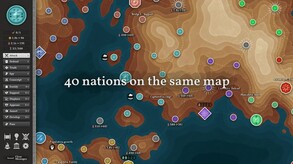
High Strategy: Oradros is a minimalist grand strategy game set in an original, low-fantasy world of hoplites and dinosaurs. There is no micromanagement, only decisions. All 40 playable realms have distinct starting conditions and goals.
Modeled estimate, not a reported figure. How we estimate →
Media
About
Stats
All-time low is the lowest price we've recorded for this game since we started tracking it.
Languages: English
Reviews
Oradros is a fascinating contrast to Urukon. Despite having the same general turn structure and interface as Urukon, the underlying systems of Oradros create a tone that is almost the polar opposite of Urukon. Urukon was largely a game of exploration with the goal of building a resource conversion engine that would achieve whatever your faction goal was (though violence/depth output was essential in any case). Passive income from your cities wasn't nothing, but it was tiny compared to what you earned by taking actions (trade, raid, and recruit in particular). Combined with the wide array of different resources possible to generate, and you've got a game where your main activity is figuring out the best cycles of resource conversion for your faction. The exploration part comes in simply because you never knew what a city's recruitment action would be until you control it. That sounds somewhat frustrating, but the majority of faction goals gave you plenty of leeway to experiment and explore and flounder before finding your engine - and the AI wasn't particularly antagonistic, mostly just doing it's own thing in parallel while you got yourself sorted out. That made Urukon quite playful in practice - a surprising contrast with it's bleak setting, yet mirrored by the general optimism of the factions: practically all of them had higher goals implying some vision of a better, attainable future. Oradros removes Urukon's resource variety, and thus the entire underlying economic and exploration engine of Urukon. Instead, Oradros adds exploitable fault lines to it's world in the form of terrain, culture, and religion. All nations in Oradros now have the same general type of objective - controlling specific locations, albeit different ones for each faction - and the AI is very active about pursuing those conquests. It's a shark tank compared to Urukon, and you need to do some absolutely *heinous* stuff just to survive much less achieve your faction goal (which is, take note, always conquest). Playing an underdog position is particularly difficult in Oradros because your active action-based income is far weaker - up to an order of magnitude weaker! - than it was in Urukon, making passive income from empire size that much more important. Ruthless opportunism becomes essential to national survival... and the far more visible and dynamic population system in Oradros makes the human cost of such ruthlessness sickeningly clear. Despite the much less bleak background setting (seriously, at least a third of the sentient species in Urukon are straight up nightmare fuel while Oradros' peoples are pretty mundane), Oradros feels far more brutal, nihilistic, and unforgiving to inhabit. Oradros is very interesting to play, so I do recommend it, but you should go in with an understanding that this is a fundamentally different - and much darker! - game compared to Urukon. I'd especially recommend picking up both Urukon and Oradros if you are at all interested in how game mechanics affect the perceived setting of a game. I wish that I knew how much of the thematic reversal between the two games was intended going in versus how much emerged through development.
Tl:drl; High Strategy: Oradros is a good follow-up to High Strategy: Urukon, with substantial changes in the core gameplay loop and a tightening of focus on strategy without compromising depth or scope. Changes I liked: + Terrain: Every node is now situated on one of half a dozen or so terrains. + Army composition can be changed, which gives bonuses or penalties to different types of terrain. Additionally, army types accrue xp with use, which allows you to upgrade them to be better still. + diplomatic stances towards a specific nation affects not just their attitude, but also gives bonuses or penalties to actions + population growth and resource production is substantially more straightforward. These factors combined make it so there is a substantial strategic benefit to planning your conquests carefully and restricting yourself to only 1 or 2 offensive fronts at a time. Where as before there was no real disadvantage beyond distance from capital to mindlessly "painting the map", now there are benefits to, say, managing relations, or leaving a weaker power standing on one front so you can focus your attention on another front. Knowing when and how to change army composition will be key in this game. Changes I'm iffy about: - From juggling 9 different resources to now only 2, manpower and gold. - Sects and rituals. If I understand it right, every population type has their favoured sects, and by favouring them you get bonuses. - Only 1 victory condition? Removing the trading makes sense, I know it does. It was maybe 50% of my actions in the first game, which doesn't make sense in a game called High Strategy rather than High Logistics. Still, it was a major part of the gameplay loop and I felt its lack sorely in the beginning. A major part of my enjoyment of the first game was figuring out each factions resource chain; by that, I mean the combination of resources that you required in order to recruit troops. As an example, one of the harder factions might require you to trade resource A for B to faction 1, then B for C with faction 2, and then trading C back to faction 1 to get resource D, which you need desperately to recruit troops but only produce a pittance. Once I got past it I appreciated that it allowed the game designer to deepen the other areas of the game without overloading the player with complexity. As for Sects... maybe I think I just haven't gotten the hang of yet. I've mostly ignored it so far.
The developer has capped the military resource at 10000 per faction. At about turn 100, you and likely more than 1 neighbor will never be anywhere less than 9500. Once it gets to 10,000 for your opponents, it's likely they've also maxed out the individual units' promotions that will keep you from getting into enemy territory. Having the spy fail in one town 6 times in a row while trying to tag that town 3 times for an insta-capture isn't my idea of fun.
10/10 would repeatedly marshal law and conscript the local countrymen before throwing them at insurmountable odds to their demise again Pro tip: triple tapping w/ spy before attack is op Also, deal with pesky neighbours with less than 50 coexist because they will *not* sue for peace and will keep coming at you until one of you are dead (preferably them)
So far I played only single game. It seems like refined Urukon. I will post more detailed review later, but for now I recommend it for right audience
Poprzednia gra kosztowała 35zł - myślę że o połowę za dużo, ta powinna kosztować 30zł a nie 90zł. Przy cenie 30zł uważam że warto, lubię wspierać też samodzielnych Twórców, ale za tak prostą grę nie można płacić 90zł.
Отличное идейное продолжение Урукона, единственный минус - одинаковые цели для всех государств
Güzel bir strateji oyunu ama bazı detayları anlaması uzun sürüyor.
Fun snowball simulator that has more depth than it initially seem, but still has a relaxing and fast play experience. Recommended!
Overall, it is a really neat game. While the actions can be overwhelming, experimenting really shows their effects. I was flying through turns by the end of my first game. I would like it if some of the Events had a tooltip or at least showed up better in the city screen, but overall, it is a great game.
Related
Related
Trends
Modeled estimate over time, reconstructed from Steam's monthly review histogram.
Momentum
Pace estimated from the game's recent review growth (our daily snapshots) at its own sales-per-review ratio — a momentum signal, not booked sales.
Related
| Night of the Blood Moon | $6.3K | 68 | 90% | $4.99 |
| Let's Learn Korean! Hangul | $6.3K | 87 | 94% | $4.99 |
| Icarus Starship Command Simulator | $6.3K | 52 | 90% | $3.99 |
| BlueberryNOVA | $6.3K | 104 | 63% | $3.99 |
| The Duck Pond | $6.3K | 81 | 96% | $4.99 |
| Minesweeper Together | $6.3K | 79 | 97% | $2.99 |