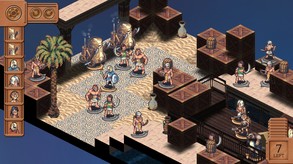
In this puzzle RPG, explore a steam-powered ancient Greece as Artemis' bear warrior on a mythological quest of technology and magic. Push, toss, and bounce friend and foe, and use the environment to your advantage. You choose the battles, allies, and plots you encounter.
Modeled estimate, not a reported figure. How we estimate →
Media

About
Stats
All-time low is the lowest price we've recorded for this game since we started tracking it.
Languages: English
Engagement
Hours played at review time, across 41 reviews with recorded playtime.
Reviews
Themes across 41 recent reviews and how positive each mention is. A keyword signal, not full sentiment analysis.
positive critical· bar length = how often the theme comes up
Reviews
Turn based tactic games are so scarce these days that is nice too see people still making these type of games. The game is a little too simple for me....even so, we should support these guys.
This game has an absolutly wonderful combat system. I adore each and every battle. so wonderful the sprites look awesome. their movments are crips and the animation is A-1 stake sauce. . . the story though. . . . the story and setting are. . . well. . . boring. boring as sin. SSOOOOOOOOO BOOOOOOOORING. BUT for certain. i will be browsing through the makers game cataloge simply to see if they used this combat system in something else (hopfully with a better story) The combination of ancient greece and rome, steam punk, and anime art style, while all potentially wonderful on their own, and maybe even paid together (at times at least) when put together in this rather uncomfortable three way, it is a feast for the senses. mind you, a feast that where everythign is either under or over cooked, and the host is standing there, grinning at you, and you know they put their heart and soul into it. so you grin and hold back the tears as the hard shell of the meatloaf cuts into the roof of your mouth. . . but a feast. the game has a very intresting tree system, where you can kinda make the story go along in its own way, learning a diffrent way to tell the same tale. . . now this WOULD be awesome if it had more characters, or if you went one path you where not able to go back and explore every path, or. . . something. . . something needed to be changed just a TINY bit to make this story progression system really cool. but when i go down one path and get the spartan turned back into a human, i dont want to go down a diffrent path and at the same time I WOULD be turning the spartan back into a human, NOW im just meeting him in the forest. . . sooooo. . . some how. . . even though i NEVER met him before. . . he is no longer a turtle? why? it bugs the hell out of me, that no matter WHAT i do, i will end up meeting the same people no matter WHERE I go. . . on the same days but in diffrent places. the whole thing just bugs the hell out of me. i wish i WISH there was more good to say about the game. since i LOVE the combat so much. and if you are into isometric grid combat system, and dont mind a clunky kinda boring story, then you will like this game. or if you want to see "anime steam punk plato" then this IS the game for you. for me though. . . i would buy it again. . . simply for the combat.
Hellenica, developed and published by The Dragonloft, is an ambitious tactical role-playing game that takes one of history’s most recognizable civilizations and transforms it into something entirely its own. Instead of presenting a faithful recreation of ancient Greece, the game imagines a world where technological advancement arrived centuries early, resulting in a fascinating blend of mythology, philosophy, and industrial innovation. Players assume the role of a chosen warrior guided by Artemis, becoming entangled in a conflict that spans city-states, rival empires, and legendary personalities drawn from Greek history. From its opening moments, Hellenica establishes itself as a title driven by creativity, offering a setting that feels both scholarly and fantastical. The game’s narrative is built around choice and consequence. Throughout the campaign, players encounter influential figures and make decisions that can significantly alter the direction of the story. Alliances are formed and broken, companions come and go, and different paths reveal new perspectives on the world. The alternate-history interpretation of Athens, Sparta, and Thebes is particularly compelling, with each faction reflecting a unique response to technological progress. Athens clings to democratic ideals while adapting to change, Sparta channels its military tradition into enhanced warfare, and Thebes emerges as an engineering powerhouse. This attention to worldbuilding gives Hellenica an identity that few independent RPGs can match. Combat is where the game shines brightest. While it follows the familiar structure of turn-based tactical battles, Hellenica distinguishes itself through its emphasis on environmental interaction. Players are encouraged to manipulate the battlefield by pushing enemies into hazards, throwing allies into advantageous positions, and using surrounding objects to create opportunities. Every encounter feels like a puzzle waiting to be solved rather than a simple contest of statistics. Victory often comes from clever positioning and experimentation rather than relying on overwhelming strength, making battles rewarding for players who enjoy strategic thinking. Character development complements the tactical systems well. Rather than constantly replacing old abilities with stronger alternatives, the game allows skills to remain relevant across the adventure, encouraging players to build flexible strategies. Preparing for battles becomes an important part of the experience, as selecting the right abilities and party members can dramatically affect the outcome of an encounter. This design philosophy promotes experimentation and keeps progression meaningful throughout the campaign. Combined with branching storylines and multiple endings, Hellenica offers considerable replay value for those interested in seeing every possible outcome. Visually, the game embraces a pixel-art style that effectively conveys its unusual setting. The environments, while modest in technical execution, possess a distinctive charm that reinforces the blend of ancient architecture and industrial machinery. Steam-powered inventions stand beside temples dedicated to the gods, creating memorable imagery that remains one of the game's strongest aspects. The soundtrack and atmosphere further support the adventure, helping immerse players in a world where mythology and invention coexist in surprising ways. However, Hellenica is not without flaws. Its independent origins are evident in several areas, particularly in its presentation and interface design. Menus can feel unintuitive, animations are limited, and some aspects of the user experience lack the polish found in larger productions. The game also demands patience, especially during its opening hours, where the combination of tactical mechanics and narrative exposition can feel overwhelming. Certain difficulty spikes and pacing issues occasionally disrupt the flow of the campaign, and some story branches feel less developed than others. Despite these shortcomings, Hellenica remains an impressive achievement for a small development team. It succeeds not because it aims to compete with blockbuster RPGs, but because it offers ideas that few games are willing to explore. Its blend of Greek mythology, alternate history, and tactical gameplay creates an experience that feels genuinely original. Players who appreciate strategy games with unconventional settings and meaningful choices will find much to admire here, even if they must occasionally look past the rough edges. Hellenica is ultimately a celebration of imagination. It takes historical inspiration and reshapes it into a world filled with gods, philosophers, steam engines, and political intrigue, all while delivering satisfying tactical encounters. Though it may not appeal to everyone, particularly those seeking a highly polished or cinematic experience, it stands as a memorable entry in the tactical RPG genre and a testament to the creativity of independent game development. Rating: 6/10
I don't usually play this sort of game, but I do really like Greek history, so I gave it a try. Turns out a blend of simple rpg tactics, greek history, and anime actually works as a combo. It was truly a pleasant surprise. The story is decent, the setting is unique, and the game mechanics are straightforward, which make it well worth it's price tag. The game is a simple, fun, diversion. My only complaint is that there is not - more - available. The game is great for it's price, but I genuinely want to pay more so that there is more game, if that makes sense. The art style and game mechanics are just fine, but what I would love more of is a longer story, more battles, and a more fleshed out conversation system. Basically a larger RPG based in the story's setting. But at the end of the day, the developers did a great job making a unique property that is fun to play.
A very well made Trpg, nice story, interesting characters, comabts fun when u know what u are doing and the art style is way to much my ally to ignor this game, sure the fights get a bit repetetive but still fun i dont look for over complicated stuff.
I had this game in my backlog for a while before playing it, and I would say I enjoyed the overall experience. The setting (Steampunk mythological Greece) is very charming, the characters are simple but likeable, the story can take unexpected turns and even in my 4th run through the "branching storyline" I was finding places I imagined only existed "in lore", and the battle system could often lead to bombastic combos where using positioning properly could make the difference between taking out 5 enemies in a turn or losing turn 2. BUT I have to put some warnings before recommending it, because for some reason the devs decided to reinvent the wheel on many staple Strategy RPG mechanics, and this led to some very unpolished aspects: 1) For starters, the decision to go with a "XP is gained through completing mission objectives" and "characters dont level up" made the game a lot more like a Puzzle game than a normal strategy game. You are sometimes encouraged to just stun enemies for an extra turn so you can finish them off the way the game wants (with a threat hazard or by throwing them somewhere most often) rather than just beat them, for example. 2) Also, regarding the battle system. I believe most of the characters, and especially Brasidas, have a very limited skill pool, and combined with the fact you usually dont permanently recruit any ally outside of the core 4 until a very late in a mission path means you have very limited synergies, so even if you can make some amazing combos combined with terrain and hazards, these combos are often repetitive after you find them. This will make your second and third run through the game a bit tedious, depending on the route you take, and you have to make multiple runs because... 3) The second biggest issue in my opinion is that the story could have easily been a solid 20 hour linear adventure with proper character development and tension building, if it was structured linearly (like Final Fantasy Tactics or Fire Emblem). But instead the devs went for a "branching paths" system that makes it more like 4 hours of plotlines that get raised and either solved in 1-2 battles or dropped to be followed in your next playthroughs. And you HAVE to go through at least 2 playthroughs to get to the true ending (although I'd recommend three). In my opinion, some of these paths should have been combined into a more epic and concise story, and allowed you to recruit an earlier ally that would follow you until later missions. 4) My play time says over 40 hours, but a lot of that was just me trying to get the hard achievements of all missions in my first 3 runs through the main story. The real game time you would get if you just want to recruit all 6 optional party members is probably more like 20 and 30 if you want to do ALL missions. Probably just short of 15 if you want to do 3 optional party members and beat the game. 5) Because of the "different timelines" storytelling, the dialogue in the game suffers a lot and you will have to sometimes listen to long introductions you've already heard and will skip, sometimes be introduced to characters and plotlines that didn't really have any set up because to meet those characters you'd have had to go through a different path, and sometimes even have to see character development that apparently happened offscreen because some characters become best friends despite having met a battle ago. 6) Because of the branching paths situation, and the repeated dialogue problem, the dialogue/cutscene system also takes a hit. Dialogue skips only works for a line rather than a cutscene (necessary because sometimes you want to skip a repeated introduction and not all), and because you have to choose who you talk with the game also uses a lot less of the "cute in-map sprite animated cutscene" that makes rpg infodumps kinda fun, and a lot more of the visual novel format of "select what character you talk to". 7) I would also say that the game really needed more tracks because many are ill fitting. Especially the victory music in some of the darker maps and story points. So, a lot of weak points. And that will kinda explain the mixed reviews. But I will also say this game was an experience I dont regret at all and I bought the game at full price (never saw it going on sale)
Hellenica is a turn based tactical rpg with a focus on puzzle like combat encounters and a narrative that allows for multiple paths, although neither of these are great, the execution, for an Indie dev, is still impressive. The story is a little hard to sum up due to the branching nature, but suffice to say you are the chosen warrior of the goddess of the hunt, Artemis. Your goal is to follow the vision given to you by the goddess, and by doing so, save greece. From there the game becomes a tangled mess of plot threads, and you can follow any one of them at your own pace, as the game allows you to go back to any point you've visited previously in order to see events again, or go down a different path. While some of the individual stories can be interesting, its neigh on impossible to keep track of them all without making a flow chart of events. I'd say that some of the side stories do prove to be somewhat engaging, and after i started committing to single story paths before going back for others, it got easier to follow. It's a decent story about rebellion, tradition VS advancement, greek mythology and steampunk, some of these themes are pulled off well, but again, it was hard to really keep track of it all. Gameplay wise, it's a very easy to follow affair. Each combat encounter puts you into a unique map and gives you one primary objective and two side objectives. Why do the side objectives? EXP. you don't gain levels by grinding, but by doing objectives, which eventually give you skill points to unlock skills to equip to units you have access to. The big downside is that you'll constantly see characters cycling in and out of the roster as time goes on, meaning you may or may not end up wasting points on a character you wont have for the next fight. the actual fighting portion is good, rather simple, but good. Every character has the ability to move, and then use a skill, with each skill being unique to that particular character (with some exceptions). Each one has a base set of skills, and slots for skills you unlock as time goes on, allowing you to customize them a bit. With these, you can set up chain attacks to combo enemies to death, either through raw damage, or enviromental hazards (for example, falling damage is a thing in this game). While this would be really boring if that was just what was on offer, the optional objectives gives you a reason to get creative with the limited move set, and turns what could have been dull into a really fun, tactical affair where you really do have to plan out your moves. Graphically speaking, it feels like this came right out of the PSX era of games, drawing up memories of final fantasy tactics and tactics ogre. It's all low polygon and pixle art, but it does so much with both that it's downright impressive how well they managed to re-capture the feel of those bygone days. However, the music? Dear god, it's awful, it really is awful. You'd think that it might have something suited to the aesthetic of the world, or matched well to the areas and so on, but no, it's really basic stuff that feels more suited to a game about cavemen than it does to greek/steampunk tactical scheming. I'd honestly replace it in a heartbeat if I knew how. As mentioned earlier, the story is an absolute nightmare to follow even at the best of times. The dialog is good, the stories are decent, but it really would have benefited from a more linear structure, or just had an FF tactics style map and allowed you to explore the whole setting as time progresses, as opposed to bouncing back and forth the timeline. The roster of characters you play as also causes issues, as you never have any of them in your group for too long, and you can't bring them back in time with you. I didn't care about any of them beyond the two staple characters who were always with you on the journey. It would have been better to allow you to do side-stories to recruit some of them permanently, and also have mandatory ones for the story join as time goes on. This way, you'd have more choice on how you approached missions, the single skillpoint you got per level would be far more valuable as you'd have to decide between one of seven or so people who got it, and I'd be able to vary things up by not being forced to start with the same two characters every time. This game is good, but it really does need better focus. I really enjoyed the combat for what limited amount of options I had as it made me use each skill to maximum effect, but I still would have liked more options. Overall, it had potential, but it didn't fully realize it, for me at least. I will recommend this despite its flaws, as there is still a good game underneath them, but I'd honestly recommend titles like Regalia: Of Men and Monarchs, Disgaea or the shadowrun games over it. If you're looking for something simple and fun, that doesn't require hours of investment to collect gear and loot to enjoy a tactical experience, this is it.
It's really more of combat puzzle game than an srpg, but still pretty good
I give this game a 5.7/10. Story is okay. Combat can be challenging, though it feels too limiting. Alright, here are my gripes: *The combat is too simple. There is no equipment system. No class/job system. Effectively every story character has a unique set of skills, which you unlock over time. *I disagree with the decision to limit your characters to two skills. I think it would have been better to have them all available as you unlock them. Choosing your layout before each fight was more irritating than rewarding. Let resource (energy/mana/etc.) costs make you decide which one to use instead. *You do not get to choose your mission crew! Every stage has preassigned group members! *The story is purposely repetitive, with you playing a psuedo time loop to recruit your companions for the final fight. This means that you run into several similar story beats as you continue to play the game, which makes the story drag. In the game, you recruit a Persian guy who uses fire magic. I would have loved to play him as a pure mage with ranged attacks, but he has a sword! And he will always have a sword!
.
Related
Related
Trends
Concurrent players on Steam, sampled daily since tracking started.
Audience
Estimated from the language of this game's reviews — a proxy for where players are, not official Steam demographics.
Related
| RedEyes 赤瞳之勋 | $13.4K | 51 | 69% | $9.99 |
| Devil and the Fairy | $13.4K | 51 | 65% | $9.99 |
| SHOWTIME 2073 | $13.4K | 295 | 71% | $1.99 |
| Heroic Kingdom: Origins | $13.3K | 58 | 90% | $9.99 |
| Casino Boss Simulator | $13.3K | 77 | 60% | $4.99 |
| Looking for Aliens | $13.3K | 352 | 95% | $3.19 |