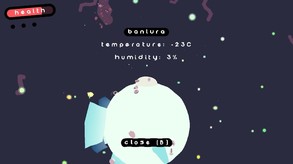
An open-world galaxy adventure game ✨🚀🌠 Explore a procedurally-generated universe filled with diverse micro-planets, asteroid belts and UFOs. 👽
Modeled estimate, not a reported figure. How we estimate →
Media

About

Genres
Stats
All-time low is the lowest price we've recorded for this game since we started tracking it.
Languages: English
Engagement
Reviews
Themes across 40 recent reviews and how positive each mention is. A keyword signal, not full sentiment analysis.
Reviews
짱.
There is a part where a collectable that is required isnt possible too pick up
I fought silly robots to fix my television! And then they were smiley and happy and waved at me. Made me entirely too happy.
Related
Related
Trends
Modeled estimate over time, reconstructed from Steam's monthly review histogram.
Hours played at review time, across 40 reviews with recorded playtime.
positive critical· bar length = how often the theme comes up
好玩
NMS demake
Great game with a good art style, gameplay loop, and concept. Would recommend. 8/10
I recommend helionaut because it's a simplistic yet immersive game. I found it very fun yet challenging in some areas. Overall, I think most people could enjoy this for its friendly controls and pleasant atmosphere. Plus the music and story is great.
This is lo-fi No Man's Sky, and I love it. Sokpop, you done it again!
helionaut, developed and published by Sokpop Collective, is a compact open-world space exploration game that transforms a seemingly trivial objective into a surprisingly expansive cosmic journey. True to Sokpop’s experimental and minimalist design philosophy, helionaut presents players with a light narrative premise—repairing a broken television—then quietly hands them an entire procedurally generated universe to explore in pursuit of that goal. What unfolds is less about the destination and more about the freedom, curiosity, and small-scale discovery that define the experience. From the moment you launch into space, helionaut establishes its central appeal: you can travel to virtually any visible celestial body. Tiny planets, asteroids, and moons dot the galaxy, each one accessible and explorable. These micro-worlds vary in terrain, hazards, and resource availability, encouraging players to land, investigate, mine, and experiment. The scale is deliberately intimate; planets are small enough to circumnavigate quickly, but numerous enough to create a sense of vastness. This design choice balances approachability with exploration, ensuring that players never feel overwhelmed while still maintaining the illusion of boundless space. Resource gathering and crafting form the backbone of progression. Materials collected from planetary surfaces can be used to upgrade your ship, unlock new tools, and enhance your survivability. The crafting system is straightforward yet satisfying, offering a gradual sense of empowerment as new blueprints and upgrades become available. Improvements to your spacecraft expand exploration possibilities, allowing you to venture further into the galaxy and access previously unreachable areas. This steady loop of exploration, collection, and enhancement gives structure to what might otherwise be aimless wandering. Combat and survival elements add light tension without dominating the experience. Hostile robotic entities and environmental dangers occasionally interrupt peaceful exploration, requiring players to remain alert and prepared. However, the game does not emphasize difficulty or punishing mechanics. Instead, it maintains a relaxed pacing where danger exists as a complementary factor rather than a central focus. This balance makes helionaut feel accessible and inviting, even for players unfamiliar with survival-heavy space simulations. Visually, helionaut adopts a minimalist 3D aesthetic that favors bold colors and simple geometric shapes. Planets glow against star-speckled backdrops, and the overall art style conveys a playful sci-fi charm rather than realistic astrophysics. The design supports clarity and exploration, ensuring that players can easily identify resources and navigate terrain. Combined with ambient soundscapes and a small in-game radio featuring multiple tracks, the atmosphere becomes quietly immersive. The music underscores the sense of solitude and wonder that accompanies interplanetary travel. One of the game’s defining strengths lies in its procedural generation. Each new run produces a different arrangement of planets and environments, encouraging replayability. Multiple playable characters further vary starting conditions, subtly altering early progression paths. Although the core objective remains consistent, the route taken to achieve it can differ significantly between sessions. This variability reinforces the spirit of discovery that helionaut aims to capture. At the same time, the game’s concise scope is both its charm and its limitation. A typical playthrough may last only a few hours, and once major upgrades are acquired, the incentive to continue exploring diminishes. There is no sprawling narrative arc or extensive endgame content. Instead, helionaut thrives as a short, self-contained experience that prioritizes atmosphere and freedom over longevity. Players seeking complex economic systems, deep storylines, or intricate ship customization may find its systems intentionally modest. Ultimately, helionaut succeeds by embracing simplicity. It offers an accessible sandbox of procedural planets, gentle survival mechanics, and steady crafting progression wrapped in a whimsical sci-fi package. Its compact design encourages curiosity without overwhelming the player, making it ideal for those who enjoy relaxed exploration and indie experimentation. While it may not deliver the scale or complexity of larger space simulators, helionaut captures the joy of venturing into the unknown, discovering small worlds, and carving out a personal journey among the stars. Rating: 8/10
É massa 👍
Momentum
Pace estimated from the game's recent review growth (our daily snapshots) at its own sales-per-review ratio — a momentum signal, not booked sales.
Audience
Estimated from the language of this game's reviews — a proxy for where players are, not official Steam demographics.
Related
| Kitty's Last Adventure | $18.5K | 173 | 98% | $4.99 |
| OCTOPTICOM | $18.5K | 55 | 95% | $9.99 |
| True Love '95 | $18.5K | 60 | 88% | $9.99 |
| Mondly: Learn Languages in VR | $18.5K | 61 | 52% | $9.99 |
| Pinewood Island | $18.5K | 55 | 84% | $9.99 |
| Evening Starter | $18.5K | 165 | 81% | $5.99 |
Related
| 7 Days to Die | $425.3M | 403.6K | 87% | $44.99 |
| Mount & Blade II: Bannerlord | $309.8M | 294K | 88% | $49.99 |
| The Forest | $254.8M | 678.6K | 96% | $19.99 |
| No Man's Sky | $230.9M | 412.2K | 85% | $23.99 |
| Sons Of The Forest | $201.1M | 315K | 88% | $29.99 |
| Don't Starve Together | $164.7M | 539.5K | 95% | $14.99 |