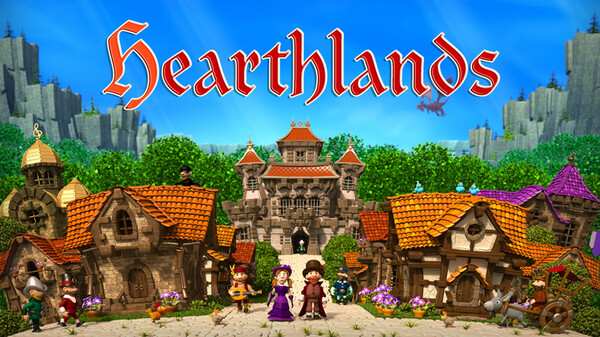
Hearthlands is a medieval/fantasy city-building real time strategy game in which you take a role of a king in a procedurally generated world. You can not control your subjects directly; instead you focus on city-building, resource management, diplomacy, magic, etc.
Modeled estimate, not a reported figure. How we estimate →
Media
About
Hearthlands is a medieval/fantasy city-building real time strategy game in which you take a role of a king in a procedurally generated world. You can not control your subjects directly; instead you focus on city-building, resource management, diplomacy, magic and other things a typical king deals with on a daily basis.
The game is very flexible: you can build a powerful realm and rule the lands with an iron grip, or establish a humble fishermen village. Or create a trading empire. Or found a small, but well-defended outpost or a raider's camp. Or become a host of a wizard's manor.
All characters, from a humble hauler to a powerful wizard have their own minds and behavior patterns. Sometimes it is interesting just to watch people scurry about minding their own business.
Build a medieval city;
Play the game the way you like it: experiment with sandbox settings or play a campaign mode (ex. Polish localization);
Keep your people happy by providing them with necessary resources and services;
Gather resources, produce goods and build industries;
See reports and tune up your economy;
Build an army and protect your city from monsters and invasions;
Trade and conduct diplomacy with neighbouring realms, or go to war with them;
Research technologies and cast spells;
Challenge yourself by going after one of the many achievements.
Genres
Stats
All-time low is the lowest price we've recorded for this game since we started tracking it.
Languages: English, German, Spanish - Spain, French, Polish, Russian, Italian
Engagement
Hours played at review time, across 40 reviews with recorded playtime.
Reviews
A Caesarlike citybuilder in a fantasy setting, but I found the building's logistics to be too big a pain in the ass to keep playing. There would be a stockpile with coal next to a smelter, and they would walk to the other side of the map to fetch coal . It's disappointing because I was enjoying it, but once you get to the campaign levels where your city gets much larger the logistical issues become too much of a headache.
This is a great game. I have been playing this on and off for about 2 years, and while it took me a good few hours to properly understand some of the mechanics, and tens of hours to properly solve every puzzle it throws in your way, it is a lot of fun to do so. To me this game seems to be mainly about the logistics of running a city; All of your stocks are represented by physical items, spread out over different buildings and storage yards. These storage yards can be configured very precisely, with the option to set a limit for each individual item, and the options to either not collect the item, only collect it from production buildings, or collect it from other storage yards. Using this simple system, and the fact that all citizens only walk over the roads you have built allows for a relatively simple start, but gives the option to design more complicated flows for your items. Due to the houses having slowly increasingly complicated needs, you can take your time to learn the game, and decide to not provide any item for the time being until you are ready to take your city to the next step. This allows you to take on all of the logistics puzzles that are thrown in your way at your own pace, or even skip steps by building less efficient systems. Besides this, every game has a world map with neighbouring nations, which all (depending on their relationship score) might want to trade with you, or go to war with you. This adds another layer of depth to your gameplay, as you can now strategize your growth based on changing supply and demand (although ongoing trade relationships don't get reduced unless a war is started), and use your trades to turn excess production into money. The only downside I have found to this game is that there is no multi-configuration mode, every single building has to be done by hand. Once you start heading into cities with hundreds of houses, this might become a bit dull, but I have found it to be not too terrible to deal with. Everything together, with the intricate production mechanisms, the tricks you can use to control your supply lines, the trading mechanics and the simple but fun warfare mechanics, Hearthlands throws a lot of interesting puzzles in your way, which can take you tens or even hundreds of hours to find the most efficient solutions to. On top of this, it has a wide range of realistic but challenging achievements, which all keep the game interesting after you have finished the campaign.
Generic indie city builder with some basic generic fighting. I know it is almost 10 years old, but it is utterly skipable now.
Hearthlands, developed and published by Four White Cats, is a city-building and management game that leans heavily on classic design sensibilities while introducing a more relaxed, simulation-driven approach to governing a medieval-fantasy settlement. It doesn’t chase the complexity or spectacle of modern strategy titles; instead, it focuses on creating a living system where your role is less about issuing constant commands and more about shaping the conditions in which your town can grow. This shift in perspective gives the game a distinct rhythm, one that prioritizes observation and planning over micromanagement. At its foundation, Hearthlands is about building a functioning settlement from the ground up. You establish resource chains, construct homes and production buildings, and ensure that your population has access to food, work, and basic services. What sets it apart is the way these systems operate. Citizens are not directly controlled; they make their own decisions based on available resources and their assigned roles. This creates a sense of autonomy within the simulation, where the town evolves in response to the structures you put in place rather than through constant player intervention. It can be rewarding to see systems align and operate smoothly, though it also introduces moments of unpredictability when things don’t behave as expected. Managing the balance between growth and stability forms the core gameplay loop. Expanding too quickly can strain resources, while growing too slowly can leave your settlement vulnerable or stagnant. Production chains must be carefully maintained, and the flow of goods needs to remain consistent to support both the population and further development. At the same time, external pressures such as hostile creatures or rival factions require attention, adding a layer of tension that prevents the experience from becoming entirely passive. Diplomacy and trade offer alternative ways to interact with the world, giving players additional tools to support their settlement’s survival. The game’s sandbox nature is one of its defining strengths. There is no rigid path to follow, allowing players to shape their settlement according to their own priorities. Whether focusing on economic growth, defensive strength, or a balanced approach, the game supports a variety of playstyles. This flexibility encourages experimentation and gives each playthrough a slightly different feel, especially when combined with procedurally generated maps. However, because the game lacks a strong narrative or structured progression, much of the motivation comes from the player’s own goals, which may not appeal to everyone. Visually, Hearthlands adopts a straightforward isometric style that emphasizes clarity over detail. Buildings, units, and resources are easy to identify, which helps when managing multiple systems at once, but the overall presentation is relatively simple. There is a certain charm in watching the town gradually take shape, though the visuals do not evolve significantly as the game progresses. The audio design follows a similar pattern, providing a subtle backdrop that supports the experience without drawing attention to itself. Where the game begins to show its limitations is in the depth of its systems. While the mechanics are interconnected, they are not particularly complex, and once the player understands how to maintain a stable settlement, the challenge begins to diminish. Over time, the gameplay loop can feel repetitive, with fewer new elements introduced to keep things fresh. The indirect control system, while interesting, can also lead to frustration, particularly when citizens make inefficient decisions that disrupt carefully planned systems. Despite these shortcomings, Hearthlands succeeds in offering a calm and approachable management experience. Its slower pace and emphasis on system design make it well-suited for players who enjoy watching a settlement grow organically rather than constantly directing every action. It captures the feel of older city-building games while simplifying some of their more demanding aspects, resulting in a game that is easy to engage with even if it lacks long-term depth. In the end, Hearthlands is a solid and quietly enjoyable entry in the city-building genre. It doesn’t aim to be expansive or highly detailed, but it delivers a focused experience that highlights the satisfaction of creating and maintaining a functioning system. For players who appreciate a more relaxed, sandbox-oriented approach to management games, it offers a worthwhile experience, even if it doesn’t stand out as a deeply complex or highly polished title. Rating: 7/10
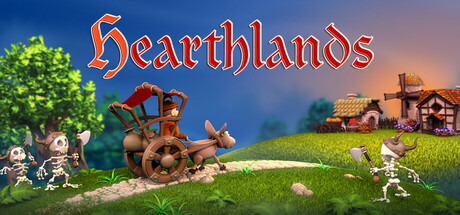
Fun city building game. The campaign is a bit boring tho, I end up leaving it in 3x speed and leaving the computer for 1h so that the sim grinds enough resources for the map to complete
Great game and the graphics are brilliant. Well done on a great game Devs
I'll start by saying I have always loved playing 'Pharaoh' and still play it to this day. So when playing Hearthlands I'm looking at it with Pharaoh in the back of my mind. And I like the game. It certainly has it's own merits. To be specific, I like that the buildings don't decay or catch fire. That's a load off my mind. I like the different types of food and items the villagers need to evolve. When I play these types of games I just like to build up the city - I've never liked the combat because I'm never prepared enough for it. Nothing has changed. I'm not prepared for the spiders or wolves - I just like that it forces me to think ahead and get ready for combat. Something I would like to see in the game relates to the menu. I would like a load button in the menu screen when playing the game. At the moment if I want to go back to a saved slot, I need to go back to the title screen and load a saved game which seems like a weird thing to leave out. Overall, I've currently played for over 86 hours so I like the game a lot (^_^)
Got it 2 years ago in a bundle and gave up after 20 minutes but after revisiting it now I regret the time I spent away from it. Brilliant little game for anyone interested in city building and trading/defending from attacks. Definitely one of those games I can see myself pouring dozens of hours into and I can't wait to do just that. 10/10 would recommend!
WYSIWYG. No updates in over a year.
Kept me up till 2AM playing. So if you don't want this to happen don't get it. Totally fun medieval city management game. But there is some kind of BUG with the SAWMILLS. The way around this is to have Woodcutters on a dedicated road NOT connected to your city with a warehouse at the end that will store your wood. From that warehouse make another dedicated road with Sawmills to connected to another warehouse to store your planks. From there make a road connecting to your city with the furniture makers close by to take the planks and make furniture. This usually solves that so that your economy doesn't crash out.
Related
Related
Trends
Concurrent players on Steam, sampled daily since tracking started.
Momentum
Pace estimated from the game's recent review growth (our daily snapshots) at its own sales-per-review ratio — a momentum signal, not booked sales.
Audience
Estimated from the language of this game's reviews — a proxy for where players are, not official Steam demographics.
Related
| Dungeons and Dragons: Daggerdale | $209.2K | 497 | 31% | $14.99 |
| Drakensang | $209.1K | 793 | 81% | $9.99 |
| Aporia: Beyond The Valley | $209.1K | 777 | 82% | $16.99 |
| Mob Factory | $209.1K | 477 | 73% | $14.99 |
| STRIDE: Fates | $209.4K | 303 | 40% | $29.99 |
| TRAIN CREW | $209K | 466 | 99% | $16.99 |