Gray Dawn is a somber, atmospheric horror experience that places narrative weight and symbolism above conventional scares. Developed and published by Interactive Stone, the game casts players as Father Abraham, a troubled priest in 1920s England whose life unravels after the mysterious disappearance of a young altar boy on Christmas Eve. Rather than focusing on monsters or combat-driven tension, Gray Dawn leans into psychological unease, moral ambiguity, and religious imagery, inviting players to navigate a story shaped as much by guilt and memory as by supernatural forces.
From the outset, the game establishes a heavy, introspective tone. Exploration unfolds in a first-person perspective, encouraging slow, deliberate movement through environments that range from grounded locations—such as churches, village streets, and modest interiors—to surreal dreamscapes that feel untethered from reality. These transitions are seamless and often disorienting by design, blurring the line between the external world and Father Abraham’s fractured inner state. The lack of traditional combat reinforces vulnerability, making every step feel exposed and heightening tension through anticipation rather than direct threat.
Narrative delivery is the centerpiece of the experience. The story is revealed gradually through environmental details, audio recordings, symbolic imagery, and fragmented memories that surface as you progress. Father Abraham is portrayed as a deeply flawed protagonist, burdened by past decisions and wavering faith, and the game never offers easy answers about his innocence or guilt. Instead, it presents events and visions that challenge the player to interpret what is real, what is supernatural, and what may be the result of psychological collapse. This ambiguity is one of the game’s defining strengths, encouraging reflection long after individual scenes conclude.
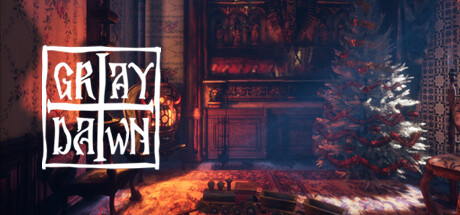
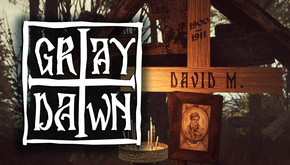
Visually, Gray Dawn makes strong use of contrast. Realistic environments are rendered with muted palettes and heavy shadows, while nightmare sequences burst into stark, often unsettling imagery filled with religious symbolism and distorted forms. Churches loom with oppressive grandeur, graveyards feel suffocating rather than serene, and dreamlike realms twist familiar iconography into something threatening. While character animations and some assets reveal the limitations of a small studio, the environmental art direction is consistently evocative and carries much of the game’s emotional weight.
Sound design plays a crucial role in sustaining immersion. Subtle ambient noises—creaking wood, distant wind, echoing footsteps—fill long stretches of exploration, creating an atmosphere of isolation and quiet dread. Music is used sparingly, often swelling during key moments to underline emotional or narrative shifts rather than to telegraph danger. Voice acting varies in quality but generally supports the somber tone, particularly in Father Abraham’s internal monologues, which add depth to his psychological struggle and frame the unfolding events.
Puzzle design in Gray Dawn is intentionally restrained. Most challenges involve observation, item interaction, or simple logic tied directly to the environment. These puzzles rarely stall progression for long, serving more as pacing tools than intellectual roadblocks. This approach keeps focus on story and atmosphere, though players seeking complex or mechanically demanding puzzles may find them underwhelming. The simplicity ensures that narrative momentum remains intact, allowing themes and symbolism to take precedence.
Replay value is modest but present. The game features multiple endings influenced by whether players discover hidden religious artifacts scattered throughout the journey. These collectibles deepen the lore and provide additional context for the story’s conclusion, rewarding thorough exploration and attentiveness. While this structure encourages at least a second playthrough, the experience remains primarily narrative-driven rather than systemically varied.
Overall, Gray Dawn stands as a distinctive entry in the psychological horror genre, one that prioritizes mood, symbolism, and introspection over spectacle or constant threat. Its strength lies in its willingness to explore uncomfortable themes—faith, guilt, and moral uncertainty—through a slow-burning, atmospheric lens. Though it shows rough edges in mechanics and polish, it delivers a memorable and unsettling journey for players drawn to story-focused horror that invites interpretation rather than providing clear answers.
Rating: 8/10