Grapple is a fast-paced physics platformer that transforms movement into the centerpiece of the entire experience. Instead of relying on traditional jumping mechanics or combat systems, the game focuses almost entirely on momentum, swinging, climbing, and creative traversal through increasingly difficult environments. Players control a strange elastic creature capable of attaching itself to surfaces, launching through the air, and navigating obstacle-filled stages using a grappling mechanic that feels both chaotic and surprisingly rewarding once mastered. What begins as a simple indie platformer quickly develops into a highly skill-based challenge centered around precision, timing, and momentum control.
The game’s greatest strength is unquestionably its movement system. Every action revolves around momentum and physics, which gives traversal a dynamic and unpredictable feel compared to more rigid platformers. Players can grapple onto walls and ceilings, fling themselves across gaps, bounce off surfaces, and chain movements together to maintain speed through entire levels. At first, the controls may feel awkward because movement behaves differently from conventional platforming games, but once players adapt to the physics, traversal becomes incredibly satisfying. The feeling of successfully swinging through a complicated section without losing momentum creates a genuine sense of mastery.
Unlike many platformers that rely heavily on unlocking abilities over time, Grapple builds depth by encouraging players to improve their understanding of the mechanics already available from the beginning. The challenge comes from learning how to control momentum efficiently rather than gaining stronger powers. This design philosophy gives the game a focused identity where player skill matters far more than progression systems or upgrades. Every improvement feels earned because success depends entirely on mastering movement.
Level design is another area where the game performs extremely well. The stages are carefully structured around traversal challenges that gradually increase in complexity as players become more comfortable with the mechanics. Each environment introduces new obstacles, movement patterns, and platform arrangements that require creative problem-solving and quick reactions. While the objective is usually straightforward — simply reach the exit — the path toward that goal often involves experimenting with different movement techniques and finding efficient routes through dangerous terrain.
One of the most enjoyable aspects of Grapple is how naturally it encourages replayability. Because movement becomes faster and smoother as players improve, revisiting earlier stages to achieve cleaner runs and faster times feels incredibly rewarding. The game clearly embraces speedrunning culture, and much of its long-term appeal comes from optimizing movement and discovering shortcuts or advanced traversal techniques. Once the controls begin to feel intuitive, replaying levels becomes addictive because there is always room for improvement.
The game also benefits from a flexible difficulty structure. New players can approach levels carefully and experiment with movement mechanics at their own pace, while experienced players can push the physics system aggressively in pursuit of perfect runs. Unlimited retries and forgiving checkpoints reduce frustration significantly, which is important because the physics-based movement naturally leads to occasional mistakes and failed jumps. The game encourages experimentation rather than punishing failure harshly.
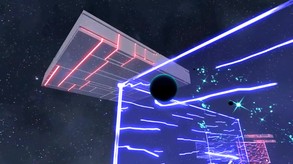
Visually, Grapple adopts a minimalist style focused entirely on readability and movement clarity. Levels are built using simple geometric structures and brightly colored surfaces that clearly indicate how different materials behave. Some surfaces can be climbed, others cause bouncing, and certain hazards punish reckless movement. The visual simplicity helps players process environmental information quickly, especially during faster sections where precise movement becomes critical. While the graphics are not technically impressive, the clean presentation supports the gameplay extremely well.
The soundtrack and audio design complement the experience nicely without becoming overly distracting. Sound effects provide clear feedback for grappling, collisions, and movement, helping players understand momentum and timing more naturally. The music maintains an energetic tone that matches the fast-paced traversal while still allowing concentration during more difficult sections. The audio presentation may not leave a lasting impression on its own, but it supports the rhythm of gameplay effectively.
Another admirable quality of Grapple is how much variety it creates using a relatively small set of mechanics. The game rarely introduces unnecessary complexity or gimmicks, instead focusing on exploring every possibility within its core movement system. This gives the experience a very cohesive identity because every level feels connected to the same central idea of mastering physics-based traversal.
However, the game is not without flaws. The steep learning curve may frustrate some players during the early stages. Physics-driven movement can occasionally feel imprecise or unpredictable, especially for players accustomed to more traditional platformers with tighter and more consistent controls. Certain sections require careful momentum management that may initially feel awkward or unintuitive until players fully understand the mechanics.
The minimalist presentation can also make environments feel visually repetitive over longer sessions. While the gameplay itself remains engaging, the game lacks the environmental variety and visual spectacle found in larger platforming titles. Players looking for strong narrative elements or cinematic progression may find the experience mechanically satisfying but emotionally limited.
The heavy emphasis on replayability and speedrunning may also divide players. Much of the game’s long-term appeal comes from replaying stages to improve times and refine movement efficiency. Players who prefer story-driven progression or constantly evolving mechanics may eventually find the gameplay loop repetitive once the core systems are mastered.
Despite these shortcomings, Grapple succeeds remarkably well at delivering a unique and highly satisfying movement-focused platforming experience. The physics-based traversal creates a strong sense of freedom and momentum that makes simply moving through the world enjoyable on its own. Its combination of puzzle-solving, precision platforming, and speed-based gameplay gives it a distinct personality that still feels refreshing within the indie platformer genre.
For players who enjoy skill-based platformers, speedrunning challenges, and games built around mastering movement systems, Grapple offers a rewarding and addictive experience filled with creative traversal and satisfying physics mechanics. While its steep learning curve and minimalist presentation may not appeal to everyone, the sheer enjoyment of mastering its movement system makes it a memorable and worthwhile platforming adventure.
Rating: 8/10