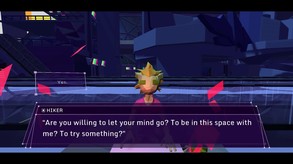
Glitchhikers is a surreal journey through the spaces between places. A late night drive, a deserted airport lounge, a moonlit walk through an empty park, a quiet carriage on an overnight train. Who will you meet? What will you talk about? Where will the journey take you? Find yourself along the way.
Modeled estimate, not a reported figure. How we estimate →
Media

About

Glitchhikers: The Spaces Between is an introspective freeform game where the player chooses from four late night journeys, slips into a liminal space, and has a unique experience travelling into their own thoughts, guided by the characters they meet along the way.

The hikers you meet on each journey will travel with you for a time, offering thought-provoking conversations, and questioning your place in the universe. Who will you meet? What will you talk about? Were they real or just a figment of your imagination?

Bask in a freeform experience that holds space for you and your thoughts – you decide on the direction, the conversations you have are always open ended, and play sessions can be as short as 30 minutes or as long as you like, with many options for replayability. Talk to passengers on a train, walk through a park with your music player, sit with your thoughts on the endless open road, or even fly through a lonely airport terminal.

Discover an extensive original soundtrack full of chill grooves, upbeat wonder, dreamy synths controlled by your movement through space, and that one busker who makes you feel right at home: each journey has its own feel.

Expanding upon the original conceptual short game released in 2014, Glitchhikers: The Spaces Between offers returning players and newcomers even more to experience. This is a game that is here for you now, and in the future, whenever you need to find some spaces between the everyday flow of life.

Silverstring Media are a vital and vibrant voice within narrative indie games, creating a string of short experimental titles and working as narrative guns for hire on indie darlings including Celeste, Crypt of the Necrodancer, Where the Water Tastes Like Wine, Manifold Garden and Wandersong.

Genres
Stats
All-time low is the lowest price we've recorded for this game since we started tracking it.
Engagement
Hours played at review time, across 41 reviews with recorded playtime.
Reviews
Themes across 41 recent reviews and how positive each mention is. A keyword signal, not full sentiment analysis.
positive critical· bar length = how often the theme comes up
Reviews
I can see myself returning to this game time and again for an hour at a time. If you're looking for a game that gives you purpose and meaning, then this isn't the game for you. And that's the point. The game doesn't answer any questions or solve any mysteries. It puts you into liminal spaces that invites you to explore and create your own meaning - is the point exploration? Getting a deeper understanding of the universe? Take the game as is - one that only asks you to think about your own answers to its questions. I saw someone call this game "pretentious, slightly annoying and not nearly as profound as it thinks it is" and like "being slightly drunk at a college dorm party." I think this might have missed the point - the game is offering no answers or even presenting itself as a deep exploration of these topics, but rather offer you the opportunity to reflect and engage with existential questions that we all have asked ourselves, sometimes at 3 am while driving in a car on a long stretch of highway, and yes, questions that have been brought up while being slightly drunk at a college dorm party. You get opinions from NPC and talks about entropy, light, etc in ways that might feel sort of half baked, but the game never asks you to agree with these positions. You can turn off the podcasts. You can sort through a range of responses to the NPC's presented views. You can just walk/drive in silence and explore the liminal spaces. This game is an art piece. If you're looking for a game with winning and goals, then don't buy this game. If you're looking to be told how to think - this isn't the game for you. If you're looking for a game that you're going to sink 600 hours to, pick up something else. But if you want a break from the daily pressures of life, or are awake at 3am and pondering your existence, pick it up and give it a go. I think the $13 is worth the buy, but if you disagree, pick it up on a sale and go in with an open mind. Or don't. Make your own decisions.
对于不需要的人来说,它是如鸡肋般食之无味,但总有人需要它的帮助
Beautiful and therapeutic, always love driving on the road. Music is wonderful....reminds me of the feeling I used to have when having the time to wander around and feel the world when everything seemed so peaceful. But all the passengers are somehow lack of charm, the topics aren't deep or appealing enough.......
助眠利器。音乐好听。 和旅客们鸡同鸭讲。但就是舒服了。 便利店店员真的没有剧情吗真的吗;; 虽说有点心灵抚慰的感觉但是和旅客聊天就是各讲各的。 一边粗暴的rua玩家一边轻声细语的感觉。 没事就会来开车/公园散步/坐火车/飞机场索尼克冒险。
i feel seen (in a good way)
this experience was one that filled me with such purpose, emotion, and meaning. I am so glad I found this amazing piece of artwork.
Glitchhikers: The Spaces Between, developed by Silverstring Media Inc. and published by Fellow Traveller, is a narrative experience that exists in a category few games attempt to occupy—one where the destination is irrelevant, and the emotional resonance of the journey becomes the entire point. It is built around the strange magic of transitional spaces: the late-night highway stretching endlessly into darkness, the fluorescent emptiness of an airport after the final boarding call, the quiet clatter of a train cutting across sleeping suburbs. These are moments when reality loosens its grip just enough for introspection to slip in, and the game leans fully into that sensation. Instead of pushing players toward goals, conflicts, or exposition, it invites them to inhabit the liminality—to breathe, to drift, to wonder. It is a work that acknowledges the beauty, melancholy, and philosophical possibility found in times when nothing “important” seems to be happening. Rather than presenting a conventional narrative arc, the game unfolds through fleeting encounters with enigmatic companions who appear in these in-between spaces. They are not exposition machines or quest givers but conversational partners—people who, like the player, are suspended in motion and temporarily removed from the demands of everyday life. Their musings are contemplative and often existential, touching on creativity, fear, isolation, purpose, mortality, and the difficulty of navigating a chaotic world. The writing avoids heavy-handedness, allowing dialogue to feel more like genuine reflection than scripted wisdom. Conversation choices shape tone rather than outcome, reinforcing the idea that these exchanges are not about persuasion or consequence, but about participating in a shared moment of vulnerability. Characters fade away without resolution, and the game trusts players to fill the emotional gaps with their own interpretations. Gameplay itself is intentionally sparse and unobtrusive. Movement and interaction serve as gentle framing devices rather than objectives, encouraging players to internalize atmosphere rather than “progress.” Each journey—whether by road, rail, or terminal—has a rhythm, gradually revealing new conversational partners and small surreal disruptions that remind the player that these worlds exist slightly askew from reality. Time feels softened, stretched, and occasionally non-linear, creating the sense that the physical space is secondary to the mental one. The refusal to assign urgency, failure states, or skill demands is a radical design choice in a medium often defined by efficiency. Glitchhikers suggests that sometimes the most meaningful moments arise when we stop trying to go anywhere in particular. The game’s sensory presentation plays a crucial role in shaping its emotional language. Visually, it blends minimalism with surreal color palettes—neon purples, hazy blues, pulsing pinks—that feel like memories rather than places. Landscapes distort, horizons glitch, and textures ripple as if the world is thinking through itself along with the player. The surrealism never overwhelms; it gently nudges, implying that reality is flexible, especially at 3:00 a.m. The soundtrack, meanwhile, offers an ambient, dreamlike mixture of synth tones, slow percussion, and drifting melodies that hold space rather than direct it. Soundscapes—engine hum, airport chatter, distant announcements—create a familiar framework, grounding the surreal in something deeply human. Together, the visuals and audio create a hypnotic sense of suspended consciousness, like floating just outside one’s own thoughts. Given its unconventional nature, the experience will not resonate universally. Players seeking clear objectives, branching plotlines, character backstories, or mechanical challenges may find the pacing too slow or the structure too diffuse. The game’s refusal to offer closure—emotionally, narratively, or thematically—may frustrate those accustomed to narrative payoff. Its conversations sometimes wander intentionally, embracing ambiguity instead of clarification. Yet these qualities are integral to its artistic identity. Glitchhikers is not designed to be consumed like a traditional game; it is meant to be inhabited, considered, and felt. Its value depends largely on a player’s willingness to sit with uncertainty and allow introspection to unfold naturally. What elevates Glitchhikers: The Spaces Between beyond a simple interactive art piece is its empathy. The game understands that modern life often leaves little room for quiet contemplation, that many meaningful thoughts arise not during major events but during commutes, delays, and late-night drives when the world feels paused. It validates the fleeting, the transient, and the unresolved, treating them not as narrative failures but as essential human experiences. In doing so, it becomes a gentle companion—a reminder that confusion, questioning, longing, and wonder are not personal flaws, but universal states of being. For players who seek games that challenge medium expectations, encourage introspection, and treat storytelling as emotional collaboration rather than delivery, Glitchhikers: The Spaces Between offers a rare and affecting journey. It asks only that you listen—to strangers, to the world, and to yourself. It lingers long after the screen fades, not because it answers life’s questions, but because it gives you space to ask them. Rating: 7/10
这个,与传统的游戏应有的样子完全是不一样的。没有什么需要去做的任务,没有什么需要去对抗的。我觉得这个是很难得的,至少从电子游戏诞生以来,应该是极少有这样的形式。毕竟,总得有什么“意义”,或者应该做些什么。不过我个人不喜欢的是在游戏过程中需要还是得对话,或者说是进行必须的互动。萝卜青菜,各有所爱吧。
ну тут надо что-нибудь покурить, чтобы потом залипать в этих абстрактных путешествиях, встречая там неведомых зверюшек и слушая их философские размышления о житие бытие под отличный саундтрек...
Нудная дичь, если честно. По трейлеру и описанию я там в себе буду копаться, а по факту я больше философии и интересного из разговоров с таксистами имею. Не часто я дропаю игры, но это именно такой случай: растянутая (в плохом смысле) нудятина, не рекомендую.
Related
Related
Trends
Modeled estimate over time, reconstructed from Steam's monthly review histogram.
Momentum
Pace estimated from the game's recent review growth (our daily snapshots) at its own sales-per-review ratio — a momentum signal, not booked sales.
Audience
Estimated from the language of this game's reviews — a proxy for where players are, not official Steam demographics.
Languages: English, Simplified Chinese
Related
| Dodge It! Online | $9.9K | 71 | 63% | $4.99 |
| Casino Simulator 2024 | $9.9K | 129 | 72% | $2.39 |
| Mace and Grace: action fight blood fitness arcade | $9.9K | 53 | 87% | $9.99 |
| Pangeon | $9.9K | 53 | 58% | $9.99 |
| Paper io 2 | $9.9K | 102 | 84% | $4.99 |
| Call of Tomsk-7 | $9.9K | 440 | 81% | $0.99 |