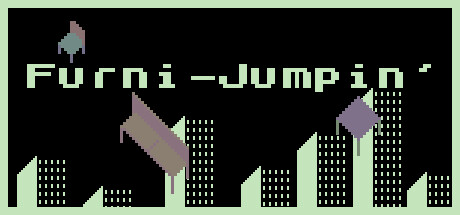
Watch out for those furniture! Furni-Jumpin' is a 2D platformer arcade game where you take control of a weird little creature dodging enemies and collecting items while jumping on furniture.
Modeled estimate, not a reported figure. How we estimate →
Media

About
Stats
All-time low is the lowest price we've recorded for this game since we started tracking it.
Languages: English, French, Italian, German, Spanish - Spain, Arabic, Bulgarian, Czech, Danish, Dutch, Finnish, Greek +17 more
Reviews
Мяу прыг прыг мяу мяу прыг 10/10 ищу девушку 18 - 22 лет желательно без члена пишите познакомимся .
All about a cat going through hard times.. You may feel frustrated playing, but that's also how this kitty feels.
a lovely little game that reminds me of a simpler time
Es un juego muy entretenido y vicioso, sobre todo cuando haces una y otra partida y empiezas a intentar conseguir la puntuación del jugador numero 1.
Furni-Jumpin’ is a small arcade-style platformer developed and published by LGV that focuses on quick, reflex-based gameplay rather than narrative progression or complex mechanics. Designed with a minimalist philosophy, the game delivers a fast-paced score-chasing experience where players control a small creature navigating a chaotic environment built entirely from furniture. Rather than offering a traditional series of levels or a story-driven adventure, the game centers on survival and skill improvement as players attempt to jump between objects, avoid enemies, and collect items for as long as possible. The premise itself is intentionally simple and somewhat whimsical. Players guide a tiny character through a surreal environment where everyday household items such as couches, tables, and chairs form the platforms used for movement. These objects appear in shifting arrangements that create constantly changing paths across the screen. The goal is not to reach a final destination but to stay alive while the environment becomes increasingly difficult to navigate. As the player continues jumping from one piece of furniture to another, the pace gradually accelerates, forcing quicker decisions and more precise movement. The gameplay revolves around a straightforward set of mechanics that are easy to learn but increasingly difficult to master. The character can perform basic jumps as well as a double jump, which becomes essential when navigating wider gaps between platforms or reacting to sudden hazards. The controls are intentionally simple, allowing players to focus on timing and spatial awareness rather than memorizing complicated inputs. This accessibility makes it easy to start playing immediately, though maintaining long runs requires practice and quick reflexes. Unlike many platformers that rely on fixed level layouts, Furni-Jumpin’ uses a procedurally generated environment. The arrangement of platforms, enemies, and collectibles changes dynamically during each session, ensuring that no two runs are exactly the same. This design prevents players from memorizing specific patterns and instead encourages them to adapt to new situations in real time. The constantly shifting layout keeps the experience unpredictable, reinforcing the game’s focus on reaction-based gameplay. Enemies appear throughout the environment and serve as moving hazards that complicate the player’s path. These creatures travel along different trajectories and speeds, forcing players to carefully consider their next move before jumping. Some enemies drift slowly across the screen while others move more aggressively, creating moments where players must react quickly to avoid collisions. Because the game’s pace increases over time, these encounters gradually become more intense as the player attempts to maintain control in increasingly chaotic situations. Power-ups scattered across the platforms introduce additional strategic elements to the gameplay. Certain items temporarily reduce gravity, allowing the character to jump higher or glide longer between platforms. Others grant extra lives or protective effects that provide a second chance after making a mistake. Collecting these power-ups often requires risky jumps or quick decisions, adding an extra layer of tension to the otherwise straightforward mechanics. Knowing when to pursue a power-up and when to prioritize safety becomes an important part of surviving longer runs. The scoring system reinforces the game’s arcade-like structure. Points accumulate through a combination of survival time, successful jumps, and interactions with enemies or collectibles. The longer players remain alive, the faster the pace becomes and the more difficult it is to maintain control. Because the game records high scores, players are naturally encouraged to continue playing in order to surpass their previous records. This loop of repeated attempts and incremental improvement captures the classic arcade mentality of chasing higher scores with each run. Visually, Furni-Jumpin’ adopts a retro-inspired pixel art style that fits well with its simple gameplay design. The graphics are colorful and slightly surreal, giving the environment a playful atmosphere. The furniture platforms are drawn in exaggerated shapes and bright colors, helping them stand out clearly against the background while reinforcing the game’s quirky concept. The small protagonist is animated with simple but expressive movements that make it easy for players to track their position during fast-paced sequences. The visual presentation also leans slightly toward a whimsical and dreamlike aesthetic. The oversized furniture and abstract layout create the impression that the character is navigating an unusual world where ordinary objects have been transformed into a platforming playground. While the art style remains relatively minimal compared to larger indie games, it successfully conveys the game’s personality and helps maintain clarity during gameplay. The audio design complements the action with upbeat sound effects and energetic background music. Each jump, item pickup, or enemy interaction is accompanied by distinct audio cues that provide clear feedback to the player. The music maintains a steady rhythm that matches the pace of the gameplay, encouraging players to stay focused as the action speeds up. Although the soundtrack is relatively simple, it supports the arcade-style structure by maintaining a consistent sense of momentum. One of the most appealing aspects of Furni-Jumpin’ is its accessibility. Because the controls are simple and the gameplay loop is easy to understand, players can jump into the experience without needing extensive tutorials or instructions. The game works well in short play sessions, making it ideal for quick bursts of gameplay where players can attempt to beat their previous scores before moving on to other activities. However, the same simplicity that makes the game approachable can also limit its long-term depth. Since the core mechanics revolve around jumping between platforms and avoiding hazards, the gameplay may begin to feel repetitive after extended play sessions. Without additional progression systems or significant gameplay variations, the main source of engagement remains the pursuit of higher scores rather than the discovery of new mechanics or content. Another challenge arises from the unpredictability of the procedural generation. While the constantly changing environment keeps runs fresh, it can occasionally produce difficult situations where enemies or obstacles appear in awkward positions. These moments can lead to sudden failures that feel unavoidable, which may frustrate players who prefer more carefully structured level design. Despite these limitations, Furni-Jumpin’ succeeds at delivering the type of experience it intends to provide. The game focuses on quick reflexes, timing, and adaptability rather than complex storytelling or elaborate mechanics. Its quirky concept and colorful presentation help it stand out within the category of small arcade-style platformers. Overall, Furni-Jumpin’ offers a compact and energetic arcade experience that prioritizes fast gameplay and score chasing over traditional progression. While it may not provide the depth or variety of larger platforming titles, it delivers an enjoyable challenge for players who appreciate simple mechanics and retro aesthetics. For those who enjoy chasing high scores and mastering reflex-driven gameplay, the strange world of furniture platforms provides a surprisingly engaging playground. Rating: 6/10
ねこちゃん が かわいい[i]!![/i] ( ついでに 効果音 も かわいい♪ ) プレイ映像をみてそう思えたのなら、セールで(すごく)安ければ おすすめ。(ミニゲームなので、定価ではちょっと..) 操作はかんたん、左右と(2段)ジャンプのみ。 最初はすぐに落下しまくったが、、慣れてくると軽快に進み続けることができ、失敗してもついつい繰り返し遊んでしまった♪ 実績の解除の為に叩き出さなければならないスコアは 少しかわいくない が、まぁ ねこちゃん は かわいい ので仕方ない。 ( コツをつかめば大丈夫 ) ※たまに遊びたくなるようなミニゲームです。 ※ほんとにミニなので、定価(600円)では..
Every-time I close my eyes I see cats jumping on furniture.
Bad game. Some mechanics aren't really straightforward and obvious. You don't recover jumps when jump on flying creatures like with furniture. Also often game is unfair to you. It may throw flying creature to you with no chance to dodge or pass through (one time it even thrown wall of 3 monsters and I died instantly!). As many of LGV games that one is done in sloppy manner. P.S. If you as me want to hit 30k+ score to get all achivements, then just encounter purple flying monster and jump on it repeatedly until satisfied (another unobvious mechanic: jumping on monster gives you some score)
なんか見た目がJUMP BUGみたいな画面で猫を2段ジャンプさせながら落ちないようにする、まあよくあるやつ(60円) 実績の3万点はまともにやるとかなりきついんだけど、踏んでも落ちない紫のやつが出てきたらひたすらその上で跳ねまわろう。 フルスクリーンだと動きに視線がついていけなくて、デフォの小さい画面で遊んだ。 シンプルでいいと思うよ、60円なら。
Related
Related
Trends
Concurrent players on Steam, sampled daily since tracking started.
Related
| MMMmmm... Cake! | $836.9 | 60 | 73% | $1.99 |
| Tachyon Project | $838 | 80 | 75% | $0.49 |
| Miyuuri's Cozy Hours | $835.2 | 53 | 94% | $0.99 |
| Finding Cats In Fallen Leaves Town | $839.5 | 58 | 97% | $0.99 |
| 101 Cats in Los Angeles | $839.5 | 58 | 91% | $0.99 |
| Miner Ultra Rag Smash | $834 | 50 | 74% | $0.99 |