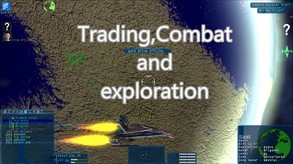
Fairspace is an amateur developed open-ended space exploration, trading and combat game. A full and rich persistent universe awaits your discovery.
Modeled estimate, not a reported figure. How we estimate →
Media

About
Genres
Stats
All-time low is the lowest price we've recorded for this game since we started tracking it.
Languages: English
Engagement
Reviews
Un jeu que j'ai beaucoup hésité à acheter mais dont je ne regrette finalement pas l'achat. Certes graphiquement ce n'est pas Eve Online mais il ne coûte que 8.99 euros et il n'y a pas d'abonnement donc il n'y a pas à se plaindre. Pour le moment je ne peux pas me prononcer sur la taille de l'univers puisque je ne possède pas encore de moteur capable de me faire quitter le système solaire du début, néanmoins il y a déjà beaucoup à faire et à voir dans ce système puisqu'il doit bien y avoir une quinzaine de planètes (sur lesquelles on peut toute se poser afin d'accepter des missions, de faire du commerce, d'acheter de nouveaux vaisseaux ou encore d'améliorer son matos...) ainsi que des tas de bases en orbites et de vaisseaux gigantesques (dans lesquels on peut également se docker). Concernant les missions c'est plutôt simple puisqu'on a des missions de chasseur de prime, de récupération de cargaison volées, de destructions de cibles... le tout ne servant qu'à une seule chose, nous permettre de dégommer des hordes de chasseurs, de transporteurs et de vaisseaux capitaux. Et puisqu'on parle des vaisseaux ils sont classés en trois familles: les chasseurs qui sont rapide et surtout très manoeuvrables, avec toutefois des faiblesses au niveau du blindage et du bouclier, les transporteurs qui, comme leur nom l'indique permettent de transporter d'importantes cargaisons au détriment de la puissance de feu mais qui sont toutefois assez rapide et résistant et enfin, les vaisseaux capitaux que je n'ai pas encore pu essayer mais qui selon toute vraissemblance doivent être extrêmement résistant, plutôt lent et lourdement armés. Au sein de ces trois familles on trouve énormément de modèles différents avec des stats différentes (vitesse, cargo, énergie, emplacement d'armes, emplacement de technologies, etc...). Il y a également un système de factions, votre réputation augmente avec les personnes pour lesquelles vous travaillez (généralement les marchands et autres officiels qu'ils soient militaires ou civils) et baisse avec les personnes que vous dégommez (généralement les pirates et autres anarchistes), simple et logique. Là où le jeu est le plus faible c'est sur les sons (mais le jeu étant encore en accés anticipé ça va peut être s'améliorer), toutefois rien de grave, c'est clair que la bande son n'est pas celle de Star Wars et que les bruitages ne sont pas géniaux mais ils ne nuisent pas non plus au plaisir du jeu. Graphiquement comme je le disais c'est pas génial mais c'est moins terrible que ce que je pensais et surtout moins génant que ce que je craignait. On ne reste clairement pas en extase devant les vues spatiales mais ça ne donne pas non plus envie de vomir et finalement c'est ça le plus important. Et puis il vaut mieux un jeu avec du contenu et du potentiel un peu faiblard graphiquement qu'un jeu magnifique où on s'emmerde. Pour conclure, je recommande chaudement ce jeu qui a énormément de potentiel...
Related
Related
Trends
Modeled estimate over time, reconstructed from Steam's monthly review histogram.
Hours played at review time, across 36 reviews with recorded playtime.
I love this game it reminds me of an old BBS Game TradeWars but way better.
Summary: "what do I do?" Needs better tutorial
If you like clunky controls, unoriginal models and sound (yes I used the fighter ship, that you are assigned when you start, and some of the sounds in a college project back in 2003), and early 2000's graphics, then this game is for you. To me it is complete crap.
Update it please :/
💋
this game is everything i wanted in a space MMO! (plus i had a small part in its earlier stages) it still needs more content but its a pretty alright game.
The usual "Elite" type gameplay but much more basic and repetitive. Includes the following annoying issues: -Single player game that still has some remaining references to other "Players" (since it used to be an MMO apparently). -Equipment screen confusingly says "Lock"/"Unlock" (and sometimes "Mount") instead of "Equip"/"Unequip". -Constant, endless pestering about the need to upgrade your ship components as you level up. Game uses some annoying and confusing equipment levelling mechanic, the function of which is uncertain. Apparently, you should be constantly paying to upgrade your ship to match your character level for some reason. Game likely uses level scaling to keep the universe same level as the player. -Travelling long distances is annoying since hyper jump & warp have short cool downs, activation timers and limited range. Meaning you'll activate, wait, jump then wait again before jumping again and repeating that process multiple times to get anywhere. This should only be the case if there's enemies nearby. A timer before a jump starts serves no other purpose than to cause pointless delays. -Missions/Jobs can only be done one at a time, the details/location of which can't be seen until it's accepted (but they're all just destroy groups of enemy ships anyways...). Level indicator is meaningless since higher level jobs pay same as lower ones: a level 2 mission reward is same as level 22 and a level 1 mission can include a capital ship (the moment that made me quit and post this review).
This game isn't so bad, I gave it another chance, and I kind of like it
Fairspace, developed and published by Sub Orbital Software, is an indie space simulation that aims to capture the spirit of classic open-ended space sandboxes while delivering a persistent universe built around player freedom. Rather than guiding players through a scripted narrative campaign, the game drops them into a sprawling 3D galaxy and encourages them to define their own path. Whether that path involves becoming a trader, bounty hunter, miner, pirate, or combat-focused mercenary is entirely up to the individual. This emphasis on autonomy forms the backbone of the experience, shaping both its greatest strengths and its most noticeable rough edges. From the outset, Fairspace establishes a sense of scale. Players pilot fully controllable spacecraft through open sectors filled with planets, stations, asteroid fields, and hostile forces. Flight takes place in true three-dimensional space, allowing movement along all axes, which gives dogfights a dynamic and sometimes chaotic energy. Unlike arcade-style space shooters that simplify movement to a flat plane, Fairspace embraces spatial freedom, requiring players to think vertically and horizontally during combat. This can feel liberating once mastered, but it also introduces a learning curve that may initially feel daunting for those unaccustomed to full 3D maneuvering. Progression in Fairspace revolves around accumulating credits, improving reputation, and upgrading or acquiring new ships. There is a wide selection of vessels to unlock, each with varying stats, weapon slots, cargo capacity, and specialization potential. Some ships are better suited for hauling goods across trade routes, while others excel in high-speed dogfights or mining operations. Building a fleet becomes part of the long-term appeal, as players can switch between owned ships depending on their current goals. The sense of growth—from piloting a modest starter craft to commanding more formidable ships equipped with advanced weaponry—provides a satisfying arc for those willing to invest time. Combat plays a central role in the experience. Encounters range from small skirmishes with AI pirates to more intense engagements involving multiple hostile ships. Battles emphasize maneuverability, aiming precision, and effective power management. Weapons vary in type and function, encouraging experimentation with loadouts that complement one’s preferred playstyle. While the mechanics are functional and occasionally thrilling, they reflect the game’s indie scope; the systems are ambitious but not always polished to the same degree as larger-budget space simulations. Nevertheless, when combat clicks, there is genuine excitement in weaving through laser fire and emerging victorious from a tense encounter. Beyond combat, the economic systems offer additional depth. Trading between stations can be lucrative if players pay attention to fluctuating market conditions and regional supply differences. Identifying profitable routes and managing cargo capacity becomes a strategic layer that contrasts nicely with the adrenaline of dogfights. Mining provides an alternative, more methodical income source, allowing players to extract resources from asteroid belts and convert them into usable currency or upgrades. These systems reinforce the sandbox design philosophy: no single path is mandatory, and players can shift focus whenever they choose. Visually, Fairspace presents a functional but modest aesthetic. Space environments feature colorful nebulae, planetary bodies, and starfields that convey scale and atmosphere without reaching cutting-edge graphical fidelity. Ship models and station interiors are serviceable, prioritizing gameplay clarity over visual spectacle. The interface, while comprehensive, can occasionally feel dense or unintuitive, requiring time to fully grasp. However, once understood, it supports the broader sandbox framework by giving players access to mission boards, trading information, and fleet management tools. One of the defining aspects of Fairspace is its persistent online universe. The game was designed with multiplayer interaction in mind, allowing players to share the same galaxy and potentially cooperate or compete. While the active population may vary, the concept of a living universe where economic and territorial dynamics can shift based on player activity adds ambition to the project. Even in quieter periods, the sense that the world continues to exist beyond individual sessions contributes to immersion. Fairspace ultimately stands as an ambitious indie interpretation of the space simulation genre. It does not possess the massive budgets or cinematic presentation of larger titles, but it compensates with scale, freedom, and a clear passion for open-ended design. Its systems may feel rough around the edges, and new players must invest time to fully appreciate its mechanics, yet those who enjoy carving out their own role in a sandbox universe may find it deeply rewarding. For fans of space sims who value autonomy over guided storytelling, Fairspace offers a galaxy where progress is defined not by scripted milestones but by the personal journeys players create among the stars. Rating: 6/10
Momentum
Pace estimated from the game's recent review growth (our daily snapshots) at its own sales-per-review ratio — a momentum signal, not booked sales.
Audience
Estimated from the language of this game's reviews — a proxy for where players are, not official Steam demographics.
Related
| Frozen Memories | $9.5K | 114 | 96% | $2.99 |
| Five nights at Stalin | $9.5K | 171 | 91% | $2.99 |
| The Gravedigger | $9.5K | 123 | 85% | $4.99 |
| Squirrelmageddon! | $9.5K | 51 | 53% | $9.99 |
| Dark Cave | $9.5K | 51 | 88% | $9.99 |
| NERVE | $9.5K | 51 | 92% | $9.99 |