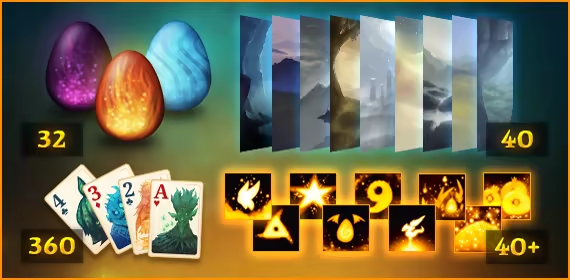
Match cards, rescue Faeries, and raise Magical Pets as you explore the many and vast enchanted worlds of Faerie Solitaire Harvest!
Modeled estimate, not a reported figure. How we estimate →
Media

About


Stats
All-time low is the lowest price we've recorded for this game since we started tracking it.
Languages: English, Russian, Simplified Chinese
Engagement
Hours played at review time, across 40 reviews with recorded playtime.
Reviews
Challenging yet relaxing game of solitaire.... different from any other I have played.
Look at my play time. Obviously, I was a huge fan of this game, but I can not recommend this in good conscience because of the developer's recent embrace of AI generated slop. He's already ruined another Faerie Solitaire release with it and he's bound to do it here as well.
Faerie Solitaire Harvest, developed by Subsoap and published on Steam by Puppygames, takes the deceptively simple framework of match-two solitaire and transforms it into a layered fantasy adventure built around progression, collection, and gentle strategic depth. At first glance, it presents itself as a cozy card game wrapped in bright colors and soft magical aesthetics, but the longer you spend with it, the clearer it becomes that the design is driven by a careful balance between accessibility and long-term engagement. Rather than relying solely on the inherent appeal of solitaire mechanics, the game builds an interconnected system of exploration, pet evolution, resource management, and board mastery that steadily unfolds across dozens of handcrafted stages. The core gameplay revolves around pairing cards of equal value to clear them from the board, a mechanic that is immediately intuitive even to players unfamiliar with more complex solitaire variants. However, Faerie Solitaire Harvest quickly adds nuance through layered board layouts, combo systems, and limited move efficiency. Each stage presents a distinct arrangement of cards, some straightforward and others deliberately intricate, requiring thoughtful sequencing rather than random matching. Because cards are often stacked or gated behind others, players must consider the consequences of each pair cleared. A careless match can block access to more efficient chains, while a carefully planned sequence can cascade into satisfying multi-clear combos that dramatically shift the board state. Progression is fueled by the accumulation of resources such as Pure Gold and mana, which tie the card mechanics into the broader adventure structure. Winning efficiently and building longer chains generates greater rewards, encouraging players to replay stages for improved performance. The resource system avoids feeling grindy because it is directly tied to skillful play; the better you manage the board, the more quickly you progress. This creates a loop that feels both relaxing and quietly competitive, as players often find themselves attempting to optimize earlier levels to maximize returns. One of the most distinctive elements of the game is its magical pet system. As you advance through the faerie world, you hatch and raise collectible creatures that evolve over time. These pets are more than cosmetic additions; they represent milestones in progression and provide narrative flavor to the experience. Each evolution feels like a small reward for consistent play, adding emotional investment to what could otherwise be a purely abstract card game. The act of nurturing and completing collections adds a subtle RPG-like layer, giving players long-term goals beyond simply clearing boards. This collectible system also strengthens the sense of worldbuilding, making the Faerie realm feel inhabited and alive rather than just a backdrop for puzzles. Visually, the game leans into a bright, hand-painted fantasy style that reinforces its cozy tone. Each location is rendered with vibrant colors and whimsical environmental details, from enchanted forests to mystical ruins. While the gameplay itself unfolds primarily on card layouts, the surrounding art provides context and atmosphere that elevate the experience. The presentation is polished without being overwhelming, and the interface remains clean and readable even as boards become more complex. Animations are smooth and unobtrusive, complementing the relaxed pace rather than distracting from it. The pacing of Faerie Solitaire Harvest is deliberately measured. It is not a game built for rapid-fire sessions or adrenaline-driven play. Instead, it thrives on a calm rhythm of observation, planning, and gradual accumulation of rewards. This slower tempo will appeal strongly to players who enjoy thoughtful puzzle-solving and incremental progression. At the same time, later stages introduce greater board complexity, forcing players to think several moves ahead. While the early game is forgiving and welcoming, the difficulty curve ensures that mastery requires patience and strategic awareness. Replayability is supported through multiple modes, including options to revisit stages for improved scores and additional challenges. Because each board is handcrafted rather than procedurally generated, the layouts feel intentionally designed, often hiding clever card placements that reward experimentation. Completionists will find satisfaction in fully evolving pets, unlocking all locations, and earning achievements tied to efficient clears. The New Game Plus option adds further longevity, allowing players to experience the adventure with heightened stakes and refined strategy. Despite its strengths, the game’s appeal is closely tied to appreciation of its genre. Players seeking dramatic narrative twists or mechanically complex systems may find the structure repetitive over long stretches. The core loop remains focused on card matching, and while progression systems add variety, they do not fundamentally alter the gameplay formula. However, for those who enjoy structured puzzle progression and collection-based motivation, this consistency becomes a virtue rather than a flaw. Ultimately, Faerie Solitaire Harvest succeeds because it understands how to expand a simple concept without overcomplicating it. It blends solitaire mechanics with fantasy worldbuilding, pet evolution, and resource-driven progression in a way that feels cohesive and inviting. The result is a relaxing yet strategically engaging experience that rewards patience, observation, and incremental mastery. For players who appreciate cozy puzzle games with meaningful long-term goals and charming presentation, it offers a polished and content-rich journey through a magical world built on the quiet satisfaction of matching cards and watching something grow. Rating: 7/10
It is a very relaxing and chill game. The rules are simple, but the combo chasing and resource loop kept me engaged far longer than I expected. The hand-painted backgrounds and overall polish make it feel consistently pleasant to play, and the extra modes give it real longevity.
***NOTE: Mac achievements are now broken (checked as of January 2025). In order to have Steam sync the achievements you have unlocked in the game, you must open the game on a PC with the same save file.*** This game is so boring and tedious. I loved the first one and thought this one would be similar, but it is totally different. The goal of this one is to match pairs, not chain together cards like in the first one. Moreover, the drop rate for resources is super low, making it super tedious and grindy to evolve/hatch pets and to get all the achievements.
I am not impressed with card games that stack the deck against the player. Burying needed cards beneath one another and placing an unbalanced deck cause this game to feel more like a cheap trick than a challenge.
Os desafios, realmente são desafios
1. The Industrial Revolution and its consequences have been a disaster for the human race. They have greatly increased the life-expectancy of those of us who live in “advanced” countries, but they have destabilized society, have made life unfulfilling, have subjected human beings to indignities, have led to widespread psychological suffering (in the Third World to physical suffering as well) and have inflicted severe damage on the natural world. The continued development of technology will worsen the situation. It will certainly subject human beings to greater indignities and inflict greater damage on the natural world, it will probably lead to greater social disruption and psychological suffering, and it may lead to increased physical suffering even in “advanced” countries. 2. The industrial-technological system may survive or it may break down. If it survives, it may eventually achieve a low level of physical and psychological suffering, but only after passing through a long and very painful period of adjustment and only at the cost of permanently reducing human beings and many other living organisms to engineered products and mere cogs in the social machine. Furthermore, if the system survives, the consequences will be inevitable: There is no way of reforming or modifying the system so as to prevent it from depriving people of dignity and autonomy. 18. Modern leftish philosophers tend to dismiss reason, science, and objective reality, and to insist that everything is culturally relative. It is true that one can ask serious questions about the foundations of scientific knowledge and about how, if at all, the concept of objective reality can be defined. But it is obvious that modern leftish philosophers are not simply cool-headed logicians systematically analyzing the foundations of knowledge. They are deeply involved emotionally in their attack on truth and reality. They attack these concepts because of their own psychological needs. For one thing, their attack is an outlet for hostility, and, to the extent that it is successful, it satisfies the drive for power. More importantly, the leftist hates science and rationality because they classify certain beliefs as true (i.e., successful, superior) and other beliefs as false (i.e., failed, inferior). The leftist’s feelings of inferiority run so deep that he cannot tolerate any classification of some things as successful or superior and other things as failed or inferior. This also underlies the rejection by many leftists of the concept of mental illness and of the utility of IQ tests. Leftists are antagonistic to genetic explanations of human abilities or behavior because such explanations tend to make some persons appear superior or inferior to others. Leftists prefer to give society the credit or blame for an individual’s ability or lack of it. Thus if a person is “inferior” it is not his fault, but society’s, because he has not been brought up properly.
Great casual game. Very replayable.
I love this game. The game itself is good, standard solitaire, lots of lore, collectibles, lovely graphics etc. But what I'm really here to talk about is the music. Holy MOLY this music is amazing. It's evocative of Secret of Mana/Seiken Densetsu, mostly Hiroki Kikuta's work. It's got a beauty and complexity to it that is engrossing while not being distracting. I absolutely adore the music in this game. I want the soundtrack so bad.
Related
Related
Trends
Concurrent players on Steam, sampled daily since tracking started.
Audience
Estimated from the language of this game's reviews — a proxy for where players are, not official Steam demographics.
Related
| Infinos Gaiden | $21K | 85 | 98% | $10.99 |
| California Swingers Club - Season 1: Sea Swap | $21K | 147 | 54% | $4.59 |
| Holo ADV: SakuraSingularity.exe | $21K | 65 | 92% | $16.99 |
| Farm Frenzy 2 | $21K | 235 | 95% | $4.99 |
| XXX Pussy House | $21K | 79 | 75% | $6.99 |
| Tank Royale | $21K | 68 | 90% | $9.99 |
Related
| Euro Truck Simulator 2 | $421.6M | 932.3K | 97% | $19.99 |
| Battlefield™ 2042 | $340.9M | 259.8K | 49% | $59.99 |
| Marvel’s Spider-Man Remastered | $130.9M | 135.8K | 96% | $59.99 |
| Planet Coaster | $109.4M | 72K | 91% | $44.99 |
| Need for Speed™ Unbound | $106.2M | 58.8K | 60% | $69.99 |
| American Truck Simulator | $103.7M | 194.2K | 97% | $19.99 |