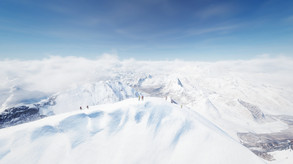
Experience what it feels like to climb Mount Everest through a sequence of immersive first person locations as you strive to reach the top of the world. Incomparable visual fidelity combined with player agency in a VR journey that feels both real and emotionally stunning.
Modeled estimate, not a reported figure. How we estimate →
Media

About
Genres
Stats
All-time low is the lowest price we've recorded for this game since we started tracking it.
Languages: English**languages with full audio support
Engagement
Hours played at review time, across 41 reviews with recorded playtime.
Reviews
Themes across 41 recent reviews and how positive each mention is. A keyword signal, not full sentiment analysis.
positive critical· bar length = how often the theme comes up
Reviews
Could not make it work, always crashing at startup... Maybe because I am using PIMAX5K+ ??? Customer service from developer is inexistant... Absolutely silent... Thanks anyway to Steam Support... Jesse did his best..
don't work. crappy game
This was a fun, cool experience. It's not too long, but as long as you buy it during the sale, it's well worth the money.
its a cool experience but graphics could be more detailed
太棒了,从大本营出发途径昆布冰川、希拉里台阶到顶峰,很有意思,体验了一次云登珠峰。 但如果是冲着玩游戏的,不建议买。只要对登山或者户外徒步有兴趣就可以直接入手。
游戏中自由模式下1960年中国北坡登顶的线路上,为什么中国CHN和西藏TIB是并列的?
Freakin amazing. Feels like you are there
Meh. Somehow this doesn't capture what I assume is an extreme and breathtaking experience. The way it's set up it works as an educational tool but all those Edmund Hillary hopefuls might want to check their expectations at the door.
Everest VR is a virtual reality experience that prioritizes presence, scale, and atmosphere over traditional gameplay, aiming to place the player directly onto the slopes of the world’s highest mountain. Rather than presenting itself as a challenge-driven climbing simulator, the experience is structured as a guided expedition that emphasizes what it feels like to stand in such an extreme environment. From the very beginning, the focus is on immersion: towering ice formations, vast snowy expanses, and dizzying drops immediately communicate the danger and majesty of Everest in a way that flat screens simply cannot replicate. The journey unfolds through a series of carefully staged locations that mirror key moments of a real Everest ascent, starting from Base Camp and progressing upward through iconic areas before ultimately reaching the summit. Each section is designed to showcase a different aspect of the mountain, whether it’s the treacherous icefalls, exposed ridgelines, or the thin, unforgiving atmosphere near the top. Movement is slow and deliberate, reinforcing the idea that this is not about speed or mastery, but about absorbing the environment and understanding the scale of the challenge climbers face. The pacing allows players to pause, look around, and take in the surroundings, which is where the experience truly shines. Visually, Everest VR is its strongest at conveying realism and awe. The environments are built using detailed photographic data, resulting in landscapes that feel grounded in reality rather than stylized or abstract. In VR, the sense of depth is especially striking: looking down a steep drop or gazing across the Himalayan range can provoke genuine vertigo and emotional reactions. The lighting, weather effects, and environmental sounds all work together to reinforce the illusion of being high above the world, isolated and exposed to the elements. These moments often feel more like standing inside a documentary than playing a game, which is very much in line with the developers’ intent. Interaction is intentionally limited and straightforward. Basic actions such as climbing, gripping tools, or moving between points exist primarily to support immersion rather than to create mechanical depth. There is no complex stamina system, no failure-heavy survival mechanics, and no demanding precision required from the player. This makes the experience accessible to a wide range of VR users, including those who may be new to virtual reality. At the same time, players accustomed to more interactive VR titles may find the mechanics too shallow, as there is little room for experimentation or skill-based play. Narration and contextual cues provide light guidance and background information, helping frame the journey without overwhelming it with exposition. The storytelling is subtle, relying more on the environment itself to convey the danger, effort, and isolation associated with climbing Everest. Silence and ambient sound are used effectively, often leaving the player alone with the wind and the vastness of the surroundings. This restraint helps maintain a contemplative tone, though it also reinforces the sense that the experience is more observational than participatory. One of the most common points of criticism is the overall length and replay value. A complete run through Everest VR is relatively short, often lasting around an hour, and there is little variation between sessions once everything has been seen. Because the experience is tightly curated rather than systemic, there are few reasons to return beyond revisiting favorite locations or showcasing the visuals to others. This has led to mixed reactions from players who expected a more game-like structure or longer-lasting content. Ultimately, Everest VR succeeds as a showcase of virtual reality’s ability to transport players to places that would otherwise be inaccessible. It is not a game in the traditional sense, but a carefully crafted experiential journey that focuses on realism, atmosphere, and emotional impact. For players seeking deep mechanics, challenge, or long-term engagement, it may feel limited. However, for those interested in immersive VR experiences, environmental storytelling, and the sheer sensation of standing atop the world’s highest mountain, Everest VR delivers a powerful and memorable glimpse into an extreme environment that few will ever experience firsthand. Rating: 5/10
cant even start it without crashing
Related
Related
Trends
Modeled estimate over time, reconstructed from Steam's monthly review histogram.
Audience
Estimated from the language of this game's reviews — a proxy for where players are, not official Steam demographics.
Related
| Night Stroll | $123.1K | 264 | 77% | $14.99 |
| Bug & Seek | $123.1K | 264 | 91% | $14.99 |
| Backrooms: Extractions | $123.1K | 741 | 73% | $6.99 |
| Train Station Renovation | $123.1K | 2.7K | 82% | $1.89 |
| Airport Ground Handling Simulator VR | $123.1K | 132 | 61% | $29.99 |
| Chronos Builder | $123.1K | 132 | 58% | $29.99 |