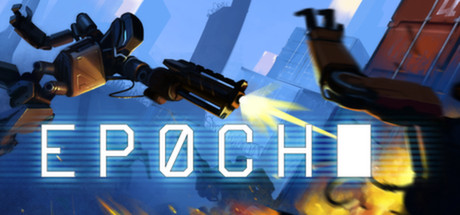
EPOCH, developed and published by Uppercut Games Pty Ltd, is a compact yet striking third-person action game that fuses arcade-style shooting with the desolation of a post-apocalyptic world. It places players in the role of a combat android awakened long after civilization has crumbled, programmed to fulfill a single purpose—to locate and protect a mysterious figure from a bygone age. What unfolds is a story told less through dialogue and more through motion, fragments of data, and the ruins of a dead society. EPOCH’s appeal lies in its combination of sleek mechanical combat, atmospheric world design, and a sense of mystery that lingers beneath its surface. It is a game that embraces simplicity without sacrificing intensity, delivering a streamlined experience that balances fast-paced action with the quiet melancholy of a world left to rust.
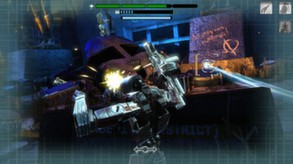
At its core, EPOCH thrives on rhythm and precision. Each encounter plays like a carefully choreographed dance of bullets and machinery, where success depends on mastering timing, positioning, and awareness. The player darts from cover to cover, dodging rockets, missiles, and energy blasts while firing back with rifles, grenades, and heavy ordnance. Movement is everything—staying still means certain destruction. The mechanics are deceptively straightforward: slide, dodge, shoot, reload, repeat. Yet within that loop lies the satisfaction of refinement, as each battle demands sharper reflexes and smarter decision-making. The game’s upgrade system reinforces this sense of growth. Salvaging parts from defeated enemies allows players to improve armor, weapons, targeting systems, and shields, ensuring that progress feels tangible even as the world remains static and broken. Combat sequences are short but intense, encouraging replayability and mastery rather than long, sprawling campaigns.
Visually, EPOCH punches above its weight for an independent production. Built on Unreal Engine 3, it combines cinematic lighting and realistic particle effects with the gritty aesthetic of a fallen civilization. The environments—shattered cities, broken bridges, and derelict industrial zones—evoke a sense of awe and abandonment. The design is both functional and atmospheric, conveying a story of decay without the need for exposition. The muted color palette of greys, browns, and metallic hues captures the sterility of a world that has outlived its creators. Explosions bloom with satisfying brilliance, and the mechanical movements of enemies and the protagonist alike have a tactile heaviness that enhances immersion. Despite the repetition of assets across stages, the presentation remains cohesive and visually engaging, maintaining a rhythm of spectacle and stillness that complements the gameplay’s mechanical flow.
The narrative is minimal yet evocative, told through fragments of recovered data and environmental storytelling rather than traditional cutscenes. As the android navigates through the remains of a human world, he uncovers messages, logs, and corrupted files that hint at the events leading to humanity’s extinction. There are no lengthy monologues or complex dialogue trees—only silence punctuated by flashes of memory and revelation. This restraint lends the story a haunting quality, allowing the player to piece together meaning through context rather than exposition. The bond between the protagonist and the person he was programmed to find becomes the emotional core of the game, a faint echo of purpose in a landscape consumed by entropy. While the plot remains abstract and open to interpretation, it manages to evoke a quiet sense of loss, making each step through the ruins feel significant.
Sound design plays a vital role in grounding the experience. The mechanical clatter of movement, the sharp crack of gunfire, and the hum of energy weapons all contribute to a tangible sense of presence. The soundtrack alternates between atmospheric drones and pulsing electronic beats, creating a sense of both isolation and urgency. It’s a soundscape that feels perfectly attuned to the world’s tone—bleak yet alive with the faint rhythm of machinery refusing to die. The audio cues also serve functional purposes, warning players of incoming attacks or signaling successful dodges, blending immersion with mechanical clarity. Together, the visuals and audio design create a cohesive aesthetic that transforms each skirmish into a cinematic event, even within the game’s minimalist framework.
EPOCH’s campaign, while relatively brief, maintains a strong sense of pacing. Each mission introduces new enemy types and combat challenges, gradually increasing the complexity of engagements. Boss battles punctuate the experience, testing reflexes and awareness in tightly contained arenas that emphasize vertical movement and timing. Once the campaign concludes, the arena mode extends the game’s life by offering an endless combat gauntlet where players can push their skills to the limit. The upgrade system, carried over from the main story, ensures that every run feels like an opportunity to refine builds and strategies. This balance between brief narrative engagement and long-term skill mastery gives the game staying power beyond its initial playthrough. However, repetition does eventually set in, as enemy patterns and level structures become familiar, revealing the limitations of its compact design.
Technically, the game runs smoothly and remains highly optimized across hardware, maintaining sharp responsiveness even during intense firefights. Its origins as a mobile title are evident in its streamlined interface, but the PC adaptation succeeds in feeling natural and responsive, especially with a controller. The controls are tight and intuitive, translating the rhythm-based dodging and shooting mechanics into satisfying bursts of motion. The simplicity of its design means there are few barriers to entry, making it accessible to both casual players and those seeking a focused challenge.
EPOCH is ultimately a study in minimalism executed with style and confidence. It doesn’t attempt to overwhelm the player with content or complexity; instead, it focuses on refinement—every dodge, every upgrade, every bullet fired contributes to a rhythm that becomes instinctive. Its world may be quiet and barren, but it feels alive through movement and atmosphere. The story it tells is one of isolation and perseverance, framed through the perspective of a machine searching for meaning in a lifeless world. Though its brevity and repetition prevent it from achieving the grandeur of larger titles, EPOCH succeeds on its own terms as a polished, visually captivating, and mechanically satisfying experience. It is a reminder that great design often lies not in scale, but in clarity of purpose, and in that sense, Uppercut Games has crafted a small but enduring piece of post-apocalyptic art.
Rating: 8/10