Encoded War, developed and published by Somnolent Team, is a focused and unconventional simulation game that builds its entire identity around one central mechanic: transmitting Morse code under pressure. Set against the backdrop of World War II, it steps away from the usual depictions of combat and instead zeroes in on the quiet but critical role of a communication operator. This perspective gives the game a distinct identity, turning what might seem like a niche concept into a structured, skill-driven experience that emphasizes precision, timing, and concentration.
The gameplay revolves around receiving instructions and converting them into Morse code as accurately as possible. At first, the process feels simple and almost meditative, as players learn the rhythm of dots and dashes and begin to internalize the system. However, the game quickly introduces more demanding scenarios, layering additional requirements and increasing the complexity of transmissions. What initially appears to be a straightforward input mechanic gradually becomes a test of memory, coordination, and mental endurance. The act of tapping out signals evolves into a skill that must be practiced and refined, rather than something that can be mastered instantly.
What makes the experience engaging is the way it creates tension without relying on traditional action. There are no visible enemies or direct threats; instead, the pressure comes from the need to perform accurately under increasingly demanding conditions. Mistakes carry consequences, and as tasks grow more intricate, maintaining focus becomes essential. This design creates a unique kind of stress—one rooted in performance rather than danger—where even small errors can disrupt the flow of a session. Over time, players develop a sense of rhythm and familiarity, and improvement feels tangible as they become faster and more confident in their inputs.
The game also incorporates elements of progression that help sustain engagement. As players advance, they encounter new challenges that require them to adapt their approach, whether by handling more complex sequences or managing additional layers of information. There is a satisfying sense of growth as early struggles give way to smoother execution, reinforcing the idea that mastery is achievable through practice. Different modes, including structured progression and more open-ended challenges, provide some variation, though the core loop remains consistent throughout.
Narratively, Encoded War keeps things minimal but purposeful. The story serves primarily as a framework for the gameplay, offering just enough context to give meaning to the player’s actions. Rather than focusing on character development or detailed storytelling, it uses its wartime setting to create a sense of responsibility and urgency. The idea that each successful transmission contributes to a larger effort adds weight to the otherwise mechanical tasks, even if the narrative itself remains understated.
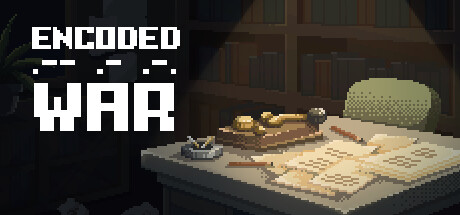
Visually, the game adopts a simple pixel-art style that prioritizes clarity over detail. The interface is clean and functional, ensuring that players can focus entirely on the task at hand. This minimalistic approach works well within the context of the gameplay, as distractions are kept to a minimum and the emphasis remains on precision. While the visuals are not particularly striking, they are effective in supporting the overall experience, creating an environment that feels cohesive and purposeful.
One of the most notable aspects of Encoded War is its originality. Few games attempt to center their mechanics around something as specific as Morse code, and even fewer manage to turn it into a compelling gameplay loop. This uniqueness is one of its greatest strengths, offering an experience that feels genuinely different from more conventional titles. At the same time, it can also be a limiting factor. The gameplay is highly specialized, and players who are not interested in its core mechanic may find it repetitive or overly narrow in scope.
The relatively small scale of the game is another factor to consider. While the progression system and challenge modes provide some replay value, the overall experience is fairly contained. Once players have become comfortable with the mechanics and explored the available content, there is limited variation to keep them engaged for extended periods. This makes the game feel more like a focused experiment or a short, skill-based challenge rather than a long-term experience.
In the end, Encoded War succeeds by committing fully to its concept and executing it with clarity and purpose. It transforms a niche idea into a structured and engaging system that rewards patience, practice, and precision. While its scope and specialization may limit its broader appeal, it offers a distinctive experience for those willing to invest in its mechanics. For players who enjoy skill-based challenges and are open to something different, it provides a satisfying and memorable journey built around mastery rather than spectacle.
Rating: 7/10