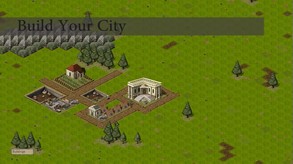
Empire Architect is an ancient city-building real time strategy game, with elements from grand strategies sprinkled in for good measure. The levels are procedurally generated, and you have limited control over your subjects
Modeled estimate, not a reported figure. How we estimate →
Media

About
Genres
Stats
All-time low is the lowest price we've recorded for this game since we started tracking it.
Languages: English*, German*, French*, Spanish - Spain**languages with full audio support
Engagement
Hours played at review time, across 50 reviews with recorded playtime.
Reviews
Themes across 50 recent reviews and how positive each mention is. A keyword signal, not full sentiment analysis.
positive critical· bar length = how often the theme comes up
Reviews
I am really liking this game so far. Very similar to CivCity: Rome. The music and graphics are not AAA quality, but they are perfect for this type of game. I'd like to see the option to "Continue Playing this City" before ending the senario. It is kind of jarring when you're in the middle of planning out an area, then suddenly get the scenario complete screen.
After trying this out I came to the conclusion it needs my review, if only to act as a roadsign of the dangers ahead. I admit I've not delved fully into the game. Pros: + Fairly straightforward copy of Caesar III and sequelling city-builders. + Roadbuilding quickbutton, once found. + Handheld early campaign for those not familiar with the game + Limitless amount of maps through random generation Cons: - Fairly straightforward copy of Caesar III and sequelling city-builders. - Handheld early campaign for those familiar with the game. - Doesn't copy well enough the mechanics of Caesar III. - Random maps are made with haphazard splat-generation. - Trees can't be cut without lumber mills, which limits megalomany. The game itself has a delightful small-team feel, and thus I hopped right into it, and but five minutes later was down the memory lane when I was but a wee lad and my crush gave me Caesar III in exchange for some game I do not even remember any more. This was both a good and a bad thing. For one, I got to remember all the cool things and micromanagement I quite enjoyed back in the day, but none of it works as well as it did with Caesar. Then, I get to troubleshoot again with employment, health, building health and water like I used to, but again with less advanced mechanics. I can make an expansive trade network with vast exports, but again I am hampered with less options than I expected, plus there are no happy caravans trodding about. This... knuckle-rapping continues throughout the game. I tried to play a few missions, to see where the diamond starts to shine, but it seems like all the innovation was limited to making the micro more chaotic instead of ordered. For instance, while the workers may choose to live where-ever, they get tired, and when they get tired they go home to sleep. I do not find this a needed mechanic to a Caesar-clone, especially when the effect of tiredness doesn't either affect that much or I just like to build workplaces close to home. In the end, I can't recommend this game. It is not the amount of effort, it is not the underlying mechanic, it is not the game itself, apart from the half-done copypasting. It is simply the fact that you may buy Caesar III for some 6 euros, and that one will give you way more bang for your buck than putting 15€ to Empire Architect.
As much as I love Caesar III; it's a little flawed and dated. So I strike out to find something similiar and find this reasonable little game. At first I was very impressed, there are some fundemental improvements here over the Impressions city builder games; Citizen Happiness, Stockpiles and unemployment/open housing/open jobs on the hud, overlay of buildings effect range before placement, etc. So far so good. But after a couple of hours the flaws start to show, some features that are present in C3 aren't here; Every construction must be accessed by a single menu and then sub menu, buildings have no animations, it's not very colourful graphical nor has much variety in sound and the combat is clunkier than C3 believe it or not. Some things have been improved on but some stalwart features just havent been taken on at all. I was very much on the fence but what swung it for me was bugs; houses full of starving people who live directly next to a market in a city with a surplus of food and therefore crushes your citizens happiness?! Ultimate frustration. It's not awful but it could be better.
This game is fine. Not great, not terrible, just fine. There's a couple of reasons why I'm ruling it as not recommended, though. First of all, it's clearly not finished. There's grammar errors everywhere, the build menu is a bit buggy (you can enter another context menu while still in the building interface, but closing either closes both), there's some keybind conflicts (Right-click, for example, is both movement and exiting a context, so if you try to pan while building you stop building), et cetera, et cetera. The fact that the update history runs pretty well until it hard stops in September 2018 isn't promising, though it's not super unprecedented for a surprise update after lots of time away (See Victoria 2, Reus, et al). The second reason I'm not recommending the game is that it often feels like you need to wrangle information out of the game, if the game is even willing to give you information at all. Things like "How much food do my people need?" or "How long does it take for my workshop to finish a cycle?" or "How far does my market reach?" are questions that are either unanswerable or so unnecessarily obfuscated that it's difficult to figure out how to optimally build a city. Maybe that's not super important to everybody, but it's the kind of thing that really annoys me. TL;DR: It's a fine game that will serve you well if you need a Ceasar/Pharaoh style citybuilder and have already finished/beaten those, but if you haven't, I'd probably rate those 2 and probably also Anno as better than this.
Complete waste of money. Still unfinished. For example, in the custom game, you can choose the number of AI, and it has a box to select the AI's nation with "Rome" preselected, and when you click this box, there are no other nations to select. The same thing with "Team." All AI will be on team 1 whether you like it or not, and you don't have a team. It's far from finished, and shouldn't be for sale.
It tries to capture the feel of the old Caesar games and it almost pulls it off but falls short in many areas. You're better off just buying Caesar III
Recommandé en soldes mais pas à son prix normal. Dommage ! Mon article complet sur Dystopeek : https://dystopeek.fr/jouer/empire-architect/
My FPS is so bad that it's giving me headaches, it's so choppy, it shouldn't be the case in a game like this? I can't seem to make any changes that help at all in the settings either. I'm a huge fan of games like the Caesar series, Pharaoh, Zeus etc, I'm hoping it gets fixed, until then it's gonna have to wait. *Edit* Thank you so much for your response, I am a bit confused about this as I have similar games and others that take a whole lot more power and run just fine. I'm running an old AMD Phenom 9750 Quad Core ~ 2.4Ghz 8 Gigs of RAM DirectX 11 Geforce GTX 750 Ti Windows 7 64-bit *Edit 2* Other developers need to learn from this, caring about your customers can change the outcome of a review by being fantastic, helpful, friendly and thoughtful. Thank you again.
[u]What is Empire Architect?[/u] Empire Architect is a city building game set in the Roman Empire. In the rest of the review, I will attempt to not go into comparisons with other games, but in advance it should be stated that this game is very similar to Caesar III, but it has quite a different scope. [u]What is it like?[/u] Empire Architect offers two ways to play, either a campaign with maps with predefined goals or a sandbox game on a random map. Whichever way you choose, you are trusted with building settlements in the Roman Empire. You do this by building houses for your people, providing them with entertainment, health and religion and making goods. Goods are needed on one hand for keeping your citizens happy (the better their home, the more goods they require) on the other for trading - the latter will be the town's main source of income. There are several different types of goods like pottery, furniture or clothes. Each product requires some raw material and at least one step of processing (e.g. pottery from clay), but there are some that require two steps in two separate buildings to process (e.g. furniture is made in a furniture factory from lumber, which, in turn, is made at a lumber mill from wood, gathered at a lumber yard). This means the player needs to set up an infrastructure for making enough materials to make enough finished goods for the populace and trade (and, in the case of certain resources, for building buildings). While goods are nice, the true soul of a city is its people, and this is where Empire Architect differs most from its inspiration. Instead of building cities of tens of thousands of nameless people, you build towns of a couple hundred, maybe a thousand inhabitants, but each of them are named and have their own routines. This means that each of them has a schedule of going to work, going home to rest and going to the market to pick up food and goods. Each citizen also has their own happiness level as well, made up of their satisfaction with their dwelling, their choice of food, choice of goods and access to water, religion, entertainment and health services and the desirability of their surroundings. Citizens can also be educated in schools so that they can fulfill jobs that require an educated employee. In an interesting minor twist of the usual formula, buildings have more than one type of employee, e.g. production buildings have workers that actually make the product and a cart pusher who is responsible for delivering their product to a storage building and, unless the building makes some raw material itself, getting raw materials for the production. While it doesn't make much difference gameplay-wise (aside from being able to set different salaries for the different roles), it is a nice touch. Speaking of buildings, another interesting difference (and one with slightly more impact) from standard city builders is that building don't just appear by themselves, they need to be built by builders, sent out from architect's offices. The bigger the building, the longer it takes to build, and when the player builds many buildings at once (e.g. a new housing block or a new production centre), if there are not enough builders, it will be quite some time before everything is finished. Helping the player in running the city is a host of informative reports and graphs, accessible from one central menu. There is a military aspect in the game as well, but like in most games of this kind it is perfunctory at best, with legionnaires and bowmen available for training and a "click somewhere and hope your guys will prevail" style of combat, so it's obvious this part of the game was not where the developer's focus was. There is no multiplayer, but on custom games, the player can choose to have one or more AI rivals on the same map. [u]Pros and cons[/u] ++Overall, the game is nice and well designed, the different parts of citizen management, production, etc. fitting well together to make the game entertaining. ++Thanks to the campaign also serving a as a tutorial, the game is quite accessible. Different difficulty levels also mean that the player can choose how forgiving or challenging they want the game to be. -That said, in some parts, there is a distinct lack of information, for example when the player is struck with a blessing or curse from one of the deities, it doesn't say what actually happened. Also, the tutorial doesn't always explain elements which do come up in the given mission (such as how to fulfill imperial orders). +For a game where having stellar graphics was obviously not the focus during development, buildings are decorated quite nicely, they show a definite attention to detail. -However, the graphics might be too minimalist even for some city building fans. +The music is nice and Roman-like... -...but gets repetitive fast. ++Having a smaller number of actual individual citizens means the player really feels like they're caring for actual people who depend on them for having a nice place to live. -On the other hand, since here the player doesn't build cities for many thousands, it doesn't feel like we build an actual city, let alone a metropolis. ++Managing all the production chains and all the requirements of the populace makes a nice kind of challenge. -Still, I feel like there's a bit of a missed opportunity here; for example, while citizens go to have a rest and buy goods, they don't actually visit entertainment buildings or temples like they do, for example, in the Tropico games.
This seems like a boring version of tropico to me.
Related
Related
Trends
Modeled estimate over time, reconstructed from Steam's monthly review histogram.
Momentum
Pace estimated from the game's recent review growth (our daily snapshots) at its own sales-per-review ratio — a momentum signal, not booked sales.
Audience
Audience
Games most often reviewed by the same players — an audience-affinity signal from our review sample, not full ownership data.
Estimated from the language of this game's reviews — a proxy for where players are, not official Steam demographics.
Related
| Windstorm: Start of a Great Friendship | $81.2K | 171 | 73% | $14.99 |
| Requiem of Reuinis | $81.2K | 208 | 91% | $10.19 |
| Lust Arcanum | $81.2K | 177 | 77% | $17.99 |
| I Walk Among Zombies Vol. 2 (Adult Version) | $81.2K | 263 | 99% | $14.99 |
| I Just Want to be Single!! Season One | $81.2K | 285 | 78% | $14.99 |
| Camera Obscura | $81.2K | 1.5K | 72% | $1.99 |
Related
| The Scroll of Taiwu : Beyond The Dome | $62.3M | 69.6K | 66% | $29.99 |
| Tabletop Simulator | $42.2M | 73.8K | 96% | $19.99 |
| Coral Island | $20.8M | 27.3K | 89% | $29.99 |
| Volcano Princess | $14.6M | 48.5K | 98% | $10.99 |
| Chinese Parents | $8M | 26.8K | 91% | $9.99 |
| Yes, Your Grace | $7.4M | 14K | 87% | $19.99 |