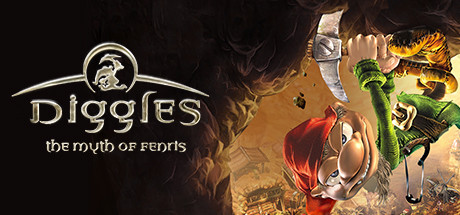
It`s impossible to refuse to help Odin when he asks to find his pet, Fenris, the hound of Hell. A mix of cinematic adventure and a colony building strategy that will take you deep down to the underground world of dwarfs.
Modeled estimate, not a reported figure. How we estimate →
Media

About

Stats
All-time low is the lowest price we've recorded for this game since we started tracking it.
Languages: English*, German*, Polish*, Russian**languages with full audio support
Engagement
Hours played at review time, across 40 reviews with recorded playtime.
Reviews
Themes across 40 recent reviews and how positive each mention is. A keyword signal, not full sentiment analysis.
positive critical· bar length = how often the theme comes up
Reviews
I’ve been trying to find this game ever since I played it on my beat up pc in 2003, still the best game out there
Hra i když staršího data, ale stále velmi zábavná.
♥ LOVE ♥ FANTASY ♥ MAGIC ♥ STRATEGY ♥
Polecam stara ale jara :)
5 star
Diggles: The Myth of Fenris is a unique blend of colony simulation, strategy management, and underground exploration developed by Spieleentwicklungskombinat GmbH and updated for modern hardware by General Arcade, with SNEG bringing the title back to modern storefronts. Originally launched during an era when strategy games regularly experimented with unusual ideas, Diggles remains a fascinating example of ambitious design that refuses to fit neatly into a single genre. It combines resource management, civilization building, character simulation, and mythology into a package that still feels distinctive years after its original release. The game draws inspiration from Norse mythology and places players in command of a dwarven civilization tasked with an enormous responsibility. Odin himself calls upon a clan of dwarves to locate Fenris, a dangerous mythical beast whose presence threatens balance beneath the world. The mission becomes far larger than a simple expedition. Players gradually establish a thriving underground society while carving through dangerous subterranean environments filled with hidden resources, mysteries, and challenges waiting below the surface. Unlike many strategy titles where workers exist purely as statistics attached to tasks, Diggles gives individual personality to its dwarven population. Colony members possess traits and behaviors that influence how efficiently they perform duties and interact with the settlement around them. Some workers become highly productive, while others may display laziness or quirks that complicate management decisions. The colony begins to feel alive because success depends not only on gathering resources but understanding the needs and limitations of the inhabitants themselves. Managing a settlement requires attention to numerous systems working simultaneously. Food production, housing expansion, technology development, mining operations, entertainment, and workforce organization all demand consideration. Digging tunnels through underground layers forms the foundation of progression. Every excavation opens opportunities to discover new materials, expand infrastructure, and unlock future advancement paths. Gradually transforming empty underground spaces into functioning industrial settlements becomes one of the game’s most satisfying elements. Technology progression creates a strong sense of long-term growth. Players guide dwarven civilization through increasingly advanced production chains, developing stronger tools, improved facilities, and more efficient systems over time. Watching an initially fragile settlement evolve into a sprawling underground network delivers a rewarding sense of accomplishment. Growth rarely happens instantly, but steady progression creates meaningful momentum across the lengthy campaign. One of Diggles’ most unusual strengths comes from its balance between direct control and automated behavior. Colony members frequently operate independently, handling assigned priorities without constant player supervision. Rather than controlling every small action manually, players establish systems and workflows that allow the colony to function organically. The result feels less like commanding units and more like overseeing a living civilization shaped by player decisions. The simulation elements extend beyond labor management. Dwarves form relationships, pass characteristics to future generations, and develop personal dynamics that influence colony development. These systems give the settlement a personality rarely found in strategy games. Over time, players become attached to the civilization they build because inhabitants feel like individuals contributing to a larger community rather than interchangeable workers. The visual presentation naturally reflects the game’s original era. Compared to modern strategy releases, the graphics appear dated and interface design occasionally shows its age. Certain management systems also require patience, particularly for players accustomed to streamlined modern colony simulators. Progress unfolds at a deliberate pace, and learning interconnected mechanics takes time before the game fully reveals its strengths. However, many of these older design qualities also contribute to Diggles’ charm. The game belongs to a generation of PC strategy titles willing to pursue ambitious concepts without simplifying every system. Its complexity occasionally creates frustration, but it also creates memorable moments that feel earned rather than handed to the player. Patience often leads to greater appreciation of how deeply interconnected the simulation systems become. The mythological setting further strengthens the experience by giving purpose to expansion and exploration. The journey toward Fenris unfolds alongside civilization growth, ensuring progression feels tied to a meaningful objective rather than endless resource accumulation. Story progression never overwhelms the management systems, but it provides enough motivation to keep players moving deeper underground. Diggles: The Myth of Fenris remains an unusual strategy experience even by modern standards. Its combination of colony building, character simulation, mythology, exploration, and underground management creates something few games have successfully replicated. It demands patience and adaptation to older design philosophies, but players willing to embrace its slower pace will discover a remarkably creative strategy game filled with personality. What makes Diggles memorable is not perfection but individuality. It embraces complexity, experimentation, and unconventional design choices that help it stand apart decades later. For strategy fans interested in older management games with ambitious ideas and a surprising amount of charm, Diggles: The Myth of Fenris remains a rewarding journey beneath the surface. Rating: 8/10
Jest przyjemna
Любимая игра детства. Ни разу не доходил до финала, и вот наконец закончил ее
nostalgic game
top
Related
Related
Trends
Modeled estimate over time, reconstructed from Steam's monthly review histogram.
Momentum
Pace estimated from the game's recent review growth (our daily snapshots) at its own sales-per-review ratio — a momentum signal, not booked sales.
Audience
Estimated from the language of this game's reviews — a proxy for where players are, not official Steam demographics.
Related
| Armor Clash 3 | $48.1K | 156 | 54% | $9.99 |
| Love Language Japanese | $48.1K | 156 | 80% | $9.99 |
| AI Olympius | $48.1K | 143 | 92% | $14.99 |
| Inspector Schmidt - The Ebbing | $48.1K | 95 | 88% | $19.99 |
| Disjunction | $48.1K | 171 | 71% | $15.99 |
| Below the Crown | $48.1K | 107 | 94% | $14.99 |