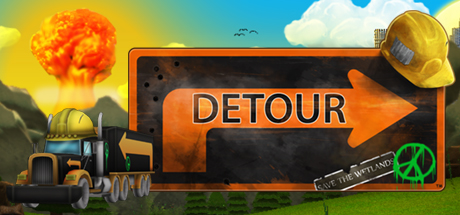
Detour, developed by Geoff “Zag” Keene and Richard Keene and self-published by Geoff “Zag” Keene, is a unique experiment in the real-time strategy genre that replaces armies and battlefields with highways and freight trucks. At its core, it is a game about logistics, disruption, and tactical improvisation. Players are tasked with guiding a convoy of trucks from their factory to a destination on the opposite side of a map, but what begins as a simple exercise in road building quickly turns into a fierce contest of territory and timing. The game’s minimalist concept conceals a surprising level of depth, forcing players to juggle resource management, infrastructure planning, and sabotage in real time. Each decision has an immediate impact—every piece of road placed, every bomb detonated, every blockade deployed—and the margin for error narrows as opponents act simultaneously.
The gameplay structure of Detour is what makes it stand apart from other strategy games. You earn credits by operating within your territory and gathering resources from the map, then spend those credits on building roads and deploying special actions. The landscape is broken into a grid of tiles that may include obstacles, rivers, bridges, or mines, all of which shape how you plan your routes. You can’t simply build a straight highway to victory; the terrain, combined with enemy interference, demands constant adaptation. The goal is straightforward—get your trucks across before your rivals do—but the execution becomes a tense balancing act between progress and disruption. Building efficiently while defending your route is critical, and the ability to strategically sabotage enemy progress introduces a satisfying competitive rhythm that keeps every match dynamic and unpredictable.
Detour’s design philosophy thrives on immediacy. Unlike large-scale strategy titles where players manage sprawling armies and long-term economies, Detour condenses the strategic experience into quick, high-intensity rounds where every second counts. The simplicity of its presentation belies its complexity. You must constantly switch between construction, defense, and offense, and every action costs valuable time and resources. The tools of sabotage—bombs, protests, traps, and blockades—are double-edged weapons. Using them effectively can cripple an opponent, but deploying them without foresight can also leave your own routes vulnerable. This constant push and pull creates a fast-paced environment that rewards sharp awareness and quick reflexes as much as planning. It feels like a game of chess played at the speed of an arcade puzzle, where clarity of thought and adaptability define success.
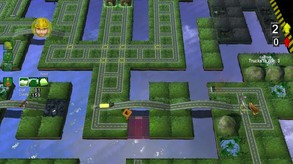
Visually, Detour is understated but efficient. The maps are presented with a clean, almost board game-like aesthetic, using bright color contrasts to distinguish roads, terrain types, and player actions. While the graphics lack polish by modern standards, the minimalist style works in service of the gameplay. It ensures that information remains readable even during moments of chaos. The soundtrack and sound effects contribute just enough atmosphere to keep the tension alive without distracting from the focus on tactics. The entire experience feels handcrafted, functional, and deliberately small in scope—an indie design stripped of unnecessary embellishment to highlight the central mechanics. The presentation mirrors the game’s philosophy: function over flash, clarity over spectacle.
Despite its clever design, Detour is not without flaws. The controls, while functional, can feel clunky under pressure. Switching between tools and placing tiles quickly takes practice, and the lack of fluidity sometimes clashes with the fast-paced demands of the gameplay. The single-player content, consisting of tutorials and challenge missions, serves primarily as a warm-up for the real attraction—competitive matches against AI or human opponents. Unfortunately, the game’s multiplayer population dwindled over time, leaving many players reliant on AI battles that, while competent, lack the unpredictability of human opponents. The difficulty curve can also be steep; once the early levels are cleared, the intensity spikes sharply, with opponents deploying sabotage and rapid construction in ways that can overwhelm newcomers. These issues highlight the game’s indie limitations but also its ambition: it reaches for a complexity and pace that few small-scale strategy titles attempt.
What ultimately makes Detour stand out is its originality. By transforming road-building into a competitive tactical sport, it captures a kind of strategic tension that feels refreshing even years after its release. There is a constant sense of improvisation—routes collapse, resources run dry, and your perfect plan can be ruined in seconds by an opponent’s well-placed explosion. Victory requires flexibility, timing, and a willingness to recover from chaos. While it may lack the long-term progression and visual flourish of bigger games, Detour’s greatest strength lies in its pure mechanical focus. Every match becomes a story of clever maneuvers and near-misses, of rival builders outsmarting each other across grids of asphalt and dust.
Detour is not a game for everyone—it’s small, demanding, and occasionally unforgiving—but for players who appreciate strategic experimentation and high-tension competition, it offers something genuinely distinct. It condenses the thrill of real-time tactics into a minimalist format where success feels earned and every decision matters. Geoff Keene’s creation reflects the spirit of early independent game design: raw, inventive, and unafraid to break from convention. It remains an overlooked gem that challenges the player’s strategic instincts while proving that ingenuity, not scale, is what gives a strategy game its staying power.
Rating: 6/10