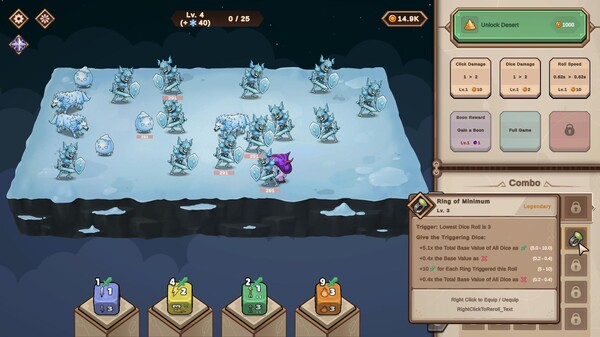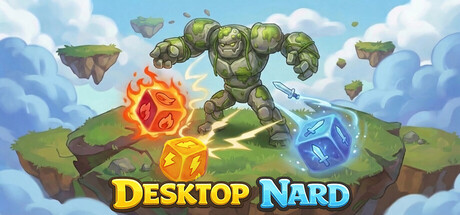
Idle Dice roll automatically for you, unleashing skills and farming rare loot in the corner of your desktop, with tons of content and loot types.
Modeled estimate, not a reported figure. How we estimate →
Media

About
A loot-based idle game where dice roll across your screen, triggering skills on monsters, farming them for you.
Let it run full-screen, or dock it in the corner of your desktop, or strip everything down into a gadget for loot to know when an extremely rare loot drops.
Main features of the game:
Itemized Dice: Every dice is a piece of loot with unique stats and skills.
Endless Loot Hunting: Monsters drop dice, gemstones, scrolls, combo rings, relics, and automator gears each pushing your build further and unlocking new synergies.
Prestige & Skill Trees: Rebirth to unlock 4 skill trees that significantly transform your game and provide powerful bonuses.
Maps: Enter a new world with powerful rewards.
And many more systems.
Stats
All-time low is the lowest price we've recorded for this game since we started tracking it.
Languages: English, French, Italian, German, Spanish - Spain, Czech, Japanese, Korean, Polish, Portuguese - Brazil, Russian, Simplified Chinese +2 more
Engagement
Hours played at review time, across 40 reviews with recorded playtime.
Reviews
Themes across 40 recent reviews and how positive each mention is. A keyword signal, not full sentiment analysis.
positive critical· bar length = how often the theme comes up
Reviews
For 40% of the cost of the entire game, you can change the color of your dice platform. The absurdity of that is indescribable. As for the game, it's ok for a few hours but inventory management and its randomness destroy any real staying power. The way the dice roll and the timing of some of the actions (I.e., the way the calculations are visually represented) are actually unsatisfying and it almost seems like they're manufactured to keep you progressing slower.
Very slow power scaling and there are bugs with simple cosmetics (platforms). Also, if you just look at the supporter pack from in-game it auto adds it to your cart.
Спасибо, кайфанул)
31 hours and achieved 100%, here's my verdict. Pros: 1. The it's literally incremental, it's increasing in difficulty as you progress through the game, but it's not that steep that makes you frustated. 2. All builds work, while i strongly support build in game, this takes me to another level of standard. Literally all build works (knight, arrow, beam, etc.) and to min/max-ing all the dices, gemstones, rings, and automation, it's achievable, and that what makes me going to play longer for hours just to max one build. 3. You thought this is an idle game, at the beginning you'll probably want this or that feature, but that especially what makes it great. It comes sooner than you think, and even more important, IT'S THERE! Cons: 1. Some feature are not explained enough (eg: each dice feature, how the damage calculation works, basic information such as beam duration, beam speed, shadow damage, and others are not there). You need to think how it work, and will it work. 2. Bug, literally. There's a feature to lower the effect amount, but it "slows" you down from killing those mobs. Somehow the damage is not updated in real time. IF, you bump up that effect amount, it will just kill your pc (trust me, i've tried with 4 shadows) All over all, i'll rate this game 9/10. One of the top idle game on my library, and probably the only one so far that i'll keep playing past 100% achievement. The only minus is the cons, but i believe it would be easily solveable (for the number 1) EDIT: the game keep crashing during my attempt to 110% now i cannot get that 25k max rolls
boring.
Game halting lag from the orbs. Posted 3 weeks ago, nothing fixed aside from one fool pretending it was. The game is unplayable in it's current state.
Honestly, the game isn't bad. It's a fun enough experience that you can easily 100% in less than 35 hours. Art and animations are good, if a little bright (I ran a full Beam Dice build and it was near blinding) and it doesn't have too many frame drops. The only negatives really are some lacking QoL features like: * Closing windows/menus when clicking off of them or hitting escape - Clicking off does nothing and hitting escape brings up the game menu on top of what you wanted to close. * Occasional graphical glitches where the dice were too large. * Tooltips could be a little better with clearer descriptions. But I'd still recommend the game as 30-35 hours for a few bucks is definitely worth it.
無味
Desktop Nard: Dice Idle is an idle progression game developed and published by Samharia Studios that takes a surprisingly unusual approach to the incremental genre. Instead of asking players to dedicate their entire screen and attention to endless clicking or menu management, it operates more like a desktop companion, quietly running alongside daily computer activity while rewarding long-term progression and thoughtful optimization. What initially appears to be a simple dice-based idle game gradually reveals itself as a layered experience built around loot systems, character growth, and build experimentation. The core concept revolves around magical dice automatically battling enemies, gathering rewards, and becoming stronger over time. Players are not constantly issuing commands or manually controlling combat. Much of the gameplay unfolds naturally, allowing progression to continue in the background while players browse the internet, work on other projects, or play different games. This design immediately gives Desktop Nard: Dice Idle a distinct identity because it understands that idle games often work best when they complement a player's routine rather than completely interrupt it. The progression systems create much of the long-term appeal. Dice function as more than simple visual representations of damage output. Each one can carry unique properties and characteristics that influence overall effectiveness. As stronger equipment appears and better combinations become available, experimentation becomes increasingly important. The process of refining builds and discovering stronger synergies creates a satisfying sense of advancement that keeps the experience engaging over longer periods. Loot collection forms the backbone of progression. Victories reward players with more than raw upgrades. Valuable items gradually expand available options and encourage different approaches to efficiency. New equipment pieces, supportive enhancements, and additional progression mechanics slowly increase complexity without overwhelming the player immediately. Early sessions remain accessible while later stages introduce more opportunities for optimization. One of the game's strongest qualities is how it handles incremental growth. Good idle games succeed by making small improvements feel meaningful, and Desktop Nard: Dice Idle demonstrates a strong understanding of that principle. Minor upgrades noticeably improve progression speed. Unlocking stronger combinations creates satisfying momentum. Every improvement contributes toward larger goals, reinforcing the addictive loop that defines successful progression-focused design. Prestige mechanics introduce another layer of strategic decision-making. Progress can be reset intentionally in exchange for long-term benefits, creating meaningful choices about timing and efficiency. Instead of merely increasing numerical values endlessly, the game encourages players to think carefully about progression priorities. Permanent upgrades and expanded progression systems ensure resets feel rewarding rather than punishing. The game also introduces elements commonly associated with role-playing progression. Build specialization opportunities encourage experimentation beyond basic numerical growth. Different approaches can influence long-term efficiency, allowing players to shape progression according to personal preference. The systems work together effectively, ensuring advancement feels connected to decisions rather than entirely automated. Another strength comes from pacing. Idle games often struggle with maintaining interest once players understand the core loop. Desktop Nard: Dice Idle addresses this by steadily introducing additional systems that reshape priorities over time. New progression opportunities help preserve engagement while giving players reasons to continue refining strategies beyond early milestones. The desktop integration remains one of the most interesting features. Because the game occupies only a portion of the screen if desired, it becomes remarkably easy to incorporate into everyday computer use. Watching progression quietly unfold while handling unrelated tasks creates a relaxed rhythm that fits naturally with the idle genre. The experience rarely feels demanding, which ultimately strengthens its appeal. Visually, the presentation remains clean and practical. Dice movement remains easy to follow while interface elements communicate information clearly. The game avoids unnecessary visual clutter, which becomes especially important for something designed to coexist with other desktop activities. Readability takes priority over spectacle, and the result supports the game's intended role effectively. Players focused heavily on optimization may occasionally encounter moments where additional convenience features would improve the experience further. Inventory organization and growing system complexity can occasionally require more management than expected. New players may also need some time before fully understanding how different mechanics interact. However, these concerns rarely disrupt the overall progression loop significantly. What makes Desktop Nard: Dice Idle particularly successful is how well it balances passive advancement with active decision-making. The game avoids becoming completely hands-off. Players remain involved through build planning, upgrade decisions, and progression management without losing the relaxing qualities that make idle games enjoyable. Samharia Studios has created an incremental game that understands the appeal of slow, satisfying growth. The combination of desktop-friendly design, meaningful progression systems, and steady reward pacing creates an experience that quietly becomes more engaging the longer it runs. It succeeds not by reinventing the idle genre entirely but by refining familiar ideas into something comfortable, accessible, and rewarding. Desktop Nard: Dice Idle works exceptionally well as both a casual background experience and a progression-focused optimization game. Players who enjoy watching systems evolve over time while steadily improving efficiency will likely find themselves returning repeatedly to chase the next upgrade and the next breakthrough. Rating: 7/10
i thought that it was a fun game. I wanted to keep playing it to see how far i could go, but once you beat the developers level, the game starts to freeze and crash consistently. that was the only downfall. i never got to max out the tree
Related
Related
Trends
Concurrent players on Steam, sampled daily since tracking started.
Audience
Estimated from the language of this game's reviews — a proxy for where players are, not official Steam demographics.
Related
| BioKept | $15.4K | 114 | 72% | $4.99 |
| Raiden Legacy - Steam Edition | $15.4K | 361 | 56% | $1.99 |
| Golden Warden | $15.4K | 52 | 94% | $9.99 |
| Frebbventure | $15.4K | 57 | 96% | $12.99 |
| Reaching for Petals | $15.4K | 203 | 75% | $4.99 |
| Cats & Dice | $15.4K | 66 | 82% | $7.99 |
Related
| UFO 50 | $4.4M | 7.4K | 95% | $24.99 |
| Kingdom Rush - Tower Defense | $4.4M | 16.9K | 97% | $9.99 |
| Pit People® | $4M | 8.2K | 93% | $19.99 |
| Town of Salem | $3.8M | 30.9K | 88% | $4.99 |
| EmergeNYC | $3.8M | 4.2K | 63% | $24.99 |
| Faeria | $3.5M | 7.2K | 84% | $19.99 |