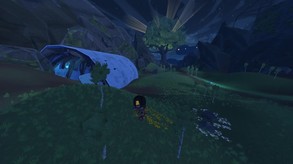
Defunct, developed by Freshly Squeezed and published by SOEDESCO, is a vibrant and fast-paced indie adventure that centers around one simple but captivating concept—momentum. The game places players in control of a small service robot that has accidentally fallen from a massive cargo ship and now must race across the surface of a deserted, post-human Earth to return before being left behind. This premise serves as both narrative backdrop and gameplay metaphor; everything in Defunct is built around the idea of motion, speed, and the joy of fluid traversal. Rather than relying on combat or complex objectives, the experience is shaped entirely by how gracefully you can move through the environment. It’s a game about mastering gravity, reading terrain, and finding that perfect flow state where every jump and slope feels effortless.
The world of Defunct is a futuristic yet strangely serene wasteland where humanity has long vanished, leaving behind remnants of their machines and technology. What might sound like a bleak setting is instead one of quiet beauty. The landscapes are wide, colorful, and full of rolling hills, deserts, and metallic structures, all designed to be traversed rather than fought over. You guide your little robot across these environments using a combination of speed-boosting mechanics and gravity manipulation. The robot’s “Gravitize” ability allows it to alter its personal gravity field: activating it downhill accelerates your speed, while using it uphill slows you down. This creates a rhythm of play that rewards smart terrain reading and timing—momentum becomes both your weapon and your challenge. The learning curve is gentle at first, but as the game progresses, mastering when and how to engage Gravitize becomes the key to maintaining velocity and chaining together exhilarating runs.
From the very beginning, Defunct makes it clear that it values feel over flash. The controls are tight and responsive, and the sense of speed, once you find your rhythm, can be intoxicating. Sliding down slopes and launching into the air before chaining into another hill feels remarkably satisfying. The inclusion of magnetic surfaces that allow you to cling to walls or ceilings adds another dimension to movement, and creative players can use these moments to string together daring shortcuts or recover from missed jumps. When everything clicks, Defunct delivers a sense of flow that few indie games manage to achieve. It captures the same kind of momentum-driven thrill found in classics like Sonic the Hedgehog or modern parkour-inspired titles, but with a personality all its own. The best moments occur when the level design and physics merge perfectly, creating stretches of terrain that feel like natural roller coasters—fast, smooth, and endlessly replayable.
Visually, Defunct uses a stylized, almost painterly aesthetic that complements its focus on movement and exploration. The world feels open and organic, with environmental storytelling hinted at through abandoned machines, rusted cities, and scattered remnants of civilization. The design doesn’t rely on excessive realism but instead uses color, light, and shape to evoke atmosphere. Each region has a distinct palette that reinforces its identity—lush valleys, sunburned canyons, and mechanical ruins all flow seamlessly into one another, giving a sense of journey even though the game is relatively short. The soundtrack is equally well-crafted, with ambient electronic music that shifts smoothly between energetic and reflective tones, depending on the pacing of each stage. Combined with the mechanical hum of your robot and the whoosh of air as you race downhill, the sound design creates an immersive sense of motion that enhances every moment of gameplay.
Yet for all its strengths, Defunct is not without flaws. Its biggest limitation is its length; the main campaign can be completed in just a couple of hours, leaving players wishing there was more to explore. While the game does include time trial challenges and optional collectibles to extend playtime, the core experience feels more like a sprint than a marathon. Once you’ve mastered the physics and learned the optimal routes, the replay value becomes largely dependent on your desire to chase better times rather than discover new content. Some segments also break the game’s pacing by introducing slow or puzzle-oriented sections that contrast sharply with the otherwise high-speed design. These moments, while brief, disrupt the flow and remind you that Defunct is at its best when it lets players move freely rather than forcing them to stop and solve minor obstacles.
The technical performance is solid for such a small-scale production. The game runs smoothly, loads quickly, and maintains stable framerates even at high speeds, which is crucial for preserving the sensation of fluidity. The physics engine, while occasionally imperfect, generally holds up well, though players might occasionally encounter awkward collisions or moments where the camera struggles to keep up with fast movement. These are minor blemishes on an otherwise well-optimized experience. The developers have clearly prioritized smooth gameplay and control precision over visual extravagance, and it pays off—Defunct feels polished where it matters most. The UI and menu design are minimal, keeping the focus on momentum and exploration rather than distraction.
Defunct’s narrative is minimal but thematically fitting. The little robot’s journey to return home doesn’t need dialogue or exposition to resonate; its struggle speaks through action. There’s a quiet melancholy in racing through a world that once belonged to humans but is now inhabited only by machines and the echoes of a vanished civilization. The environmental storytelling hints at a deeper history without spelling it out, leaving room for players to interpret meaning at their own pace. It’s a world that feels lonely yet peaceful, fast yet reflective—a paradox that gives the game emotional depth despite its brevity. The absence of overt storytelling reinforces the idea that motion itself is the story. Every hill conquered and every boost executed perfectly becomes a small act of triumph in an otherwise desolate world.
In the end, Defunct stands as a reminder that games don’t need to be massive or complex to be memorable. It’s a love letter to movement—a kinetic experience that values the physical sensation of play above all else. The combination of its fluid controls, vivid environments, and expressive world design creates a game that is both calming and exhilarating, meditative and fast-paced. Its short runtime and occasional pacing hiccups may prevent it from reaching greatness, but within its limited scope, it achieves something rare: pure, unfiltered motion that feels alive. Defunct is best approached as a compact, joyful ride rather than a sprawling adventure—a few hours of momentum and grace that linger long after the credits roll.
Rating: 8/10