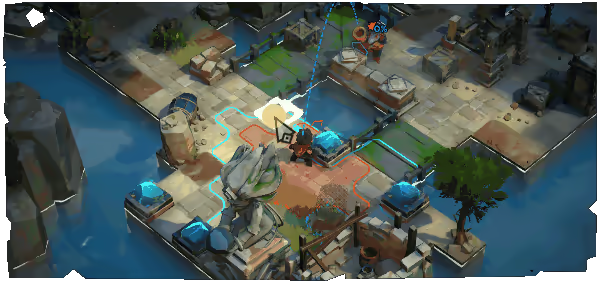
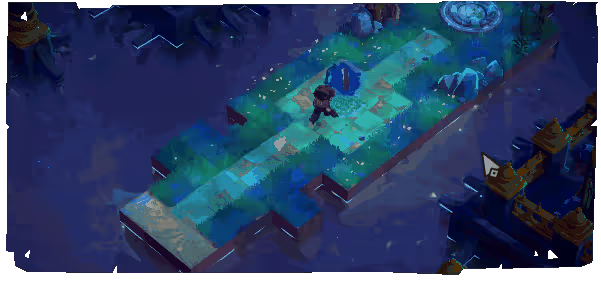
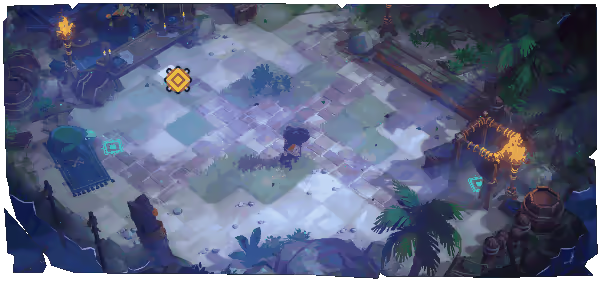
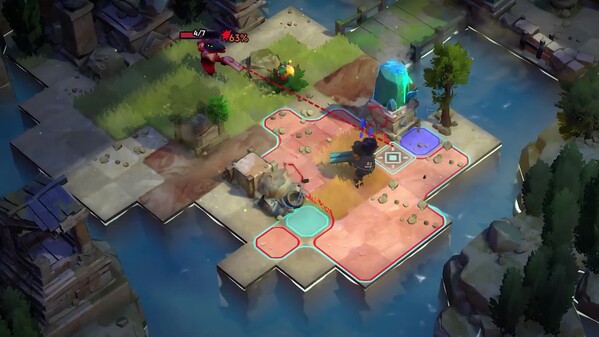
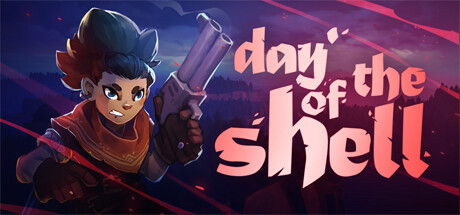
Day of the Shell is a “one-click, one-turn” tactical rogue-lite. In a shattered and flooded world, travel from island to island with only hope and a revolver, challenging and appeasing the gods.
Modeled estimate, not a reported figure. How we estimate →
Media

About
Day of the Shell is a fast-paced tactical roguelite, where each turn is played in a single click.
The gods have brought down their wrath on humanity, and only a few remote islands remain. A lonely monster huntress has risen to challenge and appease the gods, traveling through what's left of the world.
One Click, One Turn: Tactical choices are made with a single click, making gameplay simple and dynamic while maintaining strategic depth.
Explore the Islands: Survive against monsters and collect treasures on each island to open its portal. Will you be able to reach the heart of the Islands and destroy the Shell?
Shape Your Destiny: Combine the powers of the many Warden's blessings to fight your enemies. Different variations and combinations will allow you to create a unique playstyle for each game.
Death is Part of the Adventure: With each death, you return to your home island, where you can permanently upgrade or consider your strategy for the next day.

Genres
Stats
All-time low is the lowest price we've recorded for this game since we started tracking it.
Languages: English*, French, German, Spanish - Spain, Japanese, Korean, Polish, Russian, Simplified Chinese, Traditional Chinese*languages with full audio support
Engagement
Hours played at review time, across 40 reviews with recorded playtime.
Reviews
Themes across 40 recent reviews and how positive each mention is. A keyword signal, not full sentiment analysis.
positive critical· bar length = how often the theme comes up
Reviews
Sehr sehr gutes Roguelite <3
Day of the Shell, developed by Duper Games and published by Goblinz Publishing, is a tactical roguelite that builds its entire identity around an elegant, almost minimalist concept: every decision is resolved in a single action. Instead of layering complexity through numerous commands or systems, the game strips turn-based strategy down to its essentials and challenges the player to think more efficiently rather than more elaborately. The result is a focused experience that feels immediately approachable while still demanding careful planning and awareness. Set in a fragmented world shaped by divine destruction, the game places players in the role of a lone huntress navigating scattered islands in pursuit of a larger, almost mythic objective. The narrative is intentionally restrained, offering just enough context to frame the journey without interrupting the flow of gameplay. Story elements are delivered in small fragments, allowing the atmosphere and setting to carry the tone rather than relying on heavy exposition. While this approach keeps the pacing tight, it also means that the narrative never becomes a central pillar of the experience, instead serving as a thematic backdrop to the action. The defining mechanic—the one-click, one-turn system—fundamentally shapes how the game is played. Each input determines both movement and action, forcing players to think ahead and commit to decisions without the safety of incremental adjustments. This creates a rhythm that feels closer to solving a series of interconnected puzzles than managing a traditional battlefield. Every enemy position, environmental hazard, and available resource must be considered in advance, as even a single misstep can quickly escalate into failure. The simplicity of the controls makes the game easy to learn, but the consequences of each choice ensure that mastery requires precision and foresight. Despite its streamlined design, the game manages to maintain a solid level of tactical variety. Different enemy types introduce unique behaviors and attack patterns, requiring players to adapt their approach rather than rely on repetition. As runs progress, players gain access to blessings and upgrades that modify abilities or introduce new interactions, allowing for different strategies to emerge. These systems provide enough variation to keep the core loop engaging, especially during the early stages when each new discovery feels meaningful. The structure of the game is built around a series of compact, self-contained areas, each presenting a set of encounters and challenges to overcome. This segmented design keeps the pacing brisk and ensures that progress feels tangible, even in shorter play sessions. The roguelite framework reinforces this loop, with failure leading to incremental progression and a chance to refine strategy on subsequent attempts. It’s a format that works particularly well for players who prefer quick, repeatable sessions over long, continuous campaigns. Visually, Day of the Shell adopts a bright, stylized aesthetic that contrasts with its somber premise. The environments are clean and easy to read, which is crucial for a game that relies on quick decision-making and spatial awareness. Character animations are smooth, and the interface is designed to present information clearly without overwhelming the player. This emphasis on clarity supports the game’s design philosophy, ensuring that players can focus on strategy rather than deciphering the interface. However, the game’s strengths are closely tied to its limitations. The same simplicity that makes it accessible can also lead to repetition over time. While the core mechanic is well-executed, it doesn’t evolve significantly, and the structure of encounters remains relatively consistent. Upgrades and variations help extend the experience, but they don’t fundamentally change how the game is played. As a result, the sense of discovery diminishes during longer sessions, and the experience may begin to feel predictable. There is also a noticeable ceiling to its complexity. Players looking for deeply layered systems or intricate tactical interactions may find the game somewhat restrained. The challenge comes from optimizing decisions within a limited framework rather than exploring a wide range of mechanics. This design choice is intentional and aligns with the game’s focus, but it may not satisfy those seeking a more expansive strategy experience. Ultimately, Day of the Shell is a carefully crafted example of how constraint can be used as a design strength. It delivers a streamlined, engaging tactical experience that prioritizes clarity and efficiency, offering satisfying decision-making within a compact structure. While its limited scope and gradual repetition prevent it from achieving lasting depth, it excels as a focused, pick-up-and-play strategy game that rewards thoughtful execution. Rating: 7/10
A tad tedious doing the same levels but the gameplay is quite nice
game has a BUG after beating the game. i am stuck at the main menu. nothing happens if i click "play".
The game is great, the mechanics, the probabilities (whether you hit a shot or not, it makes it feel like risk and reward in some cases), but I feel the difficulty is too high, and when you reach the first boss you often arrive with few skills or upgrades, the first boss becomes a wall that prevents you from advancing (and I understand the reason that it's a boss, that it doesn't have to be easy, but the difficulty takes a huge turn), and it puts you at a great disadvantage for the following reasons: it's a field full of enemies, plus the boss has a lot of health, and the boss gives the minions a shield in one turn, which makes the fight long, and you have an 80% chance of losing. Besides the fact that there comes a point in the boss fight where you have no way to protect yourself because the environment is destroyed, leaving you exposed and sometimes taking unfair damage, something that would be great is creating different attack patterns or the same boss with different sets of attacks, so it doesn't become repetitive. I don't know much about programming and that kind of thing, but fixing that boss would greatly improve the ability to continue. I've sometimes quit the game because reaching that boss without certain skills or passive abilities that are good for fighting it, and having some that don't benefit me, makes reaching it feel unfair (do you understand?). Another thing, when you reach the second level or world, the enemies start having a lot of health and appear in droves, multiplying the difficulty. I feel it would be great to add more actions or possibilities to be able to face it, since the enemies have a lot of health and the player has little, and that's just talking about the initial part. Because perhaps later in the game this will become easier by unlocking passive or active abilities, but it gets somewhat tedious... This is my opinion, and perhaps it won't be taken into account or will be overlooked. Your game is very good, it has many things going for it, but it becomes somewhat repetitive with these issues, which are more about adjusting the difficulty and polishing certain aspects. I hope this feedback is helpful. Thank you very much for your attention.
It's tricky, and you gotta do a decent number of runs to get the baseline to beat the first boss (and even that requires some luck on the draw), but the game is very fun while offering interesting tactical situations. Do you take the shot even if you risk a low odds hit? Do you run for perfect cover or do you take a risk but move towards a goal? The destructible environment also means you are always in flux. You never know when your secure position will suddenly be a lot less secure. It does aggravate me that certain encounters can become just running nonstop or taking damage, and unless you have the right Boons, that can just be infinite until you die. And considering how few boons you get in that starter run, you might just not have them when you hit the first boss. But that's also kinda the nature of the game.
It's like Hades but turn-based. Sadly, not nearly as good or as interesting as hades, but I appreciate the dev. It's a cool game, build variety and some sort of consumable item like a grenade would add a lot more replayability. I would recommend if all the things I mentioned previously are something you like. Turn based tactic rougelikes are a niche this game fills nicely.
nice
I tried really hard to like this game but, enemies just become more of a damage sponge the more you progress.
Topzera
Related
Related
Trends
Concurrent players on Steam, sampled daily since tracking started.
Audience
Estimated from the language of this game's reviews — a proxy for where players are, not official Steam demographics.
Related
| Battle Suit Aces | $170K | 354 | 90% | $16.24 |
| Darkestville Castle | $170K | 716 | 93% | $14.99 |
| Jane's Advanced Strike Fighters | $170K | 404 | 36% | $9.99 |
| Peaceful Days | $170K | 280 | 86% | $16.99 |
| Cursed Armor | $170.1K | 691 | 89% | $9.99 |
| Moose Miners | $170.1K | 524 | 69% | $9.99 |