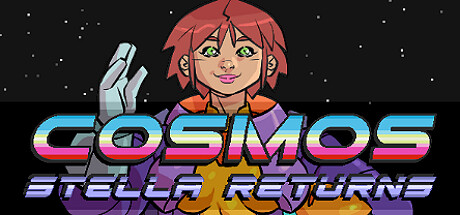
Cosmos: Stella Returns is a metroidvania that will bring you to the mysterious planet of Memoria. Shoot, jump, collect materials and new items in this action-platform with a vintage flavor!
Modeled estimate, not a reported figure. How we estimate →
Media
About


Stats
All-time low is the lowest price we've recorded for this game since we started tracking it.
Languages: English, French, Italian, German, Spanish - Spain, Japanese, Portuguese - Portugal
Engagement
Hours played at review time, across 31 reviews with recorded playtime.
Reviews
Fun game by a great dev
"Cosmos: Stella Returns" is a nice, simple and short metroidvania that is a little longer than the first installment and the story is a little more fleshed out. Play as the titular heroine who must save the human archive on supplement earth! As in other series by SEEP, some music and the enemy behaviour is recycled from the prevoius title, but hey, why not? The bosses and their patterns are still a little bland and overall the whole ordeal is nothing groundbreaking, but I liked it, for one buck something I had over two hours of retro fun with it! The devs know what they are doing and they are doing it and I can really appreciate that!
A good little Microvania. I could nitpick about a few things (ladders always felt wrong) but I knew what I was getting going into a game like this. I just wanted something to sink a few hours into and this was a fun time like Seep's other games.
Cosmos: Stella Returns is a retro-inspired Metroidvania that wears its influences proudly while carving out its own modest but heartfelt identity. Developed and published by SEEP, the game places players in the role of Stella Mironova, a spacefaring warrior stranded on the enigmatic planet Memoria. From the very beginning, the experience communicates a clear intention: to deliver a tightly focused exploration-driven action platformer that prioritizes classic design sensibilities, mechanical clarity, and a steady sense of discovery over spectacle or narrative excess. At its core, the game is built around familiar Metroidvania fundamentals. Players explore a large, interconnected world filled with branching paths, locked areas, environmental obstacles, and secrets that can only be accessed once the appropriate abilities are unlocked. Progression is gradual and deliberate, encouraging backtracking and curiosity rather than linear advancement. Each newly acquired skill meaningfully expands Stella’s movement or combat options, subtly reshaping how previously visited areas can be approached and reinforcing the satisfaction of mastery that defines the genre. Combat in Cosmos: Stella Returns is straightforward but functional, leaning into precision rather than complexity. Encounters require careful timing, positioning, and awareness of enemy patterns, especially as the game ramps up difficulty in later regions. Boss fights serve as clear milestones, testing both mechanical skill and understanding of newly unlocked abilities. While the combat system doesn’t introduce radical twists, it remains consistently engaging thanks to tight controls and well-paced enemy design that avoids overwhelming the player with unnecessary mechanics. Exploration is where the game truly shines. Memoria feels deliberately constructed to reward observation and persistence, with hidden rooms, optional upgrades, and collectibles scattered throughout its biomes. The map design encourages players to experiment and remember previously unreachable paths, fostering a strong sense of place despite the game’s relatively compact scope. Optional items and upgrades provide tangible incentives for thorough exploration, making completion feel rewarding without being mandatory for progression. Visually, the game embraces a nostalgic pixel-art aesthetic reminiscent of 1990s action platformers. The environments are cleanly designed, readable, and distinct enough to differentiate regions without relying on excessive detail. Character sprites and enemies are expressive within their limitations, and the overall presentation prioritizes gameplay clarity over visual complexity. This restraint works in the game’s favor, ensuring that platforming challenges and combat encounters remain easy to read even during tense moments. The audio design complements the visual direction well. A synth-heavy, atmospheric soundtrack underscores exploration and combat, reinforcing the sci-fi tone without overpowering the experience. Sound effects are crisp and functional, providing clear feedback for movement, attacks, and enemy actions. Together, the audiovisual elements create a cohesive retro-futuristic mood that supports immersion while staying true to the game’s old-school inspirations. In terms of pacing and difficulty, Cosmos: Stella Returns strikes a generally fair balance. While some sections may feel demanding, the game avoids excessive punishment and typically allows players to recover quickly from mistakes. The learning curve is approachable, making it accessible to newcomers to the genre while still offering enough challenge to satisfy experienced players. Optional content and collectibles add replay value for those who enjoy completionist goals, extending the lifespan beyond a single playthrough. Ultimately, Cosmos: Stella Returns is not a game that seeks to redefine the Metroidvania genre, but rather one that refines and celebrates its core principles. Its strengths lie in solid level design, consistent mechanics, and a clear respect for the genre’s roots. For players who appreciate classic action-platformers built around exploration, incremental growth, and atmospheric sci-fi worlds, the game offers a focused and enjoyable journey that feels sincere, polished, and comfortably familiar without being derivative. Rating: 7/10
I know this game is very cheap and thus i shouldn't expect too much from it, but what i dislike more than a bad game is a bad game that had potential. See this game could've been an easy good microvania but the stingey checkpoint distribution and resulting artificial difficulty dragged it down tremendously. It's literally the difference between a thumbs up or down for me, and given the very frustrating final levels in this game due to this issue i'm gonna opt for the later option. Every other aspect of cosmos stella returns is decent making it a fine albeit basic game. The combat is fine, with a rather respectable amount of different enemies for such a small game and even several bosses. Although these aren't really good bosses due to very exploitable blind spots, they are in the end bosses nonetheless. If anything, the gaunlet sections before each boss were the most fun part about the game, which played more like a shoot em up platformer rather than a metroidvania. Speaking of metroidvanianess, the game is very poor at that, while it does have a tiny bit of backtracking and ability gating, the world is barely interconnected and each level is basically 100% linear. At least going for 100% completion was easy due to this but it was still not that fun to explore in this, which is a metroidvania's most important aspect imo. The platforming was very basic but at least the controls were responsive. Enemy placements were very annoying though which made retreading old ground cumbersome. The music was fine i guess, nothing great although the aforementioned gauntlets had an upbeat and adrenaline fueled song to motivate you. Visuals were fine but uninspired and story was messy with tons of grammatical errors and typo's. One note even says 'humans humans' twice in a row??! Atleast the game ran fine with no crashes lag or bugs but there's many more complex and less frustrating metroidvania's to play so why bother with this one?
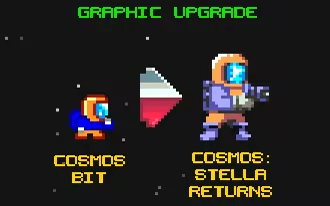
While not completely retro (4:3 play window but status bars filling the sides, modern music), [b]Cosmos Bit[/b] was clearly 8-bit styled; therefore, this is the 16-bit sequel and it shows it immediately from the main character, much more detailed and with a head as big as the old sprite. It's quite fun to recognize several old enemies who have gone through the same upgrade, looking even menacing in some cases. Due to the bigger sprites and closer view, the screen scrolls up and down much more than previously. Coupled with SEEP's always good choice of colors, and a general nailing of a SNES aesthetic, it's one of the best-looking titles they have put out so far. Under the visual upgrade, however, the game plays exactly the same, with just a few changes around that don't, however, undermine its core. The bombs always have a weird arc but the spaces are wide enough for them to be of use, and they are needed to clear a few obstacles. The emergency extra life point has been replaced by a temporary invincibility, while the "sonic" attack is now a slide that damages enemies and can travel horizontally in mid-air. Most important addition is the star icons dropped by enemies, which can be used both on emergency healing stations and on save/upgrade pods to be exchanged with gems. Given how luck-based the drops of gems are always (this time I struggled with the yellow ones), it has proved a lifesaver at times when you are just a few little gems away from crafting an upgrade. Most enemies still are annoyances, but at least there is a reward from being forced to clear the way from them. As an extra for thorough exploration, there are also some illustrated cards to be found (more on them later). From most save stations that can be found, teleporters lead to linear levels (the map isn't even active there) that cannot be revisited afterwards, culminating with bosses that, predictably as this is a SEEP game, are the least challenging part of those sections. At least they aren't all monsters floating above the player. Aside from those few innovations, [b]Stella Returns[/b] is more or less the same game, even in how new areas are unlocked (the next attack upgrade acts like a key), and in overall duration: very competently made, actually quite pretty to look at, and fun for the few hours it lasts, yet leaving a sensation that, once again, more could have been done with it. The ending leaves open the chance for future adventures of Stella Mironova, but it's not the first time I hope SEEP will use their talents for a single, bigger, more ambitious title rather than it being one of 3-4 released in a single year, like this has been. A final but important aside for the intro and ending pictures, and the cards: their styles are so different between them (there's even a realistic-style picture of the heroine at the end of the closing credits), I've been left with the strong impression that they are AI-generated, and retouched, filtered, and pixelated to hide artifacts. This being from before it became mandated to declare if and where AI is used, I'm unable to verify.
I forgot to shut the game down. My actual playtime was about 35 minutes. It fixed some of the annoyances of the original game, but the checkpoints are still way too far apart. You have 3 HP to start and it's just game over when you die and you start over from your last save, losing all progress. My quit moment was finally getting to the first upgrade, some kind of map enhancement, then I walk on to the next screen and lose my last HP to a dog that is too close to the edge to kill before it hits you. The actual game play is decently fun, but I don't have the time or patience any more to keep redoing this much content. If you do, go ahead and give it a try.
Jueguito corto y facil,con logros faciles
I find it inferior to the first game in tearms of gameplay. There are some hideous backtracking parts in this one.
Very linear, very combat focused Metroidvania with some sometimes frustrating sections. Also has a difficulty spike after the tutorial before it cools down again. Not a masterpiece but a fun game if you like blasting tough and platforming and good value if you get it on sale
Related
Related
Trends
Modeled estimate over time, reconstructed from Steam's monthly review histogram.
Momentum
Pace estimated from the game's recent review growth (our daily snapshots) at its own sales-per-review ratio — a momentum signal, not booked sales.
Audience
Estimated from the language of this game's reviews — a proxy for where players are, not official Steam demographics.
Related
| Lamia's Game Room | $3.9K | 228 | 64% | $0.49 |
| Steampunk Syndicate | $3.8K | 82 | 57% | $1.99 |
| Gore Storm | $3.8K | 69 | 94% | $2.99 |
| Blank Frame | $3.8K | 92 | 87% | $2.99 |
| 13层:公寓异常管理员 13 Floors: Anomalies | $3.8K | 125 | 66% | $0.99 |
| Box Cats Puzzle | $3.9K | 102 | 95% | $2.99 |
Related
| 7 Days to Die | $425.3M | 403.5K | 87% | $44.99 |
| Mount & Blade II: Bannerlord | $309.8M | 293.9K | 88% | $49.99 |
| Palworld | $279.6M | 445.8K | 94% | $20.99 |
| Clair Obscur: Expedition 33 | $263.7M | 178K | 95% | $47.99 |
| The Forest | $254.8M | 678.5K | 96% | $19.99 |
| Ready or Not | $238.1M | 338.9K | 78% | $49.99 |