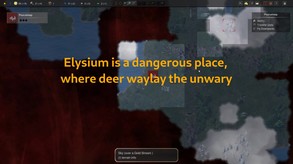
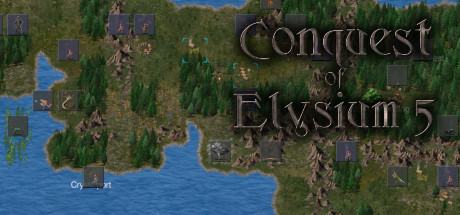
Conquest of Elysium 5 is a quick turn based fantasy strategy game with a touch of rogue-like. The game is full of depth, details and monsters. There are also a huge number of factions, each with its own unique gameplay and magic rituals.
Modeled estimate, not a reported figure. How we estimate →
Media

About
Genres
Stats
All-time low is the lowest price we've recorded for this game since we started tracking it.
Languages: English
Engagement
Hours played at review time, across 59 reviews with recorded playtime.
Reviews
Themes across 59 recent reviews and how positive each mention is. A keyword signal, not full sentiment analysis.
positive critical· bar length = how often the theme comes up
Reviews
You start a game. You move your starting army to attack a nearby town. A pack of wolves moves onto your now undefended citadel is captured and you immediately lose the game. 10/10
I wrote first review at 30+ hours, but now I want to remake it, once I hit 100 hours. There is a lot to tell, but I will try to keep it short. LIST OF ADVANTAGES AND DISADVANTAGES: + A lot of depth, achieved by numerous, mechanically different factions, numerous artifacts and troop traits. + Simple gameplay loop that becomes intuitive overtime + High replayability. Maps are randomly generated, each faction plays drastically differently and takes time to master. I am sitting at 100 hours and I still haven't played 1/3 of the factions. + Strong feel of discovery. Even playing the same faction, every game will surprise you with something new. + Lore notes are full of small jokes and curiosities, so it can be genuinely interesting to read. - Hideous UI, terrible controls. - Extremely steep learning curve - Game has insufficient descriptions. Often you read a description of a spell or a troop and you have no idea what is it doing, until you test it or read about it online. Some descriptions look more like developer's note to himself, than something that is supposed to be read by player. - No coherent database. Not inside the game, nor on the internet - Game can be unfair. Factions are not balanced to be competetive overall, they are all situational. If the map throws a situation your faction is genuinely bad at, you might lose, even if you played everything right. - No customization of the map or game rules. You have a few map presets, but there is no premade map list and you can't, for example, turn off inferno invasions or guarantee some sort of crisis happening. It's pure random and it's disappointing. BASIC GAME: It's a auto battle wargame with simple base mechanic and big depth achieved by faction rules, wildlife and random events. Instead of full faction, you choose "a class". Class is tied to one of the factions, but severely modifies it. For example, a baron, a necromancer and an enchanter are all human faction, they will have same starting units but play drastically differently. You pick hero/faction, roam around, gather points of interests, face neutrals, eventually meet other faction and you two check, who made better use of their prep time. Your faction sorcerers don't only throw lighting bolts at enemy in combat. They also can perform rituals on world map. Unlocking high level rituals is the closest the game has to research tree, since high level summons or enhanced troops are often a game changer. The trick here is - you use the same resources to unlock rituals and to cast them. So you are always trying to strike a balance, between calling for some magical support now and accumulating resources to move to the next level. Neutrals roam map freely and can take unprotected points of interest away from you. Some of the bigger packs can be tough enough to take over defended points and require an intervention of an actual hero. Overtime, some other monsters, barbarians and ancient demons can find their way to the map, messing with everyone's plans. All factions seem to have snowballing potential. FACTIONS: Each faction requires gold and iron. That's where similarities end. Most of factions could be separated to civilization based (the ones that make active use of cities and villages), nature based (the ones relying on forests and sites of magical power) and opportunistic, that can go both way, depending on situation. All factions have some semi unique resource they need, used for spell casting. This resource often largely determines priorities for the factions: Demonologist high on gold income achieved from mines is pathetic, in comparison to one, collecting his gold from villages and cities, together with sacrifices. Spell casting itself is also different for different factions. Some have convoluted rules and numerous resources, some need to nuke their own resource points for especially powerful rituals, some need to read astrology prognosis to choose optimal time for their misdeeds and some just gamble with their lives each time they attempt a summoning. For example: Necromancer needs human settlements to collect severed hands for spellcasting. He also has a variety of free spells, but they wither him away. So naturally, you hire apprentices to do the withering spells for you. Eventually apprentices go mad, you turn them into undead mages and use as a troop. Aside from that, necromancer can, wants and should seek for ancient burial sites, temples and battlefields to summon powerful undead. Eventually you can achieve immortality in three different ways, with lich being the hardest, but the most rewarding. Troll king starts with strongest hero in the game (troll king himself). He can easily take down any non magical threat and even storm cities in solo. However, even low level mage, protected by a couple of stone walls or a bunch of low level spearman can put you to rest. Troll King is irreplaceable, so you are limited in your options against civilized enemies. On the other hand, Troll King can conquer forests, to use them as citadels and collect mushrooms, that are used by his mom for primitive, but powerful rituals. Until you build a decent army of trolls, you are focusing on outskirts, ravaging villages, taking over vulnerable towns and hunting iron bogs and mines to pump up your iron and mushroom production. Barbarians are also interested in forests, but they collect herbs, that are later used to make ink to tattoo their warriors. These give them different boosts, ranging from increased speed and to invulnerability to physical damage. They are not as focused on a single hero and instead use a whole bunch of replaceable warchiefs, priests, sorcerers and seers working together. Losing a necromancer master or a troll king is a severe setback. Losing barbarian chief is a Tuesday. I do recommend the game, but only if you are already into underground indie games and are used to crappy UI, unintuitive controls and keeping game wiki open in another window
Conquest of Elysium 5 is a turn-based strategy game that is supposed to be played like a classic roguelike. I like it a lot. In this game, you lead one of the wildly different and unique classes to become the only surviving player on the map. This might involve conquering the world or perhaps surviving several competing apocalypses longer than other contenders. The roguelike comparison is important here: it is not about modern roguelite traits, but classic ones. The world is randomly generated and inherently imbalanced; some characters are clearly better suited to certain kinds of worlds; things you had no knowledge of could easily end your run; things you had knowledge of can still end your run. Sometimes you learn that you shouldn't park your army on a frozen river during the last turn of winter, extracting a valuable lesson from the experience; sometimes you learn you shouldn't venture into the Void without a way to return; but sometimes a wild dragon simply captures your capital, and there's nothing you can do about it. There are manual saves in this game but no autosaves, so the developers are clearly not opposed to the idea of you breaking Ironman mode, though they don't actively encourage it. In terms of gameplay, this game is a visitor from a world where Civilization and other genre-defining titles did not exist. It's a fresh take that doesn't take for granted conventional staples like city-building and tech trees. Some classes do develop their economy and some do have something you could call research, but more often than not your high-fantasy leader commands a high-fantasy army, trying to control the land, raise troops, and do their own thing. Every class has its own relationship with the map: they collect different resources from different sites and utilize them in their own way. More or less everyone has access to a roster of mundane, medieval-ish units, and as you control more cities, temples, and libraries, you gain access to randomly available mercenaries, wizards, and heroes. You can instruct spellcasters which spells to use in battle, and this is where your influence over combat ends: you just bring troops and see what happens. Every class adds a layer to this basic formula; many have unique commanders with specific ways of learning new spells and abilities (normal wizards have to find libraries on the map and pay gold to study), and most possess unique strategic abilities, such as summoning creatures. Usually you start with two commanders and armies can't move without commanders, and you probably have to guard your starting base, so in the beginning it feels like roguelike in more sense than one - you can only afford to move a single army around the map. But later depending on a class it can turn wildly different. I have had a victory where for most of the game I didn't move anyone out of cities we controlled, and I still won this game (everyone should try Voice of El!). Some other factions play much more like traditional map-controlling empires. There's a lot of playstyles in here. This all might sound complicated, but it is very elegantly designed. I have already listed everything you can do in this game. The game would be shallow if it didn't have hundreds of... things. There are numerous planes, such as Heaven, Inferno, Hades, or the Elemental worlds, that are simulated in the background. In most playthroughs, you won't interact with them, and you will very rarely visit them yourself. But they are all there! If a random event opens a portal to Inferno and demons come through, you can march back and bring the battle to them. Unit stats aren't complex, making it easy to understand what they do, yet you have a huge variety of units and spells, the game walks a fine line between variety and comprehensibility. It's an entertaining simulation, and it is not as imposing as it might look - then again, you can't go into this game expecting to win. It's not fair at all. But when you do win, it happens in an entertaining way, completely devoid of a boring endgame grind. Try this game. It's a good time, as long as you enter it ready to accept your fate.
This game is great. My favorite part is when you get like 8 turns in (past the hardest part in the game) and a tatsu flies out of the fog of war and snipes your citadels and you lose. No wait my favorite part is when you survive the first 8 turns (the hardest part of the game) and then you look at how many of your enemies survived and your 8 man ffa is a 3 man ffa. Actually if I think about it my favorite part is when I finally figure out the faction mechanic and I hit the "summon god" button, then read the gods description and its like "this is the weakest of all gods", then he runs around the map and solos literally everything without taking any damage. After a while I kept some stats on the games I've played so far, so here they are Games played: 48 Games made it past turn 8: 9 Games I won: 4 Games everyone lost: 1 God entities summoned: 2 Avg Difficulty: Butler Score: 10/10, I like to be abused
cant wait to drop a review 200 hours in when ive actually won
Pretty fun auto battler, the descriptions always give me a chuckle. It does reward creative thinking but can be quite punishing if you aren't paying attention. E.g. I was very excited to try out my new "curse of pigs" spell. Confidently turned a horde of a thousand geckos with pointy sticks into a horde of rampaging wild boar. Lesson learned. Next game as said geckos burning every forest i came across to flush out a druid. He was on the other side of the map, being quiet inside my territory. Hours until i bothered to check.
this game is not a ordnary strategy game but a immersive empire builder with multiple different planes to travel to. it tickles my autism right
Epic
Overpriced for what it is. Overly complex and unfun. No explanation of controls. Icons are bite sized.
One of the best games I've played. Don't recommend if you're not autistic.
Related
Related
Trends
Modeled estimate over time, reconstructed from Steam's monthly review histogram.
Engagement
DAU/MAU are modeled from peak concurrent players (≈×8 and ×28) — Steam publishes no active-user counts, so treat these as rough estimates, not reported figures.
Audience
Estimated from the language of this game's reviews — a proxy for where players are, not official Steam demographics.
Related
| Costume Quest | $1.1M | 4.1K | 94% | $9.99 |
| GOD EATER 3 | $1.1M | 9.9K | 79% | $5.99 |
| STORROR Parkour Pro | $1.1M | 1.7K | 72% | $17.49 |
| First Class Trouble | $1.1M | 4.4K | 80% | $14.99 |
| Duck Detective: The Secret Salami | $1.1M | 6.6K | 95% | $7.99 |
| Pure Farming 2018 | $1.1M | 1.7K | 73% | $19.99 |
Related
| For The King II | $7.9M | 15.9K | 71% | $24.99 |
| Legendary Creatures 2 | $35.3K | 964 | 72% | $1.79 |
| Wizard of Legend | $7.1M | 21K | 91% | $15.99 |
| He is Coming | $936.6K | 4K | 85% | $8.99 |
| Spellmasons | $531.9K | 1.2K | 92% | $19.99 |
| Legend Creatures(传奇生物) | $363.8K | 3.9K | 90% | $4.99 |