Chip’s Challenge 2, developed and published by Niffler Ltd., is a long-awaited sequel that carries a unique legacy. For over two decades, it existed as an unreleased project—complete but trapped in licensing disputes—before finally emerging on Steam in 2015. This history alone gives the game a kind of mythical status among puzzle enthusiasts, especially those who grew up playing the original Chip’s Challenge on platforms like Windows 3.1 and Atari Lynx. When the sequel finally arrived, it was not reimagined or modernized, but presented almost exactly as it had been conceived in the 1990s—a pure continuation of its predecessor’s design philosophy. The result is a game that feels both nostalgic and timeless, retaining the intellectual charm and mechanical precision of the original while expanding upon its complexity with hundreds of new puzzles and elements.
At its foundation, Chip’s Challenge 2 continues the grid-based puzzle structure that defined the original. Players guide Chip—or occasionally Melinda, his fellow puzzle solver—through intricate levels made up of tiles that represent terrain, traps, switches, and collectibles. The goal is simple in concept but devilishly layered in execution: collect the necessary microchips scattered throughout the map in order to unlock the exit and proceed to the next stage. The sequel introduces a wealth of new mechanics that greatly expand the range of puzzle design. Players can now pick up and drop items, manipulate railroad tracks, use teleporters and switches, and contend with more varied enemy behavior. Each element interacts with others according to strict internal logic, creating a chain of cause-and-effect that demands meticulous planning. The introduction of Melinda as an alternate playable character adds subtle but meaningful variety, as she interacts differently with certain tiles and environmental hazards, requiring players to rethink strategies even in familiar settings.
The game’s structure unfolds gradually, easing the player into its complex logic over the course of its two hundred levels. Early puzzles reacquaint players with familiar mechanics—keys, locks, ice tiles, and water boots—before layering in new features that test adaptability and observation. The learning curve is steady but deceptive; by the middle levels, the puzzles become truly labyrinthine, forcing players to juggle multiple objectives while anticipating every possible interaction between tiles and items. The brilliance of Chip’s Challenge 2 lies in this layered puzzle design. Solutions are rarely about dexterity or timing but about deduction and experimentation, rewarding players who are patient, methodical, and willing to think several moves ahead. Every level feels like a small, self-contained piece of logic architecture, and when all the moving parts finally click into place, the satisfaction is immense.
However, that satisfaction does not come easily. As the difficulty escalates, Chip’s Challenge 2 can become punishingly demanding. Certain levels rely on memorization or trial and error rather than pure logic, leading to moments of frustration when small mistakes force a complete restart. Some puzzles hide critical information behind what feels like unfair design—teleporters that lead to unexpected traps or items that must be used in a specific order with no margin for improvisation. The difficulty curve is uneven, likely a reflection of the game’s long and fragmented development. Some levels flow elegantly and reward creative problem-solving, while others feel like endurance tests for the most stubborn players. Yet even in its harsher moments, there is an underlying consistency in its logic; once the solution is known, it always makes perfect sense in retrospect. This adherence to fair, deterministic puzzle rules is what keeps it engaging despite the occasional frustration.
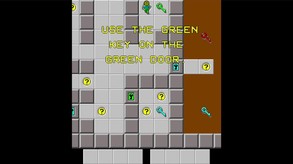
Visually, the game is unapologetically old-school. It retains the tile-based presentation of its predecessor, with pixelated sprites and a top-down perspective that values clarity over flair. Every object, from keys to monsters to floor switches, is instantly recognizable, adhering to an internal visual language that is essential for understanding the puzzles. The aesthetics might seem minimal by modern standards, but they serve their purpose: every tile communicates its function at a glance, allowing players to focus entirely on strategy. The music, consisting of simple MIDI compositions, reinforces the nostalgic tone. While not particularly memorable, it fits the calm, methodical pace of the game. Sound effects are sparse and functional, punctuating movement and actions without drawing attention away from problem-solving. The presentation as a whole prioritizes utility and nostalgia, appealing most to players who appreciate clarity and precision over spectacle.
Chip’s Challenge 2’s greatest strength is the sheer volume of content it offers. With two hundred handcrafted puzzles, it provides an enormous range of logical challenges, each testing different facets of reasoning—from spatial awareness to sequencing to resource management. The game also includes support for player-created levels through a separate editor, allowing the community to craft and share their own designs. This feature significantly extends the game’s longevity, giving it the potential to remain relevant long after all official levels have been solved. While the interface of the editor is somewhat clunky and dated, it nonetheless provides powerful creative tools that mirror the meticulous structure of the main game. For fans of the original, this feature feels like a natural evolution—an invitation to participate in the same kind of intricate design that made the series beloved.
When viewed as a whole, Chip’s Challenge 2 feels like a time capsule from another era of game design. It lacks the cinematic polish or modern conveniences that contemporary puzzle games often include, but that is precisely what makes it stand out. It demands patience, careful thought, and a willingness to learn from failure. The satisfaction it provides is rooted in mastery rather than momentary spectacle. Each completed level feels earned through reasoning and perseverance, evoking the spirit of classic PC puzzle design where depth and logic mattered more than graphics or story. It is a game that asks nothing more than for players to think, experiment, and persist.
In the end, Chip’s Challenge 2 is a labor of love that triumphs through its dedication to purity of design. It does not modernize or reinvent itself, nor does it need to. Instead, it delivers exactly what long-time fans had waited decades to experience—a faithful continuation of a classic puzzle formula expanded with new ideas and a staggering amount of content. For those who value cerebral challenge and retro sensibilities, it stands as one of the finest examples of tile-based puzzle design ever crafted. It is demanding, methodical, and occasionally unforgiving, but it rewards the kind of quiet satisfaction that few modern games can replicate. After so many years in obscurity, Chip’s Challenge 2 emerges not as a relic of the past but as a testament to the enduring elegance of pure, logical gameplay.
Rating: 8/10