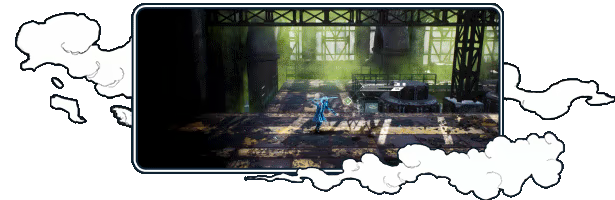
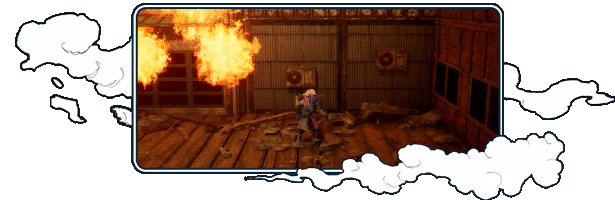
Test your limits in this hardcore, cyber-samurai game set in post-apocalyptic Japan. Parry your foes’ blows with your weapon of choice and use implants to attack the weaknesses of unstoppable bosses from Japanese folklore!
Modeled estimate, not a reported figure. How we estimate →
Media

About


Genres
Stats
All-time low is the lowest price we've recorded for this game since we started tracking it.
Languages: English*, French, German, Simplified Chinese, Korean, Russian*, Japanese*, Italian, Spanish - Spain, Catalan*languages with full audio support
Engagement
Hours played at review time, across 40 reviews with recorded playtime.
Reviews
Themes across 40 recent reviews and how positive each mention is. A keyword signal, not full sentiment analysis.
positive critical· bar length = how often the theme comes up
Reviews
Just started, the entry point is hard, and the story is very confusing at first but as you progress further it gets much clearer. And initially it feels super hard to beat even at normal level, but as you get hold of the mechanics it really gets easier. Recommended to play on normal for challenge, but you can always switch between difficulty in options. Awesome graphics BTW, really enjoy so far.
Good concept, poor execution. Using sound/smell/heat to detect enemies and overcome environmental challenges is really unique, but the game just isn't fun to play. Movement feels slow and clunky, parrying and ranged attacks are pointless as you can easily dodge everything with i-frames. The game looks decent but 90% of the time you're stuck with a colour filter over everything to show what sense you're using. Story is terrible and the writing doesn't fit the tone of the game. "I'm weird. / Yeah, you're weird." or when the Ancient AI says "Sup bro!" The dragon boss bugged out on it's 3rd phase so I had to redo the fight as there wasn't a checkpoint. Also during this fight you have to wall-climb which isn't explained, and it doesn't work well. You have to hold up to climb upwards, then hold left/right to jump sideways. If you press "A" to jump or kick off the wall like most other games you just fall. A simple explanation of the controls would have helped. There's also a complete lack of direction - no map, no guidance on which areas to travel to first. Check the Steam forums and loads of people are asking for help. I'm currently in a hidden side area which seems to be endless. Sometimes you get sent to the past and there's a random walking segment e.g. collect 3 valves to progress, push a few crates etc. and it doesn't fit with the rest of the game. This isn't worth your time so don't bother. Thankfully only wasted 85p on it.
游戏内已知雷点 1,以机械形态去微光森林时,刚进地图走不远会有一个可捡物品,捡起时角色会卡住,只能回档重来(亏损较轻) 2,诅咒空洞第三个场景有一个倒吊的怪,打死必掉一个可捡物品,捡起以后角色会卡住,需要回档重来(因为前面要走一大段路,所以重来很费时间) 备注:不管重来多少次只要是捡这些东西一定会卡住,不要手贱 目前总结有用信息: 除剧情提示升级技能以外,优先解锁第二列和第三列技能,分别为空中冲刺和地面冲刺,战斗中非常有用,满级以后冲刺可以处决大部分小怪 易卡关点: 水上祭坛的龙,主角被吞下后需要通过一些房间来过关,其中有一个房间只有两块平台,房间旋转以后会有水涨高(会直接淹死)--过关技巧:旋转时主角不可控,旋转前的地面两边有绿色高亮条状物,为主角的可抓取物品,在墙边贴近跳一下会自动抓取,然后爬到房间顶端等水落下即可苟活(然后反复苟活来打爆机关) 备注:如果打天津麻罗的时候小怪车轮战打不过,就去其他未探索地图刷经验升级技能,且击杀过的小怪只提供一次经验值,不可重复刷同一张图的同一个小怪 冲刺满级以后游戏会很简单
jogo fraco demais meu deus
Blind Fate: Edo no Yami is an ambitious and atmospheric action-adventure that sets itself apart through both its thematic fusion and its mechanical identity. Developed by Troglobytes Games and published by 101XP, the game places players in a cyberpunk reimagining of feudal Japan, where folklore, machinery, and authoritarian rule collide. Rather than presenting this world through conventional visual clarity, the game commits fully to its central idea: the protagonist is blind, and perception itself becomes a mechanic rather than a passive assumption. This design choice shapes nearly every aspect of the experience, from combat to exploration, and defines the game’s tone as much as its difficulty. You play as Yami, a cybernetically augmented samurai who serves a corrupt shogunate while slowly uncovering the truth behind his mission and his own condition. The narrative unfolds gradually, leaning into themes of obedience, loss of humanity, and distorted perception. While the story is not delivered through constant exposition, it relies on environmental storytelling, voiced dialogue, and boss encounters to build its world. The setting is one of the game’s strongest elements, presenting a haunting version of Edo-era Japan filled with mechanical demons, corrupted myths, and crumbling districts that feel both ancient and futuristic. The most distinctive feature of Blind Fate: Edo no Yami is its sensory system. Instead of rendering the world fully visible, the game obscures much of the environment unless Yami actively scans it using cybernetic senses such as sound, heat, and smell. Enemies may be little more than silhouettes or static outlines until they move, attack, or are deliberately revealed. This creates a constant sense of uncertainty and tension, forcing players to slow down, observe patterns, and gather information before engaging. The system reinforces the fantasy of playing a blind warrior relying on technology rather than sight, but it also demands patience and adaptability. Combat is methodical and unforgiving, drawing inspiration from Souls-like design without fully replicating it. Yami’s katana-based moveset emphasizes timing, positioning, and stamina management, with parries and dodges playing a crucial role in survival. Enemies are aggressive and often deal heavy damage, especially early in the game when upgrades are scarce and the sensory mechanics are still unfamiliar. Boss fights, in particular, test the player’s mastery of both combat fundamentals and perception tools, requiring careful reading of audio cues and attack rhythms rather than visual spectacle alone. As the game progresses, Yami unlocks new abilities and upgrades that expand both combat options and sensory effectiveness. These improvements gradually make the world easier to interpret and battles more manageable, creating a sense of growth that mirrors the character’s increasing awareness. However, this progression curve is uneven. The early hours can feel excessively punishing, especially for players unfamiliar with precision-based combat or those who struggle with the limited visual feedback. While later sections feel more balanced, the initial difficulty spike may deter some players before the game fully opens up. Level design follows a largely linear structure with occasional branching paths, focusing more on combat encounters than on exploration-heavy platforming. Environments are richly styled, combining neon-lit industrial zones, decaying temples, misty forests, and oppressive strongholds. While visually striking, traversal can sometimes feel stiff, and platforming elements lack the refinement seen in dedicated metroidvania titles. The world is compelling to move through aesthetically, even if mechanically it prioritizes forward momentum over discovery. Audio design plays a crucial role in selling the game’s core concept. Sound cues are not just atmospheric but functional, often serving as the primary indicator of enemy presence or danger. Voice acting and music reinforce the somber, oppressive tone of the narrative, adding emotional weight to key moments and boss encounters. In contrast, visual feedback can occasionally feel inconsistent, with hit detection or animations not always matching the intensity implied by the combat system, which can undermine immersion during high-stakes encounters. Reception to Blind Fate: Edo no Yami has been mixed, largely reflecting its bold but uneven execution. Players who connect with its sensory mechanics, challenging combat, and dark thematic direction often praise it as a refreshing and daring take on the action genre. Others criticize its rough edges, including repetitive enemy encounters, imprecise controls at times, and a learning curve that feels more punishing than rewarding. These criticisms are valid, but they coexist with genuine admiration for the game’s willingness to take risks rather than follow established formulas. Ultimately, Blind Fate: Edo no Yami is a game defined by ambition. It does not always succeed in harmonizing its ideas into a consistently polished experience, but its commitment to concept and atmosphere makes it memorable. For players willing to engage with its demanding mechanics and unconventional approach to perception, it offers a distinctive journey through a grim, cybernetic mythos. It may not appeal to everyone, but for those seeking something different in the action-adventure space, it stands as a bold and thought-provoking experiment. Rating: 6/10
不提这稀烂的手感和迟钝的反馈,二段跳加冲不能攀爬是什么操作?触顶不能二段落下的时候反而能二段跳??最脑瘫的就是暂停再返回都有可能触发的敌人消失的bug让你死都没法死,必须返回主菜单再进入重打一遍。
Clunky movement and combat. Story is ok Too many collectibles that needs backtracking on same map over and over. Got tired and don't wanna complete it.
Настолько лютая хрень с деревянным управлением, однотипными врагами, невнятными боссами - что я впервые (!) за 13 лет пользования Steam хотел сделать возврат, но именно этот кусок взял в магазин Бука и вернуть не получится))). Поздравляю разработчика Troglobytes Games и издателя 101XP - вы смогли сделать то, что не удавалось даже самому откровенному трэшу со дна стима. Всем, кто посмотрел на скрины и прочитал в описание и отзывах про киборга-самурая, японский фольклор - хочу сказать, что тут есть туповатые диалоги, попытки в самурайский пафос и нулевой геймплей. Я вас предупредил) UPD: Спустя 10 часов мата и мучений, я прошёл основной сюжет и полностью прокачал персонажа, осталось пройти дополнительные секретные уровни - правда есть сомнения, что я буду этим заниматься когда-либо. Сюжет, даже не смотря на кривой перевод, можно оценить на 5 из 10, хотя он не нов и вполне банален. По всем остальным аспектам игры - резкий негатив: * Прокачка - долгий гринд на одинаковых противниках, опыта требуется много, а дают мало. * Механики - мини-игра с ударом в уязвимую точку сильно ломает ритм и динамику боя, также как и QTE-добивания. Зачем эти качели в динамичной игре решительно не ясно. * Билды и их вариативность - играть нужно только так, как придумал разработчик. Первые 4 или 5 навыков вообще без вариантов выбрать самому, игра просто не даст. Дальше нужно качать навыки по одному из каждой ветки, если качаешь только одну - страдаешь от противников, которые прям специально заточен под недостающую атаку или навык. * Противники - на основных уровнях их где-то 6-7 видов, но секретке встретил пару новых, возможно, тут есть разнообразие, но оно скрыто от игрока. * Боссы - есть пара, которых нужно просто долго и упорно тыкать атакой, есть пара больше похожих на квестовые головоломки (залезть на дерево с QTE, от атаки не увернутся, если не подойти к краю арены и не пробежать по стене). Последний босс - это вообще отдельная дичь: 9 фаз, из которых 6 - QTE (это же интерактивное кино, не?), остальные - убивает любым касанием, еще и регистрируется не просто попадание мечем, а просто нахождение в какой невидимой области.
Pretty slow paced, the gameplay tried to implement something new with the senses, but honestly it's just a miss for me. It was fun at first, but then it just got repetitive and boring.
E' vuoto sia a livello grafico, in alcune cose come interfaccia e luoghi, ma a livello di gameplay, pensate che sto per dire che sia bello? NO E' ANCORA PEGGIO
Related
Related
Trends
Modeled estimate over time, reconstructed from Steam's monthly review histogram.
Momentum
Pace estimated from the game's recent review growth (our daily snapshots) at its own sales-per-review ratio — a momentum signal, not booked sales.
Audience
Estimated from the language of this game's reviews — a proxy for where players are, not official Steam demographics.
Related
| Decline's Drops | $76.7K | 222 | 95% | $14.99 |
| FreeCell Quest | $76.7K | 277 | 81% | $9.99 |
| Butterfly's Poison; Blood Chains | $76.7K | 106 | 94% | $44.99 |
| 7,62 High Calibre | $76.7K | 479 | 75% | $4.99 |
| Palindrome Syndrome: Escape Room | $76.7K | 547 | 82% | $9.99 |
| Trap Legend | $76.7K | 582 | 96% | $9.99 |