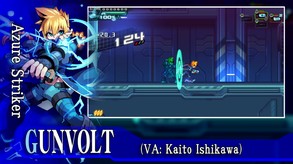
The ultra-refined 2D side-scrolling action you remember from "Azure Striker Gunvolt" is recharged and better than ever! In Gunvolt 2, series anti-hero Copen joins the fray as a playable character! Copy abilities from defeated boss characters and use them as your own!
Modeled estimate, not a reported figure. How we estimate →
Media

About
Stats
All-time low is the lowest price we've recorded for this game since we started tracking it.
Languages: English, French, Italian, German, Spanish - Spain, Portuguese - Portugal, Traditional Chinese, Korean, Japanese, Simplified Chinese
Engagement
Hours played at review time, across 40 reviews with recorded playtime.
Reviews
Themes across 40 recent reviews and how positive each mention is. A keyword signal, not full sentiment analysis.
positive critical· bar length = how often the theme comes up
Reviews
azure striker gunvolt 2 привлекла меня сильнее первой, сейчас объясню почему, 2 играбельных персонажа, новые злодеи, часть из которых мне запомнилась, более интересные уровни и боссы итог - эта часть вышла более крутой, тоже стоит ознакомления с ней
Azure Gunvolt 2 is more Azure Gunvolt. It looks good, sounds good, and this time [i]plays[/i] good too. This game includes more levels and a second playable character with a full campaign. It is still plagued by some faults that existed in the first game, but they are not as severe here. It is the same run-and-gun Mega Man style gameplay, but with much better level design. Narratively speaking, it assumes you have played the first game. If you care about the story, you will unfortunately need to play that to get the full experience, though the story itself is nothing special. [h2]Story[/h2] This game follows the same narrative structure as the first. You have an introduction with cutscenes, after which you can freely choose which boss level to do in any order. There are no cutscenes in between, so the story is easily ignorable. You have optional scenes you can view at the level select with your companion, which are also easily skippable. The scenes are charming at best. Finally, there is a big story segment at the end. Additional story is told through mid-level dialogue, which is just as bad as in the first game. This time, you cannot accidentally miss it, which is an improvement. However, boss battle monologues are the worst part. Each time, you must sit and dodge just to read what they are saying, and it is not always trivial information either. To get the final "true" endings, you must play the final level two times per character, which is a little annoying. There is no indication in-game that you must do this, other than the lacklustre default ending. Both stories from Copen and Gunvolt feel quite threadbare. You do not learn much about either of them or their supporting cast. Bosses are not particularly well developed either beyond their single monologue. Some reappear slightly more often, but most meander and do not meaningfully contribute to the story. You also learn very little about the antagonists. The main antagonist of this game was a minor boss in the previous title, which is an interesting throwback but ultimately inconsequential. The most enjoyable part of the story was the side interactions between Copen and Gunvolt's supporting cast. These are viewed awkwardly during level select, where you roll the RNG in the hopes of getting a non-repeat scene. It is clunky. There is also a secret epilogue if you complete enough objectives. It is not really worth the effort to see. [h2]Gameplay[/h2] You can play as Gunvolt and Copen, each with distinct styles of play. General gameplay still revolves around high scores and is otherwise quite easy due to pre-evasion. Pre-evasion being on by default is a poor choice, as it feels like easy mode is enabled automatically. If you want any semblance of challenge, I recommend turning it off. [h3]Gunvolt[/h3] Gunvolt plays exactly the same as before, and it is just as good here as it was in the first game. You tag enemies, zap them, and win. High scores focus on zapping many enemies at once, getting simultaneous kills, and avoiding damage. In contrast to the first game, Gunvolt’s levels are much less gimmicky with respect to his electricity. The most interesting twist is the water level, where using electricity drains all your EP if you are submerged. Otherwise, the levels are fairly generic, such as an ice stage. [h3]Copen[/h3] Copen is dramatically more agile than Gunvolt. His core mechanic revolves around his "bullets", which he uses to dash. If he collides with an enemy mid-dash, he gains Gunvolt’s auto lock-on, and firing his gun will hit that enemy from anywhere on the screen. Getting high scores with Copen mainly involves staying airborne, as that maintains the combo. Colliding with an enemy refreshes the used dash charge, encouraging you to dash into enemies consecutively. You dash extremely fast and far, making him a blast to play. Copen’s levels lack strong gimmicks or themes based around his moveset. This is not necessarily a bad thing, but it is noticeable when compared to Gunvolt. Most levels are reused between Gunvolt and Copen across both campaigns, with subtle differences. Each character has four unique levels out of eight or nine total. I suspect this reuse hampered the creativity of some stages. [h3]Equipment System[/h3] Gunvolt’s equipment system remains mostly the same as in the first game. He can equip modifications to his gun, his EP, two eye accessories, and more. Copen, on the other hand, uses a "memory" system. You can equip anything as long as you have enough memory slots, with each item consuming a significant amount. Some items are generic, such as damage reduction, while others grant movement abilities like double jump or air dash. Copen’s options feel more generic overall compared to Gunvolt’s. [h3]Quests[/h3] Quests are moderately improved. You no longer need to manually accept three every time you return to the level select, which is a massive quality-of-life improvement. However, they are still very monotonous. A quest such as "Complete stage under 11 minutes" unlocks "Complete stage under 8 minutes", forcing you to replay levels even if your best time already meets all criteria. This is quite annoying. Some quests are unique to specific levels, but they are not particularly interesting. They reward materials used to craft gear for each character. [h3]Crafting[/h3] After each level, you are given random materials. All of their sprites look very similar, making it difficult to tell materials apart. Beyond that, the RNG-based system means that if you want to craft something specific, you have no idea how to obtain the required materials. Are they tied to certain levels? Are some more likely to drop in specific stages? The game never explains this. The system is frustrating and actively interferes with engaging in the entire equipment system. This was also an issue in Gunvolt 1. [h3]Level Design and Bosses[/h3] Level design is vastly improved over the first game. In Gunvolt 1, many enemies fell from the ceiling directly onto you or fired from off-screen, resulting in unavoidable hits. This happens far less here. Cheap hits are much rarer, making S+ ranks feel more attainable. However, cheap hits still exist, primarily in boss fights. Some bosses have poorly telegraphed moves, particularly when they suddenly jump or move across the arena in unpredictable ways. Many boss ultimate attacks function more like puzzles that must be learned rather than tests of pure reaction. This leans heavily into memorisation for high scores, which is not appealing to me. Gunvolt, and to some extent Copen, still suffers from poor visual clarity when using EP moves, leading to additional hits. These issues discourage me from learning levels deeply enough to pursue S+ ranks. The combo requirements are too strict given how often you can take unavoidable or barely visible hits. On that note, S ranks are much easier to obtain than before. It feels far better than constantly earning B ranks, but it also feels overtuned. I frequently achieved S ranks on my first attempt. Despite performing very well, I often failed to reach S+. The gap between S and S+ feels massive. The ranking system would benefit from interim ranks, such as "SS" or "SSS", to provide a clearer sense of progression toward S+. Once again, vocal tracks are tied to achieving a 1000+ combo, which is frustrating. You want to trigger them, but reaching the threshold is difficult, and maintaining it is often brief. This significantly undermines a large portion of the soundtrack. [h2]Conclusion[/h2] I highly recommend this over the first game. The levels are fun, and the new playstyle brought by Copen makes the experience feel fresh. The story is... present. It is plagued by many of the same issues as the first game, but overall this feels like what the original should have been.
Azure Striker Gunvolt 2 is a fast-paced, electrically charged 2D action-platformer that builds upon the foundation of its predecessor while refining its mechanics and presentation to near perfection. Developed and published by INTI CREATES, the studio renowned for its expertise in side-scrolling action games, it represents the best qualities of classic Japanese game design—tight controls, layered combat systems, expressive visuals, and a distinct sense of style. The sequel expands the world and gameplay of the original by offering two distinct protagonists, each with their own playstyles, narrative perspectives, and thematic arcs. Rather than simply being an iteration, Gunvolt 2 feels like a parallel evolution, one that sharpens the identity of the series and celebrates both precision and flair in equal measure. The story continues the saga of Gunvolt, an adept warrior who wields the power of lightning, as he faces new threats in a world struggling with the aftermath of psychic wars and technological upheaval. His nemesis-turned-ally, Copen, joins as a fully playable character, providing a stark contrast in both personality and gameplay. While Gunvolt fights with elegance and finesse—tagging enemies with his gun before detonating them with bursts of electric energy—Copen fights with aggression and mobility, dashing into enemies to mark them and then unleashing a flurry of homing attacks. The inclusion of two protagonists gives the game a natural duality: Gunvolt’s playstyle emphasizes control, positioning, and resource management, while Copen rewards timing, precision, and risk-taking. Each character’s campaign offers a unique perspective on the overarching narrative, with overlapping encounters and personal motivations that give the story a more rounded emotional depth. The narrative itself remains pulpy and melodramatic in the best way, full of anime energy and earnest dialogue that complements the larger-than-life tone of the game. What makes Azure Striker Gunvolt 2 stand out among modern action games is the precision of its design. The controls are sharp and responsive, giving players a sense of flow and rhythm once they master each character’s mechanics. The levels are crafted to test that mastery, mixing linear speed segments with pockets of exploration, hidden collectibles, and optional challenges that reward both curiosity and execution. Each stage introduces new hazards, enemy types, and mechanics at a pace that keeps the experience fresh, culminating in elaborate boss encounters that test reflexes and strategic thinking. Bosses are the true stars of the game—each one is an extravagant display of pattern recognition and mechanical spectacle, demanding adaptability as players learn to dodge projectiles, counter attacks, and exploit weaknesses. The ranking system encourages replayability by rewarding clean, efficient play, motivating players to perfect their runs and chase the coveted S-rank scores. The addition of side missions and optional challenges further expands the game’s longevity, making it a rewarding experience for both casual players and dedicated completionists. From a presentation standpoint, Gunvolt 2 is a masterclass in retro-modern design. The pixel art is rich and expressive, combining classic sprite aesthetics with modern effects such as dynamic lighting, smooth animation, and explosive particle work. The environments are varied and visually engaging, ranging from industrial complexes and neon-lit cities to crumbling ruins and high-tech laboratories, each pulsing with the game’s signature electric energy. Every transformation, attack, and explosion feels deliberate and impactful, reflecting the precision of INTI CREATES’ craftsmanship. The soundtrack complements this energy perfectly, blending fast-paced electronic tracks with melodic flourishes that heighten the sense of urgency and emotion. Each boss encounter is accompanied by a powerful theme that enhances the drama, while quieter interludes give the game moments of reflection amidst the chaos. The optional Japanese voice acting adds authenticity and character to the dialogue, even if the frequent chatter during missions can sometimes distract from the action. The game’s structure embraces replayability through its dual campaigns and branching challenges. Playing through Gunvolt’s route offers a sense of continuity from the first game, focusing on fluid traversal and chaining attacks, while Copen’s campaign feels like a mechanical counterpoint that redefines the rules of engagement. His dash-centric style gives battles a more aggressive rhythm, and his ability to copy enemy abilities introduces a layer of experimentation reminiscent of the Mega Man series. Each character’s toolkit is balanced and satisfying, allowing players to approach the same environments in completely different ways. The learning curve is steep but fair, and as players begin to internalize movement patterns and attack timing, the game opens up into a seamless, exhilarating experience. For those who thrive on mechanical mastery and score optimization, Gunvolt 2 delivers in spades, while still remaining accessible enough for newcomers to enjoy. Although the game’s foundation is solid, its ambitions are conservative. Azure Striker Gunvolt 2 doesn’t radically reinvent its formula—it builds upon it. Some levels echo the structure of the first game, and the sequel’s emphasis on refinement over innovation may leave players wishing for more daring evolution. The abundance of dialogue and story sequences can also disrupt the pacing for those eager to jump straight into the action. Yet, these minor drawbacks are overshadowed by the sheer polish and confidence of the design. Every encounter feels intentional, every mechanic tightly integrated, and every victory satisfying. The brevity of individual stages, combined with the depth of scoring systems and replay challenges, makes the game ideal for both short bursts of play and marathon sessions. In the end, Azure Striker Gunvolt 2 stands as a vibrant showcase of what makes 2D action games timeless. It carries forward the spirit of the classic side-scroller while infusing it with modern fluidity and artistic ambition. The combination of slick mechanics, dual protagonists, and strong aesthetic design results in an experience that is as stylish as it is satisfying. INTI CREATES proves once again that precision, passion, and attention to detail can elevate even a simple premise into something special. Whether you’re drawn to the kinetic rhythm of Gunvolt’s electrical artistry or the relentless aggression of Copen’s acrobatics, the game delivers a sense of mastery that few modern action titles can match. It is a refined, confident sequel—one that doesn’t need to reinvent itself to remind players how exhilarating the art of 2D action can be. Rating: 9/10
I think that the gameplay is decent but it is hard to say for sure because the game keeps bombarding me with unnecessary dialogues all the freaking time. just shut up already, tell me how the controls work, nobody gives a damn about the story.
一如既往的inti的美少年美少女都很美味,系统只要稍微上手一下就可以打得很爽而且也有新手保护(指无限阳炎和复活),就走个流程体验双主角高速横版+AVG也很棒。 故事主打的就是王道中二热血少年漫风,但制作应该也是知道游戏受众并非物理层面上的少年们所以还夹杂了很多怪话和让人姨母笑的地方(双主角都有拒绝女装话题,汐安感到了焦虑.jpg,网络大肘子赛托斯),看着角色们的吐槽和反应还是很快乐的。 槽点比较大的白毛男二阿Q拉乃迫真雄小鬼版名护启介(前期),[spoiler]全剧结束了这魔怔人居然都还没吃过一次人格修正拳,整的他在剧中唯一一次情绪崩溃的CG成了游戏中最大的笑点。[/spoiler] 总的来说对于喜欢横版的玩了肯定不亏,写给大人看的少年漫也很有趣,推荐。
Joguei Azure Striker Gunvolt 2 e gostei do rumo mais sombrio da história, isso torna a experiência mais interessante. O fator replay também melhorou bastante, especialmente por poder jogar com Copen. No entanto, o que me desagradou, e ainda desagrada, é a qualidade da tradução para o português. A localização tem muitos problemas, com adaptações desnecessárias, principalmente a troca de nomes originais japoneses por versões ocidentalizadas, como "Acura" virando "Copen". Entendo que parte disso vem da localização em inglês, que a tradução brasileira seguiu, mas mesmo com mais pessoas envolvidas na equipe de tradução, isso não trouxe melhorias perceptíveis. A experiência acaba perdendo parte da identidade original do jogo por causa disso.
与上一部相比有了双主角,还有专门为两人分别设计的不同关卡,内容上很丰富。成为新的可玩角色的角色亚裘拉在游戏性上设计得挺好的,空中冲刺撞击的锁定方式,以及通过空中连击进行得分判定的机制都很好玩,但是人设就有点魔怔了。剧情上最后的结局更是烂完,作为一个双主角的作品很难想象为什么要搞出这种两边不讨好的剧情,融合角色本来就是常见的雷点还把素材的记忆都抹杀了,搞得两主角忙活了半天都成了小丑,直接把前面决战塑造出的气氛都毁了,就冲这个结局就值得一个差评。
"My song is...always...inside you..."
I've 100%'d this game twice before, and I was more than happy to again. This is one game I ALWAYS come back to, it's been a top favorite of mine ever since I played the original version back on the 3DS.
Exelente jogo, pegou os pontos fortes dos primeiro jogo, removeu muito problemas e adicionou um personagem extremamente gratificante de jogar. Apesar de imperfeito, é muito divertido e inovador, mesmo que muitos comparem a mega man, gunvolt é, sem dúvida, uma franquia única!
Related
Related
Trends
Modeled estimate over time, reconstructed from Steam's monthly review histogram.
Audience
Estimated from the language of this game's reviews — a proxy for where players are, not official Steam demographics.
Related
| Fargone | $208.6K | 595 | 69% | $11.99 |
| Glass Masquerade 2: Illusions | $208.6K | 3.2K | 91% | $4.99 |
| Fleeting Iris | $208.6K | 565 | 75% | $13.99 |
| Fantasy Aquarium | $208.5K | 918 | 78% | $6.99 |
| Night Shift Nurses | $208.5K | 642 | 84% | $19.99 |
| BEARS, VODKA, BALALAIKA! 🐻 | $208.4K | 2K | 90% | $1.99 |
Related
| 7 Days to Die | $425.3M | 403.5K | 87% | $44.99 |
| Mount & Blade II: Bannerlord | $309.8M | 293.9K | 88% | $49.99 |
| Palworld | $279.6M | 445.8K | 94% | $20.99 |
| Clair Obscur: Expedition 33 | $263.7M | 178K | 95% | $47.99 |
| The Forest | $254.8M | 678.5K | 96% | $19.99 |
| Ready or Not | $238.1M | 338.9K | 78% | $49.99 |