Atama is an atmospheric horror-stealth game developed and published by Team Zutsuu that blends psychological tension, Japanese folklore, and an inventive perspective mechanic to create a distinct and haunting experience. The story centers around Kaede, a woman drawn to a remote village after receiving a final, cryptic letter from her aunt, who hints at an old family curse and a legacy that cannot be ignored. What begins as a quiet return to one’s roots soon unravels into a descent through the supernatural decay of Kisaragi Village, a place swallowed by silence and haunted by restless spirits. The narrative unfolds with restraint, letting environmental details and fragments of notes carry the burden of storytelling. There are no lengthy cutscenes or expositional monologues—only an eerie sense of history and inevitability. Atama’s strength lies in this subtlety; it doesn’t explain everything, instead letting its empty streets, abandoned shrines, and flickering lights whisper the truth to those willing to listen.
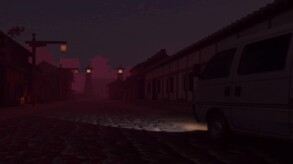
The visual design of Atama captures the stillness and dread of traditional Japanese horror through deliberate simplicity. The environments—forests, shrines, and half-collapsed buildings—are sparse but suffused with atmosphere. Rather than relying on sharp textures or flashy effects, the game focuses on contrast and shadow, allowing the world to breathe through its emptiness. The soft glow of lanterns, the faint outline of fog on the ground, and the claustrophobic darkness of narrow alleys all combine to evoke a feeling of isolation and vulnerability. The enemies—grotesque, floating heads and twisted spirits—emerge from this gloom with startling clarity. Their strange movements and distorted forms are terrifying not because of their realism but because of their uncanny otherness. The sound design complements this perfectly: whispers carried by the wind, the distant shuffle of feet, and moments of complete silence create an ever-present unease. When danger draws near, the sound of your heartbeat rising and the enemy’s heavy breath become your only warnings, grounding the horror in anticipation rather than surprise.
Atama’s most defining feature is its use of perspective as a gameplay mechanic. In addition to the standard stealth approach of avoiding detection and moving quietly, the player can momentarily see through the eyes of their pursuers. This ability transforms the familiar act of evasion into something strategic and unnerving. Watching the world from an enemy’s view—seeing yourself from their vantage point, realizing how close you are to being found—creates a sense of disembodied tension rarely achieved in the genre. This mechanic encourages memorization of patrol routes, environmental awareness, and timing. You are never armed, never capable of direct confrontation; survival depends entirely on patience and observation. The game’s pacing mirrors this restraint, alternating between slow, cautious exploration and brief, frantic escapes that test both nerves and reflexes. The design rewards careful thought, forcing the player to adapt and make use of limited knowledge to survive in an environment that offers no forgiveness.
Despite its creativity, Atama is a short and tightly contained experience. Most players can finish it in one or two sittings, and the simplicity of its structure leaves little room for mechanical evolution. However, this brevity also ensures that the tension never dissipates; the game doesn’t overstay its welcome. Each area feels deliberate, each encounter precisely placed to build unease rather than overwhelm. The repetition inherent in stealth gameplay is softened by the variety of environments and the escalating unpredictability of the enemies’ behaviors. Occasionally, the AI can behave inconsistently, leading to moments where you escape detection in unlikely ways or get caught unfairly. These issues don’t derail the experience, but they remind you of its small-scale, indie origins. Still, the game’s ambition and atmosphere far exceed what its limited budget might suggest. It’s clear that the developers understand that horror is most effective when rooted in mood, rhythm, and uncertainty rather than in raw spectacle.
Atama succeeds because it knows exactly what kind of experience it wants to deliver. It is not about power, victory, or elaborate progression systems; it is about the sensation of being hunted, the discomfort of existing within someone else’s gaze, and the slow unraveling of a forgotten past. The game’s focus on restraint—both visual and mechanical—makes every encounter feel personal, every sound a potential threat. Its Japanese setting, rooted in traditional aesthetics of quiet terror, gives it a timeless, folkloric quality that sets it apart from Western horror conventions. For players who appreciate tension over action and atmosphere over exposition, Atama offers a rewarding, nerve-wracking journey through darkness and memory. It may be short and unpolished in places, but its haunting tone, inventive perspective mechanic, and unnerving sense of isolation make it one of those rare indie horror games that lingers in the mind long after the screen goes dark.
Rating: 7/10