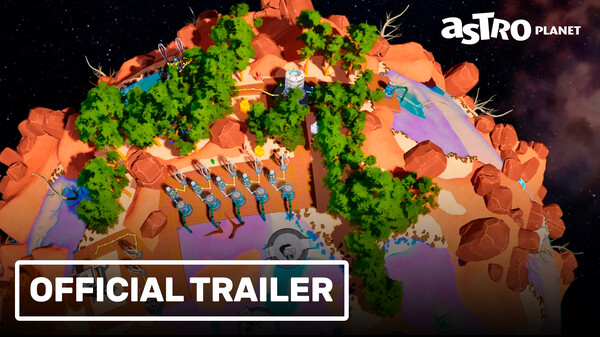
AstroPlanet is a survival and base-building sandbox game developed and published by VIVA. The game places players in the role of a lone astronaut stranded on an unfamiliar alien world after a catastrophic crash. With no immediate rescue in sight, the only option is to survive using the limited tools available and gradually build the technology necessary to turn the hostile environment into a habitable settlement. Combining elements of exploration, crafting, resource management, and terraforming, AstroPlanet attempts to create a compact survival experience centered around rebuilding life on a barren planet.
The narrative framework is relatively simple but serves its purpose well. After the player’s spacecraft is destroyed during a landing attempt, the astronaut is left alone on a distant world with an atmosphere that is not naturally suited for human survival. Oxygen is scarce, resources are scattered across the landscape, and the planet itself presents environmental challenges that make long-term habitation impossible without technological intervention. The astronaut must begin constructing equipment, shelters, and life-support systems in order to remain alive while slowly expanding the base of operations. What begins as a desperate struggle for survival gradually evolves into an ambitious project to reshape the planet’s ecosystem.
Gameplay initially focuses on gathering essential resources from the surrounding environment. Players must explore nearby terrain to collect materials such as minerals, crystals, and other components needed for crafting tools and structures. These early stages emphasize basic survival tasks such as building shelter, producing oxygen, and establishing energy sources that allow equipment to function. As more resources are gathered, the player gains access to additional technologies that expand the possibilities for base construction and environmental manipulation.
One of the central gameplay loops revolves around resource management. Every piece of equipment and every building requires materials, which forces players to carefully balance their priorities. Some resources are needed to maintain life-support systems, while others are required for expanding the base or constructing automated production facilities. Deciding how to allocate these materials becomes an important part of the strategic decision-making process. Efficient resource use allows players to grow their base faster and unlock more advanced technologies.
Terraforming is one of the game’s most distinctive mechanics. Instead of simply surviving on the alien world, the player gradually gains the ability to alter the planet’s environment. Through specialized machines and environmental technologies, players can introduce oxygen into the atmosphere, cultivate plant life, and convert barren terrain into greener landscapes capable of sustaining life. This transformation process happens slowly over time, but it creates a rewarding sense of progress as the planet begins to change in response to the player’s actions.
Exploration plays an equally important role in the experience. The alien world contains multiple areas that offer valuable resources and hidden discoveries. Venturing further away from the safety of the base often reveals new materials, strange geological formations, and occasional hazards that challenge the player’s survival skills. Exploration not only provides essential materials but also unlocks new technological blueprints that allow the player to improve equipment and expand the settlement.
The base-building system gradually becomes more complex as the game progresses. What begins as a small survival shelter can eventually grow into a larger outpost with multiple interconnected systems. Players can construct resource processing machines, energy generators, farming facilities, and automated production lines that streamline the gathering of materials. Managing these systems requires careful planning, particularly when balancing energy consumption and resource flow within the base.
Visually, AstroPlanet adopts a bright and stylized art direction that emphasizes the alien nature of its world. The landscapes feature unusual rock formations, colorful terrain, and environmental details that create a sense of exploring a truly foreign planet. While the graphical detail is modest compared to large-budget survival games, the visual style succeeds in making the environment feel distinctive. The gradual transformation of the planet during the terraforming process also adds visual variety, as areas that were once barren begin to show signs of life.
The audio design complements the feeling of isolation that defines much of the game. Ambient sound effects such as wind, machinery, and distant environmental noises help create the impression of being alone on an unfamiliar world. The background music is subtle and atmospheric, allowing players to focus on exploration and construction while reinforcing the quiet tension of survival.
Despite its appealing concept, AstroPlanet does show some limitations in terms of scale and variety. Compared to larger sandbox survival games, the number of different systems and environmental events is relatively modest. After players become familiar with the main mechanics of gathering resources, building structures, and terraforming the environment, the gameplay loop may begin to feel somewhat repetitive. Additionally, the overall size of the world and the range of missions available are smaller than those found in more expansive survival titles.
However, the game’s smaller scope also contributes to its accessibility. AstroPlanet focuses on delivering a clear and manageable survival experience without overwhelming players with overly complicated systems. The straightforward progression from basic survival to planetary restoration provides a satisfying sense of achievement, especially for players who enjoy building and transforming environments over time.
Overall, AstroPlanet is an enjoyable indie survival sandbox that emphasizes exploration, construction, and ecological transformation. Its combination of base building, resource management, and terraforming mechanics creates a gameplay loop that steadily rewards patience and experimentation. While it may lack the depth and content variety of larger survival games, its focused design and thematic emphasis on rebuilding a damaged world make it a compelling experience for players who enjoy science-fiction survival adventures.
Rating: 6/10