Astraeus is a compact yet ambitious real-time strategy game that rethinks the genre through the lens of virtual reality. Developed and published by E McNeill, the game places players not above a battlefield, but inside it, surrounding them with glowing asteroid networks, flowing resource lines, and swarms of ships fighting for control. Rather than attempting to replicate traditional RTS complexity wholesale, Astraeus focuses on clarity, spatial intuition, and rapid decision-making, resulting in a strategy experience that feels distinctively shaped by VR rather than merely adapted to it.
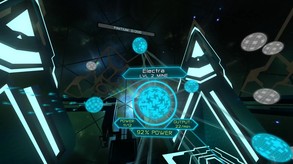
The central concept revolves around controlling an asteroid belt where each asteroid functions as a strategic node. From the earliest moments, players are tasked with deciding how to specialize each rock—whether to mine valuable Finitum, generate power to sustain the network, or manufacture ships for offense and defense. These roles are simple on their own, but their interdependence quickly creates meaningful tension. Power must flow efficiently across your territory, mining operations must be protected, and production hubs must be positioned to respond to enemy incursions. Because everything is visually represented as glowing connections in three-dimensional space, understanding the health and reach of your empire becomes an intuitive, almost physical experience.
What truly sets Astraeus apart is how naturally it leverages VR to communicate strategic information. Instead of panning a camera or zooming through menus, you simply turn your head or lean in to inspect different parts of the battlefield. Supply lines arc through space like constellations, and fleets move in visible streams between asteroids, making it easy to grasp where pressure is building or resources are bottlenecked. This spatial awareness replaces much of the micromanagement typical of RTS games, encouraging players to think in terms of territory flow and network integrity rather than individual unit commands.
Combat in Astraeus is fast and decisive, favoring momentum over attrition. Battles tend to resolve quickly once supply lines are disrupted or production nodes are overwhelmed, reinforcing the importance of strategic positioning over brute force. Because there are no complex unit upgrade trees or deep tech paths, success depends largely on timing, expansion choices, and reading your opponent’s intentions. This streamlined approach keeps matches brisk, often wrapping up in under half an hour, which suits the immersive but physically demanding nature of VR play sessions.
The game offers multiple ways to engage with its systems, including skirmishes against AI opponents and multiplayer matches. AI behaviors can be tuned to emphasize aggression, economic expansion, or balanced play, giving each match a slightly different rhythm. A narrative-driven mode adds personality through light storytelling and a talkative AI companion, injecting humor and context into what is otherwise an abstract struggle for resources. While the narrative is not the game’s primary focus, it provides a welcome layer of charm and helps ground the experience.
Visually, Astraeus opts for clean, minimalist aesthetics that prioritize readability over spectacle. Asteroids, ships, and energy flows are clearly delineated, ensuring that even in the heat of battle, players can quickly understand what’s happening around them. This restraint works in the game’s favor, particularly in VR, where clutter and visual noise can become overwhelming. Sound design complements the visuals with subtle effects and ambient tones that reinforce the sci-fi atmosphere without distracting from strategic decision-making.
That said, the game’s simplicity can feel limiting over long periods. Without deeper progression systems or varied unit types, experienced strategy players may find that they exhaust the available tactics relatively quickly. The lack of long-form campaigns or evolving mechanics means that Astraeus shines brightest in short, focused sessions rather than extended marathons. Its appeal is strongest for players who value elegant systems and spatial problem-solving over exhaustive depth.
Community reception reflects this balance of innovation and limitation. Players interested in VR strategy often praise Astraeus for making RTS concepts feel natural and approachable in three dimensions, while others note that its niche focus and modest scope prevent it from achieving the staying power of traditional PC strategy classics. As an experiment in VR design, however, it stands out as a thoughtful and confident attempt to explore what strategy can look like when freed from the flat screen.
Ultimately, Astraeus succeeds by embracing restraint and designing around the strengths of its medium. It does not aim to replace traditional RTS giants, but instead offers a streamlined, immersive alternative that feels genuinely tailored to virtual reality. For players curious about strategy games in VR—especially those who enjoy quick matches, spatial reasoning, and elegant systems—it delivers a distinctive and memorable experience that highlights how perspective alone can transform familiar mechanics.
Rating: 6/10