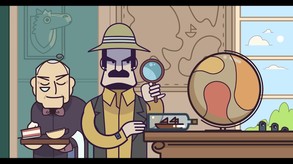
Explore the deepest caves with a cup of tea in your hand, reach the heart of the jungle with your finger on a globe, send your highly educated employees to uncivilized tribes and don't let them convince you it's a certain death! The worst case scenario? You will hire new ones.
Modeled estimate, not a reported figure. How we estimate →
About
Genres
Stats
All-time low is the lowest price we've recorded for this game since we started tracking it.
Languages: English**languages with full audio support
Engagement
Hours played at review time, across 40 reviews with recorded playtime.
Reviews
Themes across 40 recent reviews and how positive each mention is. A keyword signal, not full sentiment analysis.
positive critical· bar length = how often the theme comes up
Reviews
Comprato per il design davvero bello e variopinto, ma sono rimasto deluso dal gameplay. Molto lento nel progredire con una curva di difficoltà non molto bilanciata. Non lo consiglio.
A far too abstract push-your-luck game with an awfully bad tutorial and introduction. For this to have been released years after Renowned Explorers is just mad. I can't think of anyone to recommend this game to, who wouldn't be having a better time with a narratively richer game like Renowned Explorers or a snappier push-your-luck styled game like Skull or Dead of Winter.
Archeo: Shinar is what looks like some kind of browser/mobile app that's mistakenly been put on Steam. This is a simple click-turn "business simulator" game where you manage a team of archaeologists, assign them to "jobs" and click through the various RNG events that plague your career of digging things up for profit. I can't stress enough how surprised I am to see this isn't just a webpage, but instead a paid product on Steam. Must be some kind of joke, right? From a technical perspective, the game doesn't meet basic minimum requirements that most PC gamers expect as standard. While there are options to change the resolution for the game, all this does is scale up the simplistic 2D art assets used to make the game, which makes little or no difference to the graphics quality. Without any other substantial graphics tweaks, it's not possible for gamers to improve the lacklustre 2D visuals. The game features mostly static, barely animated 2D images, the kind of thing you expect to see in browser/flash games. While the artwork itself, while mediocre, might be considered passable, the visual presentation here is negligible, it might as well be a slideshow or a Youtube video. Pac-Man, Space Invaders and Asteroids had more advanced animation and visuals going on than this game does. The controls can't be customised because the game has such a dumbed down, simplified interface that it's just point and click stuff like a browser/Flash game. The fact that the interface is this dumbed down might be seen as a problem in itself, however... this is a fairly shallow experience if you're the kind of gamer that likes to play games with deep, rich control schemes and interaction. You'll get none of that here. For gameplay purposes, because the user interface for this game is mostly just 2D static images... it might as well be a browser game. And we all know, Steam isn't here to compete with Chrome and Firefox. If the game can be done in a web browser, it's just not rich or compelling enough to appeal to serious gamers on PC. These technical defects push this game below acceptable standards for any modern PC game. Reviewing SteamDB to check how popular this game was with players reveals a surprise... there's a modest spike in player counts for the game. But this only happened once, around the same time that trading cards were applied to the game... so this is just card idlers getting their cards and moving on. A closer look at the numbers shows the game just has a couple of players every week running up the game and idling it for cards, then deleting it. We must ask how it benefits gamers for there to be so many games like this, with no merit as a serious game, that only generate sales from people idling and selling the trading cards. Archeo: Shinar has the laughable, eye-watering price of $13 USD, for which you could easily get any number of older AAA games. Given the defects and quality issues with the game, coupled with the unrealistic price, this is impossible to recommend. For comparison, the $13 asking price for this game could get you games like "Bioshock Infinite", "Subnautica" or "Project Zomboid". Quality, professionally made games like those are frequently on sale cheaper than this. There's also thousands of free, superior quality games on Steam.
not fun
Blech. Cumbersome interface that wasn't play-tested nearly enough. Inscrutable RNG. Ugly art. Menus aren't consistent and windows don't respond consistently. Too many unnecessary and un-fun mechanics tossed in willy-nilly. Worst of all, just plain uninteresting. Overall, it's a chore to play, and the reward is just enough story to bore you to tears.
Interesting management game but it falls completely short in immersion.
Archeo: Shinar, developed and published by Artists Entertainment, is a witty and multifaceted management simulation that explores the business side of archaeology—a subject rarely seen in gaming. Rather than letting players live out the cinematic fantasy of being an adventurer in the field, it throws them into the bureaucratic, financial, and ethical struggles behind every expedition. You play as the head of an archaeological organization during the golden age of exploration, juggling staff, funding, politics, and morality as you pursue fame and fortune in uncovering ancient artifacts. It’s a game that satirizes the romance of archaeology while celebrating the thrill of discovery, delivering a complex mix of humor, strategy, and tough choices. The core gameplay revolves around managing your team of researchers, explorers, and assistants while preparing expeditions to exotic, dangerous regions around the world. Every decision—from who to hire and how to train them, to which site to excavate and how much risk to take—carries long-term consequences. Your employees have individual stats, personalities, and needs; pushing them too hard or ignoring their well-being can lead to fatigue, accidents, or even rebellion. Financial management is equally crucial. You must balance your budget carefully, deciding whether to invest in equipment, pay wages on time, or risk taking loans. The threat of bankruptcy looms over every turn, and running out of funds can quickly bring your budding empire of explorers crashing down. Expeditions serve as the beating heart of Archeo: Shinar. Once your team is assembled, you send them to explore new regions—jungles, deserts, mountains—each filled with hazards and potential treasures. Success depends not only on preparation and staff skill but also on luck and strategic foresight. You may discover relics that can be sold to museums or shady buyers, or stumble upon cursed ruins that endanger your entire team. The outcome of each expedition is partly determined by probability, which injects a sense of unpredictability that mirrors the real-life uncertainties of exploration. This risk-reward balance makes every expedition thrilling, as a perfect plan can still fail spectacularly. What makes Archeo: Shinar stand out is its sense of personality and dark humor. The writing embraces irony, poking fun at the moral contradictions of early 20th-century archaeology—colonial arrogance, corporate greed, and the commodification of history. Characters gossip, complain, and express their fears or ambitions through dialogue that gives the game its distinctive tone. Even the menus and random events drip with sardonic wit, offering scenarios that challenge your ethics as much as your business sense. Should you sell a priceless artifact to a private collector for a fortune, or donate it to a museum for prestige? Should you exploit a newly discovered site despite the warnings of local tribes? These moments give the game emotional and thematic depth, turning what could have been a simple management simulator into a clever reflection on human ambition and corruption. Visually, Archeo: Shinar opts for a minimalist yet effective style. The art direction favors clean lines, muted colors, and stylized character portraits, giving it a polished, board game-like feel. The interface is intuitive and well-organized, presenting complex systems in an approachable way. While it lacks high-end animations or dynamic visuals, the charm lies in its presentation of information—it feels tidy, efficient, and professional. The soundtrack complements the experience with subdued, thematic music that underscores the tone of the game without becoming intrusive. Together, the presentation and sound design reinforce the atmosphere of being both a scientist and a capitalist opportunist in the world of archaeology. However, Archeo: Shinar is not without its rough edges. Its steep learning curve can be daunting, especially for new players unfamiliar with management or strategy games. The tutorial covers the mechanics but doesn’t fully explain the reasoning behind them, leaving players to experiment through trial and error. Some mechanics, particularly in the expedition phase, rely heavily on random chance, which can make outcomes feel arbitrary despite careful planning. The game’s pacing can also drag during the mid-to-late stages, as the core loop of managing resources, training staff, and sending expeditions repeats with limited variation. Players seeking a faster or more narrative-driven experience may find its methodical pace a bit too slow. Yet for those who appreciate detailed simulations and slow-burn strategy, Archeo: Shinar offers immense satisfaction. It rewards careful planning, risk assessment, and adaptability, all while weaving humor and moral ambiguity into its systems. Few games manage to make the administrative side of exploration this entertaining, and fewer still succeed in balancing satire with depth. Each playthrough feels like a case study in ambition versus ethics—a commentary on how easily noble pursuits can become tainted by greed and vanity. Ultimately, Archeo: Shinar is an intelligent and unconventional management game that turns archaeology into both a business and a moral battleground. It combines sharp humor with strategic complexity, forcing players to think not only about survival but also about what kind of legacy they wish to leave behind. While its learning curve and reliance on luck may deter some, its distinctive concept and clever writing make it a hidden gem for players who enjoy thoughtful, system-driven games. It’s an experience that proves history is never just about what we uncover—it’s about the choices we make in the process. Rating: 7/10
💋
TL;DR - Poorly made, feels incomplete/unpolished - Poor artistic, UI and tutorial choices - Min-maxing is encouraged, but not fulfilling - Generally disappointing I hadn't even started the game and I had a lot to say. Music The menu theme when you start the game is amusingly short at about 25 seconds and, annoyingly, it doesn't loop well. Think triumphant exploration music that concludes abruptly before starting back up again. It was grating. I will grant that once I started a game, the main menu theme changed to something that looped a lot better. Disregarding that, the music is really delightful in general. There's an in-game record player where you can select background music. The vibes range from up-beat and exploratory to really chill and lovely. Personally, I really like both the Postcards songs. Sad to see non of the music is on Spodify. Voice Acting There is voice acting in this game. An interesting choice, as I feel a game like this wouldn't need voice acting, save for maybe the "letter from my father" intro sequence. Which, by the way, isn't volume mixed correctly. The other voice actors are about on the same volume level while the intro sequence is way too loud. I listened to a total of 3 voice actors in my admittedly short playtime of this game and I wanna say they suffer from poor mic quality issues (I don't know enough about audio to really say) and one voice actor was just... let's say not great. This lead me to the bewildering discovery that, in a game that has voice acting, there is not a voice volume bar in the settings menu. Not even a toggle. You have to turn down Global volume for the voices, which turns down everything. The Tutorial I admit, I did not spend long in the tutorial (there are 5 parts) because it was the most annoying thing I had to endure from a game in a while. In tutorial fashion, you cannot click anything other than what the tutorial tells you to click. We enter character creation (which in hindsight, why is there character creation in the tutorial?) and every button is there to see. Male/Female toggle, hair arrows, face arrows, name text box, super damn simple. "Cuppy", the tutorial cup that is voiced, has a paragraph to say for every action you take. She tells you to choose the gender, you click She greets you, you click her dialogue box She asks you to name yourself, you name yourself She goes on for no reason about your family name for about a paragraph and tells you to pick your appearance, but you have to click her dialogue box first, not the arrows She takes another paragraph to tell you where the arrows are thAT YOU CAN CLEARLY SEE She takes another paragraph to talk about your appearance, even though you only took one action, and asks you to pick a stamp, you pick a stamp She tells you to click done Literally none of that was necessary. It's character creation. Why the ♥♥♥♥ do I need a play by play in character creation. This isn't Baldur's Gate with a million sliders for every detail, there's not much to explain. Note: there are portions of the tutorial where you can't access the options menu to exit, so you have to sit through it. She talks in paragraphs for no reason in most of the tutorial, which I didn't finish as most of it you can intuit yourself. Art style and animation This game has a very charming art style, though there are a couple of style inconsistencies here and there. I have also noticed that many of the assets suffer from resizing, as some of them are crisp and clear while others are bloated and fussy or pixelated. The animation is boiled down to throwing around and resizing PNGs, ala work-place-training-video, and there are many instances where animated assets go out of UI bounds. It's a choice, and in my opinion as an artist myself, it isn't a very good one. It makes everything feel really unpolished. There are ways to get around a huge animation work load and this choice brought me out of any emersion I had (But maybe that's just me, as I would notice details like that). It may have benefited them more to not have animation at all. UI It seems as though some of the UI isn't sized correctly. I'd changed my resolution properly, but the options button seems a bit small. This goes for back buttons and font sizes as well. On that note, there isn't a settings button in the options menu. You have to exit your game and go to the main menu if you want to change any volume settings. Also, half the buttons are styled and rounded while others are just dark boxes with text. (I also ran into a bug where I couldn't click on the character portraits during an expedition. I could only click on the character names.) The Gameplay You start with a party of people who you can send on expeditions. Each character has 7 skills that you can increase, which scratches my min-maxing itch. Once you're on an expedition, there will be pop ups for you to assign a person in the group. These pop ups are timed and shows a skill needed to complete the task. However, you don't have a way to see each persons skills. You have to remember the skills they have from before you started the expedition. This mechanic would be cool and fine if I didn't have 7 skills and 5 characters to keep track of, with the implication that you would get even more characters as you play. And of course, even if you pick the best person, there's still a chance you can fail. It deflates the satisfaction of min-maxing character skills in certain areas. Outside of expeditions, there's a real estate mechanic, a black market, a place to buy and sell items for your people, and a place to grow your influence. Conclusion Ultimately, I got annoyed with this game. Put simply, it's poorly made. Which is disappointing, because in concept, the gameplay loop could be really fun. However, it seems like it's designed to have a long-ish playtime (I wouldn't know, I only played a couple hours) but I'm not sure the replayability would survive that. Really looking at it, this game consists of a handful of menus and chance. It's worth $8, maybe even $5, but definitely not $13. This review is posted long after the updates have stopped, so there doesn't seem to be any hope of improvement. I got this game on a 90% sale, which is about $2. Obviously, experiences are different between people and frankly, there's nothing *wrong* with this game. But I could definitely have a better time playing something else, and I think you would too, so I can't recommend it.
Love the idea of this game, but the gameplay loop is very minimalist and dull.
Related
Related
Trends
Concurrent players on Steam, sampled daily since tracking started.
Momentum
Pace estimated from the game's recent review growth (our daily snapshots) at its own sales-per-review ratio — a momentum signal, not booked sales.
Audience
Estimated from the language of this game's reviews — a proxy for where players are, not official Steam demographics.