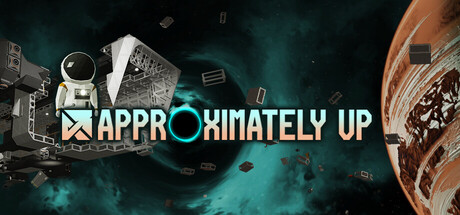
Build, crash, rebuild! Explore new planets in co-op multiplayer with your fully modular spaceship made from whatever bolts together long enough to fly. Mount giant thrusters, annoying cables, and everything in between. Complete wild missions, face the dangers of space and argue with your crew!
Modeled estimate, not a reported figure. How we estimate →
Prices
Each in the currency that store quoted — not converted: the gap between two rows is the publisher's pricing, not an exchange rate.
Every market we collect.
About
Approximately Up is your best chance to experience spaceflight in whatever you and your crew (singleplayer or co-op multiplayer with up to 4 players) can bolt together! Build epic spaceships or barely flying trashcans — it’s entirely up to you. Control your creation from a first-person view right from the deck of your ship. Complete challenging objectives, hunt achievements, face the dangers of space, and collect new components to expand your current spacecraft — or build hundreds of new ones. One is never enough!
Everything begins with a single piece of frame and grows into a massive, complex ship built from thousands of components. Create automated systems, experiment with different input controllers, sensors, and meters — connect them to whatever you need, and let the magic (or chaos) happen! Once it looks ready (or not), hit launch and see what happens!
Experimental power sources that need to be delivered to a station on another planet — causing unexpected power outages mid-flight? Some strange energy crystal charging up like a ticking time bomb? Or maybe it’s just a massive, ridiculously heavy submarine this time? Can your spaceship handle that?
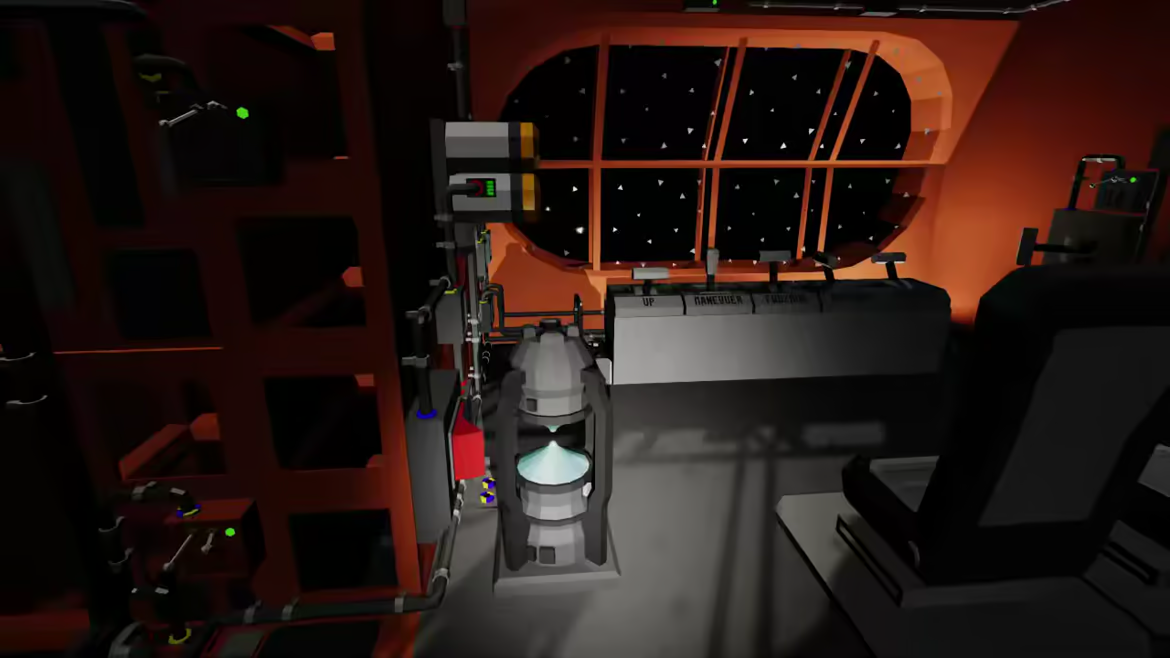
Is the planet covered in oceans? What’s hiding beneath that thick atmosphere? Can you see the surface through those massive clouds? Everything’s waiting for you to find out! Explore 15 unique planets, each with its own look, feel, and dynamic soundtrack that changes in real time as you explore and make new discoveries!

Who forgot to connect that cable? Who mounted the thruster backward? Who forgot the solar panels? Or the door-opening button? Is the radar working? How about the batteries? Enjoy the hilarious chaos in co-op multiplayer with up to 4 players — and find out once and for all... WHOSE FAULT WAS IT?!
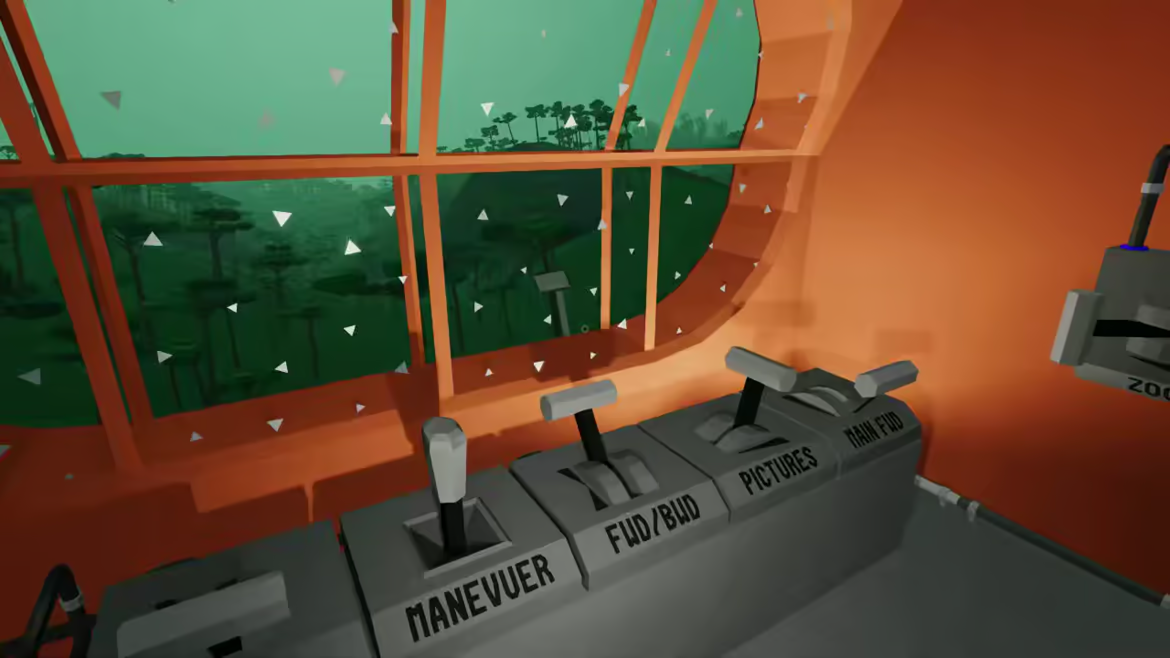
You start on Earth and slowly explore a system of 15 planets, each with its own size, gravity, atmosphere, temperature, and challenges that make every world feel different. Most planets have one or more Planet Stations, which work as checkpoints and garages where you can build ships and start new missions. When you land on a station, it unlocks permanently and becomes a new place you can launch from. To reach these planets, you build your own modular spaceships and experiment with different parts - electric engines, fuel engines, mixed fuels, solar panels, heat-resistant frames, and more. By completing missions like delivering components between planets, you earn new ship parts that let you create better and more advanced designs. All flights are fully first-person from inside your craft, and because distances are huge, your ship design really matters - some trips will take only minutes, while others can turn into long journeys if your ship is weak. The whole game is about exploring planets, upgrading your ships, unlocking new stations, and trying to make it to your destination without crashing.
Note: Demo currently supports English only. Additional languages will be available in the full release.
Engagement
Reviews
Themes across 811 recent reviews and how positive each mention is. A keyword signal, not full sentiment analysis.
Reviews
I'm not sure why this is being advertised as a wacky party game when it's much more of an in-depth space sim. It's basically Stationeers but for spaceflight instead of exocolonies. Regardless, it's already a very well-made experience, and I'm not halfway through despite already sinking 65 hours of my time into it. It seems like a shoo-in for best vehicle building game of 2026.
Approximately Up is a space exploration and engineering sandbox built around the idea that constructing the spacecraft is just as important as successfully flying it. Developed and published by Approximately Games, it combines first-person adventure, vehicle construction, simulation, planetary exploration, missions, and cooperative multiplayer. Rather than handing players professionally designed spacecraft, the game encourages them to assemble their own machines from individual components and discover through experimentation whether those creations are actually capable of surviving a journey into space. Ship construction forms the heart of the experience. Players begin with structural elements and gradually assemble increasingly complicated spacecraft using engines, controllers, sensors, meters, electrical equipment, batteries, solar panels, fuel systems, and other functional components. These elements are not simply decorations because they influence how the finished vehicle behaves. Power generation must support whatever equipment has been installed, propulsion needs to provide enough performance for the intended journey, and controls have to be arranged so the player can actually operate the machine. A design can therefore look perfectly reasonable while hiding an engineering mistake that only becomes apparent after launch. The freedom offered by this system encourages experimentation rather than forcing everyone toward one ideal spacecraft. Players can construct relatively sensible vehicles or create enormous and unconventional machines containing huge numbers of individual parts. Different propulsion technologies provide additional possibilities, including electric and fuel-based solutions. The result is an entertaining relationship between creativity and practicality. Adding more equipment may provide greater capability, but additional complexity can introduce new problems involving weight, energy consumption, fuel, controls, or reliability. Building something ridiculous is easy; making that ridiculous creation function effectively is the real achievement. Approximately Up gives all of this construction a purpose through its mission system. Assignments can require players to transport unusual and potentially troublesome cargo, including experimental equipment, dangerous materials, and extremely large objects. Such objectives turn spacecraft design into an ongoing puzzle. A vehicle that performs well during ordinary exploration may be unsuitable for carrying a massive payload, while another design might have enough thrust but lack sufficient endurance for a longer journey. Completing missions also rewards additional components, steadily expanding the range of machines that can be constructed. Exploration takes players beyond Earth and across a system containing 15 different planets. These locations feature variations in gravity, atmosphere, temperature, scale, appearance, and environmental conditions. Some worlds contain extensive oceans, while others are obscured beneath enormous atmospheric formations. These differences are important because traveling to another planet is not merely about reaching a different visual environment. Changing conditions can expose weaknesses in a spacecraft and encourage players to redesign their vehicles specifically for particular destinations. Planet Stations provide an effective progression mechanism for these expeditions. Reaching and landing at a station permanently unlocks it, allowing future adventures to begin from that location. This means successful exploration gradually expands the player's network of useful starting points. It also prevents every expedition from requiring a complete journey from Earth. Combined with the component rewards obtained through missions, these stations create a satisfying sense that exploration permanently improves the player's ability to travel farther and attempt more ambitious projects. The first-person perspective adds considerably to the game's personality. Players physically occupy and operate their homemade spacecraft instead of controlling everything from a distant strategic viewpoint. Cockpit organization, controls, instruments, and internal construction therefore become meaningful parts of the experience. This perspective should make successful launches more satisfying while making engineering disasters considerably more entertaining. Realizing halfway through a journey that an essential system was connected incorrectly has a very different impact when the player is standing inside the malfunctioning vehicle. Cooperative multiplayer extends that concept to groups of up to four players. Friends can work together while constructing and operating spacecraft, dividing responsibilities or creating complete organizational chaos. The engineering systems naturally produce situations where players can debate who forgot an important component, incorrectly connected a system, or made an unfortunate design decision. This gives cooperative play an organic source of humor rather than relying entirely on scripted comedy. Single-player support remains available, however, allowing the construction, exploration, and mission progression to function as a solo experience. The game's complexity could also become one of its main obstacles. Players primarily interested in immediate spaceflight may find the detailed construction process demanding, especially when troubleshooting electrical systems, propulsion, controls, and other interconnected equipment. Inefficient designs could also make certain journeys unnecessarily long. Yet failure is clearly intended to be part of the experience. Approximately Up is less concerned with producing flawless spacecraft than with letting players learn why their latest creation failed and then return to construction with a better solution. Steam Workshop support further complements the sandbox approach by creating opportunities for players to share and experiment with community creations. Together with achievements, Steam Cloud functionality, online cooperative play, and the extensive construction mechanics, it gives the project room to remain interesting beyond simply reaching every destination. Much of its long-term appeal should come from inventing increasingly elaborate spacecraft rather than completing a strictly linear campaign. Approximately Up stands out because nearly every major mechanic supports the same central idea. Missions provide reasons to build, construction provides solutions to those missions, rewards expand engineering possibilities, and planetary exploration continually introduces new challenges for those creations. The combination of technical experimentation and deliberately chaotic humor gives it a distinct identity. Players who enjoy engineering sandboxes and learning through spectacular mistakes are likely to get the most from it, especially with friends. Approximately Games has created a concept where an ugly spacecraft barely reaching its destination can feel more rewarding than piloting a perfect machine that was provided from the beginning. Rating: 8/10
Media

Related
Related
Price dynamics, follower growth, revenue and sales trajectories with interactive tooltips
This and every other Pro feature is free until October 20, 2026. A free account is all it takes.
Genres
Stats
All-time low is the lowest price we've recorded for this game since we started tracking it.
Languages: English, French, Italian, German, Spanish - Spain, Portuguese - Portugal, Japanese, Korean, Russian, Simplified Chinese, Czech, Polish +2 more
Hours played at review time, across 812 reviews with recorded playtime.
positive critical· bar length = how often the theme comes up
This Game Is Brilliant! Everything that I’ve always wanted in a space exploration game!!
UWU
Building is fun, flying is fun, crashing is sometimes fun too
skib very fun could use a HUD
Awesome game. Stationeers meets Kerbal Space Program.
yes
во
10/10, build, crash, fly, interesting game for co-op.
Selling now
See how fast this game is selling right now — estimated copies and revenue per day from recent review growth.
Active players
Estimated daily and monthly active players (DAU/MAU) modeled from peak concurrency.
Players by region
Where this game's players are, estimated from review languages.
Players also reviewed
The games this title's players most often review too — audience affinity.
Related
| Game | Estimated lifetime revenue | Reviews | Review score | Price |
|---|---|---|---|---|
| $2.8M | 3.8K | 95% | $19.99 | |
| $6.2K | 394 | 66% | $0.49 | |
| $2.7K | 12 | 92% | $5.99 | |
| $2.2K | 20 | 45% | $4.99 | |
| — | 0 | — | — | |
| — | 0 | — | — |
Related
| Game | Estimated lifetime revenue | Reviews | Review score | Price |
|---|---|---|---|---|
| $1.1M | 914 | 66% | $34.99 | |
| $1.1M | 4.7K | 84% | $7.99 | |
| $1.1M |
| 2.2K |
| 81% |
| $19.99 |
| $1.1M | 3.1K | 94% | $19.99 |
| $1.1M | 4.8K | 51% | $14.99 |
| $1.1M | 14.3K | 90% | $2.49 |