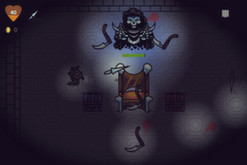
Conquer the forces of Death in A Wizard’s Lizard, an action RPG for Windows, Mac, and Linux. Explore ever-changing dungeons, filled with powerful weapons and items. Battle back the hordes of evil. Rescue villagers to improve your town and increase your power for your next trek into the dungeon.
Modeled estimate, not a reported figure. How we estimate →
Media
About
Stats
All-time low is the lowest price we've recorded for this game since we started tracking it.
Languages: English
Engagement
Hours played at review time, across 50 reviews with recorded playtime.
Reviews
Themes across 50 recent reviews and how positive each mention is. A keyword signal, not full sentiment analysis.
positive critical· bar length = how often the theme comes up
Reviews
It starts out being a blast as you rescue townsfolk, get newer and better items, and get further along into the game; but eventually devolves into repetitiveness. Although a roguelike in vein of TLoZ and BoI, it hardly gets very random. Due to this, as your skill level goes up, you get further in just to be hit by gobs of enemies. This is where the game's fault lies in as the enemies tend to take a lot of punishment before going down. As you get to the final area of the game, it gets worse in this regard as now said sponge enemies now hit like trucks and with every death you'll just be visiting the same rooms over and over and over. Now in an average roguelike, this wouldn't be a problem. In AWL, it's hardly random enough to give the player a reason to continue to do so. Finding blueprints enables you to reduce the luck element by finding a good enough item that you can now use at the beginning of the game upon purchasing it. However, even that process could essentially be considered "grinding" as you're going through the same places yet again to get something to help you get through the game's 3 main areas. Due to enemies spamming you in large amounts and them being able to take a heavy amount of punishment; rather than them changing up tactics, (or even getting new attacks or becoming faster for example) they essentially don't do anything creative with them. Everything else, such as the music, is passable at best. Overall, the game's faults will eventually wear you out on enjoying it.
You awaken in a Wizard's Tower as Raga, the adorable reptilian familiar of a great wizard, only to witness your master being taken away by Death himself. After a brief tutorial, it turns out the little guy wants to take on Death's Crypts and its perils all alone and here your adventure begins. The story is very straight forward, very effective and is perfectly reminiscent of the best titles of the 80s and 90s. [i]A Wizard's Lizard[/i] is a fantastic new top-down ARPG dungeon crawling experience which borrows many light elements from the roguelike genre, making it a more than worthy addition to Steam's growing library of rogue-lites. While beginning [i]A Wizard's Lizard[/i] I can see that buried under all of it's simple and elegant charm there is a lot of content to be discovered. The first thing I noticed is that aside from our strong-willed little Lizard mascot, there are 4 more mysteriously blacked out character slots for unlockable types all of varying look and ability. After the short cutscene and tutorial you stumble into the huge halls of a luxurious and massive museum where you learn that the cherished artifacts of this sprawling monument have been stolen by, once again, Death himself. There are at least six different vast rooms in the museum all full of empty podiums for you to fill up with items, enemies and a vast array of other unlockables that you find throughout your journey, just another telling sign of the incredible amount of content and replayability that you will find with this game. Your next stop before getting into the chaotic meat of this addictive game is the town which you'll notice at first seems a little empty. You find out that lost in the Cemetery ahead are the people of this once thriving town for you to find who will give different perks such as discounts in shops which are all persistent throughout your plays and once again adds another insane layer of content to this already hefty game. As you find people certain areas of the town will fill out for you to interact with including the Shop and Tavern, creating more and more reason to revisit the starting area as you delve deeper and deeper. You have several main abilities to master in your endeavors through the dungeons ahead including your main weapon which is tied to precise right-stick directions, a dash ability, soul Orbs which act as bombs, and Totem Poles which act as defensive towers with different forms for you to find and try. There are loads upon loads of different items and artifacts to find of varying abilities such as the skill to see damage numbers in combat or increased attack power and every single one of them alters your gameplay just enough to change up your playstyle on every consecutive run, keeping you on your toes each time. The game is definitely challenging though you are given a second chance with the very cool and unique life/death system, plunging you into the realm of the dead upon the loss of life and turning you into a ghost for extended play. This isn't as much of a relief as it sounds, however, as you will be joined by the rampaging spirits of foes killed in the past. As you get into the core gameplay things happen very quick instantly throwing you into the hectic rooms of the cemetary all of which are procedurally-generated and randomized in classic roguelite fashion, bustling with hordes of enemies and destructible objects scattered all across the enviroment. The action itself is very tight, precise, fast paced twin-stick fare which require quick reflexes and fast thinking with your arsenal of abilities and there is so much going on in a single room it can sometimes get overwhelming. Luckily with the perks you get from various items, upgrades to your abilities such as Totem Poles, persistent bonuses from rescuing townspeople, and discoverable shortcuts the game becomes more manageable, fun, and addictive with every play. [b]Most will be quick to put this in the same category as other top-down roguelites of recent years, but I'd say [i]A Wizard's Lizard[/i] sets itself apart by achieving a much closer feeling to the classics it was inspired by than titles such as [i]Binding of Isaac[/i] by having a much stronger and more realized resemblance to the sound, aesthetics, and gameplay of old favorites akin to [i]Zelda[/i] or [i]Gauntlet[/i]. There is no limit to the replayability of [i]A Wizard's Lizard[/i], and it is a must-buy as well as a very welcome addition to the world of roguelite dungeon crawlers.[/b]
An Indie darling in its own right, Binding of Isaac has had the benefit of an extensive DLC expansion and being developed and produced by the one of the creators of the critically acclaimed Super Meat Boy. To this day, both of these still hold a spot amongst my most favorite games. I’ve put near 40 hours into my Isaac addiction alone, so I’m rather critical when it comes to grading similar titles. With my time with the Wizard’s Lizard, I’ve found an equally addicting affair that takes several lauded features from Isaac and other similar roguelike titles, and modifies and even improves some to craft an occasionally familiar, but wholly enjoyable experience. First and foremost, WL plays like a twin-stick Isaac; you’re not limited to 4-way firing. You also have a dedicated sprinting function, which you will utilize to get out of sticky situations. Rather than bombs, you have access to a magical immediate-area blast attack and “totems” which, depending on type, can be laid at any point and can rain all manner of elemental justice on your enemies. These run on a cooldown system, and it quickly shows to be an unwise decision to waste them on weaker enemies. In fact, a major benefit the totems bring to gameplay is an element of strategy that Isaac typically lacks. There are situations where enemies will not be defeated by standard weaponry alone before they can reach you, but with a well-placed totem, a trap can fell a group of nasties before they have the opportunity to sap half your health bar. And sap it they will, but then even this becomes a unique part of WL, as death isn’t the end. In fact, it’s often the means to great rewards! Dying once turns your character in a halo wearing ghost, and this brings new implications and dangers. On death, enemies occasionally leave behind spirits of their own, and while in your own ghostly form, they can now hurt you. The risk comes in several dungeon-wide escapades that require the use of living and ghostly forms to pursue, as being ghost lizard allows you access to specific items that only he can reach. While death can bring on even greater challenges with new enemies, it’s entirely possible to earn your life back. Fighting through the ghostly hoard to earn back the privilege of your fleshy exterior is all but imperative, as you will not likely survive the later areas without the crutch of your ghostly half to fall back on should you perish [i]again[/i]. Just like in Isaac, every game you start drops you in a fairly different series of rooms each time, though they start to blend together on repeat playthroughs, as the situational variety tends to dwindle quickly. In lieu of upgrades that give or modify abilities, you find a variety of weapons and equipment, like helmets, gloves, charms and the like. However, (and this is a big issue I have with WL), wearing a spiked helmet, green gloves, demon boots, a diamond ring, several charm necklaces AND carrying an abacus around do not change my appearance in the slightest. One of the most entertaining visual aspects of Isaac was the variety of horrid things you could do to him simply by finding upgrades! The game loses an excellent source of entertainment by not providing similar feedback to the player beyond a menu screen list. In keeping up with any upgrades and items you’ve nabbed, the in-game menu screen provides a much needed function that I always wish was in Isaac. You always have access to a larger map and a detailed list of all owned items [i]and[/i] their abilities. This leads to my favorite feature in Lizard, one that really sets it apart from Isaac in a superb way: progression! Before beginning a run, you’re dropped into a hub, where you have access to a store. While dungeoning, you may run across special shops that will sell you a single blueprint. These blueprints give permanent additions to the hub store, where you can buy and set your starting equipment before each run. To earn money for your equipment, you must seek out missing adventurers in the dungeons and rescue them. Each rescue adds a permanent 500 gold to your starting funds, and a plucky new npc to wander around the hub. But far and away my favorite indication of progression comes from the upper door in the hub, which leads to the museum. What could be in a museum, you ask? Well, this museum provides several rooms, each detailing a specific aspect your progression. How many enemies have you killed from a specific dungeon? What weapons have you found? Equipment sorted through? Each found item finds a resting place, along with an apt description of what it is and what it does. The enemy rooms indicate just how many you’ve killed, along with an often cute description and their behavior pattern. It adds an entirely new dynamic to playing the game, and appeals to my want to play just one more in hopes of finding another [i]something[/i] to add to my collection. The metagame is strong in this one. The last item of importance in the hub is the ability to open shortcuts to further dungeon zones a la Spelunky. Opening the first one was a bit of a pain for me, so I’ll enjoy not explaining how I did it. There are secrets that are in no way apparent on your first, fifth, or twentieth playthrough, and I won’t give any hints as to the whereabouts of the few I know of. What I will touch on is possibly the most important aspect of this game in relation to Isaac: [b][i]The Difficulty[/i][/b]. Typically, the game is standard fare, with your ability to escape dungeons unscathed hinging on your ability to adapt to specific creatures and situations that most often present themselves. That said, there were certainly rare instances of little resistance prior to a specific room, only to be so completely overwhelmed as to die then and there. At the end of each zone you will come across a boss, and this is one of the stronger aspects of WL when compared to Isaac. In Isaac, boss characters may differ on colors, and therefore strength, speed or defense. In WL, bosses [i]behave[/i] differently, with varying methods of attack, depending on your luck of the draw. I can’t tell you how irritated I was to reach the first boss for the second or third time only for him to whip out an entirely different attack pattern that I hadn’t previously witnessed… and kill me. I was flabbergasted in the best possible way. That said, boss encounters can be [i]too[/i] difficult. They have far too much health, and the few attack upgrades you can find barely augment your strength to point where I didn’t even really notice a difference. Expect to spend a lot of time learning patterns and flexing your muscle memory if you want to succeed. Wizard’s Lizard more than scratches the itch left by Binding of Isaac, and improves and even introduces many features unique to the genre. [b]This game relies heavily on acquired blueprints, making your starting inventory the most important aspect of each playthrough[/b]. During my play time, I’ve noticed several mechanics and ideas lifted straight from the most popular action rogues, namely Isaac and Spelunky, but this in no way detracted from my time with WL. Rather it insights warm feelings of times gone by with some of my favorite gaming experiences. In the week that I’ve been playing WL, features have been added and notable tweaks were made. I fully expect more content to make its way in for a good while, and what’s here is already arguably more than enough. In short, this game is excellent, and easily sucks away the hours crawling through dungeons just to get a little bit closer to the end, or find that one item or blueprint you’ve been pining after.
Someone recomended me this game because it was supposedly similar to "Binding of Isaac", but had native controller support and other roguelike elements and I decided to try. The game was interesting on the first run, but once I realized how little the items added to the gameplay and the repetitive nature of the levels it got boring pretty quick. In my opinion, what makes "Binding of Isaac" shine as a great game are the unique items and the carefully balanced challenge. You keep trying to do one run after another, motivated by the thrill of what new item combination you will obtain, how will it affect your gameplay and how far can you get with it. I felt no such thing in AWL, none at all. After 10 runs or so the SAME items would keep popping over and over, and I could barely tell the difference between any of them. The weapons were the most interesting part, but even so they had all the same damage and it didn't fell much different from using any of them. The "level design" was OK at best, switching quickly from empty rooms with a zombie to a large room with 5 enemies at close range, while a goblin throws daggers at you and a werewolf comes charging from off-screen. Then an empty room with explosive barrels and a switch that opens the door. I get it is "randomly generated", but the generation mechanics and base rooms should be more interesting or ballanced. The player should be given the opportunity to gear a bit or meeting new enemies before being thrown in a room with 10 of it charing at him. The totem mechanic interested me a lot, but then I got an abbacus and checked the totem damage, which was basically the same as my own weapon and got disappointed. I tried to make a full-totem build by obtaining the totem book and shaman items, but in the end using it was so clunky, having to put it on the ground and kite enemies to it while waiting for it to poof and hope that the hitbox didn't cheat me. Most of the times it was simply easier to backtrack and throw hits at the enemy one at a time than wait for them to get hit by the totem. Now don't get me wrong, I love "roguelikes" and the difficulty associated with them, but what makes them fun is the possibility to test your limits and play the game everytime with a different set of cards. This feels to me more like I am playing an old NES game like Ghosts and Goblins where I have to keep repeating the same stuff and the difficulty is centered around perfect timing, patience and execution of it. I personally do not recommend the game, and if you feel that the things I cited are important for you, if you enjoyed "Binding of Isaac" for the items and hate doing the same stuff again, maybe this is not the game for you.
A Wizard's Lizard (AWL) is a unique roguelike which not only shines because of its graphics, but also by its innovation and gameplay. Unlike typical roguelikes (RLs) AWL features progression, meaning that you can free townsfolk each of whom grants you money for your next runs. During your runs you can aquire blueprints which allow you to purchase gear before your next attempt. This system makes dieing less punishing and significantly lowers the frustration level which is typical for this genre. Unlike other RLs AWL grants you a 2nd chance when you die. You can walk around as a ghost, but will face more enemies. If you manage to reach a pentagramm you can also revive yourself! Tip: There are puzzles and secrets which require you to be a ghost! This being said, AWL is a very "skill" dependent game. Snowballing into victory by overpowered items won't happen. AWL also features an interesting totem system. Totems are stationary buffs, debuffs or "turrets" that can be found during or, with according blueprints, purchased before the run. Giving a player "abilities" is nothing new, but it's relatively new for roguelikes. It's also worth mentioning since it was introduced as direct result of community feedback. Having followed and played the game for 5 month before the initial release, I am happy to see that the Devs not only do their best to fix the usual problems, but also value gameplay suggestions. I deeply recommand this game, for roguelike-veterans as well as players who are new to the genre.
[h1]At the Time of Writing[/h1] [b]Game:[/b] A Wizard's Lizard [b]Price:[/b] $8.49* (reg $16.99) [b]Genre:[/b] Action/RPG/Rogue-like [b]Time Played:[/b] 42 hours [b]Personal Enjoyment Rating:[/b] ☺☺☺☺☻ [b]Links I Found Helpful**[/b] A Youtube review by [b]Northernlion[/b][url=https://www.youtube.com/watch?v=eYPa6XHPxP4]https://www.youtube.com/watch?v=eYPa6XHPxP4[/url] [h1]General[/h1] You may think that I absolutely love this game if you've looked at my hours played, and although I am enjoying it and I do recommend it, take it with a grain of salt please. I've found this game to be somewhat difficult, but the completionist in me just can not accept defeat, and so I keep coming back again and again. At this point I have 50 deaths and 0 wins. Therefore, I'm not at all sure what the ratio is between the game being challenging and my skill level being awful. There are a few characters to unlock, however that is far in your future if you're anything like me. First you need to learn the ropes of the game. One of the most enjoyable aspects of a Wizard's Lizard is the opportunity to explore for yourself and get to grips with how to accomplish the objective of the game. However, as you learn a little more each time you die, it has to be said that the biggest drawback to this game is the repetativeness. Last of all, I must mention that I have not played The Binding of Isaac, and therefore I can not give you any comments comparing the two games to each other. I find the Binding of Isaac too gory. [h1]Gameplay[/h1] You are a lizard. A very cute lizard that looks cross and sticks his tongue out every time you attack. Your objective is to battle Death and help your wizard. You do this by wandering through the dungeon until you get to the last area. There are three main areas and two side areas. Getting hit (losing health) is a very bad thing because healing items are relatively few and far between. As you progress further and further into the dungeon, you'll be able to rescue villagers and buy blueprints which are the two persistent progression aspects to the game. They will give you more options in town before you start a run, making you more powerful, and thus more likely to get further. That's about it. It's pretty simple. Kill stuff before it kills you. Don't get hit. Get to the end. Although, as I might have mentioned before, it isn't necessarily easy to do. [h1]Controls[/h1] Controls are WASD to move and arrow keys to attack (you can also use the mouse to attack, but I found it rather cumbersome to use). There are few hotkeys to learn to make life easier, but the three most important ones are: Z is a spell attack, X puts down a totem, and shift makes you dash. It's important to learn to use your abilities to help you clear out rooms faster and with less death. [h1]Storyline[/h1] Very basic. It's really more of a theme than anything else. At the start there is a short cutscene setting you up to go rescue your wizard. Since I haven't managed to win a game yet I can't comment much more than that. [h1]Sound[/h1] I really enjoy the music, it's quite fun if repetitive, but repetitive like Tetris or other beloved old games. You are warned if you hate repetitive music. The sound effects are rather basic and a little jarring on the ears. There are only a few which I deem practical sounds - giving you warning of an incoming attack. [h1]Graphics[/h1] Delightful graphics in my opinion. Cartoony, sure, but charming. I also appreciate that I can turn off the bloody globs of zombie exploding because I do not enjoy gore. The lighting effects are very neat, although after a while they became tiresome for me because they do make gameplay harder. There is an option to turn the lighting effects off. [h1]Pros[/h1] [b]+ [/b]explore the game for yourself to learn the ropes [b]+ [/b]charming graphics [b]+ [/b]hotkeys [b]+ [/b]a lot to do for completionists [b]+ [/b]achievements*** are more like challenges [b]+ [/b]super cute lizard [h1]Cons[/h1] [b]- [/b]repetitive [b]- [/b]repetitive [b]- [/b]repetitive [h1]Help Me Help You[/h1] [b]If you did not find this review helpful,[/b] I would really appreciate your constructive criticism - tell me why it wasn’t helpful for you. It’s my hope to make the reviews that I do take the time to write up, as helpful as they possibly can be. [h1]Rothana's Steam Review Archive[/h1] For those that are interested in seeing more of my reviews, I have set up an archive of them at an external website. I don't earn anything off of this at all, it's just a little side project that I add to when I can. Steam won't let me create a direct link though, so you'll need to make your own way to the URL I describe now: [b]rothana dot weebly dot com[/b] [b]Footnotes[/b] [b]*[/b]Any prices that I mention are in CDN because that is what I see. The primary price I list at the top is the price that I bought the game at. [b]**[/b]I will not be keeping an eye on whether the links are up to date, so if they are broken I apologise. Remember that these are external websites and I'm just trying to be helpful - I'm not responsible for the content on the other end. [b]***[/b]Don't even get me started on achievements. My rant follows: [spoiler]Suffice it to say that I think most achievements are complete waste of space. The only reason I'm going to mention them as a plus point on a game is if they're being used properly. I don't care if you managed to kill your first zombie in the first five minutes of the tutorial... that [b]isn't[/b] an achievement. Achievements should be challenges for the player to complete which are somewhat difficult to accomplish, and/or make you think about the game in a different way, thereby getting you to explore different ways of doing things and thus expanding upon the gameplay.[/spoiler] [b]Edit Log[/b] 27/11/2014 added "help me help you" section 18/02/2015 added "rothana's archive" section
While this game looks nice, has a great theme and tone set by the visuals, and has a pretty nice upgrade system, there were many things that really killed my enjoyment of it. While individual rooms are generated well, with a random layout and varied monsters, each floor is utterly predictable, from the number of rooms to the effective contents of each. You don't do much damage, and you don't have many ways to get HP back, which is nice and reasonable, however every time you kill an enemy or break a destructable object the entire screen shakes. It seems like overkill, and quickly becomes more of an annoyance. Does every single kill need to have that impact? You can have upwards of 50 creatures on the screen at a time in some rooms. That's stopped being an occasional screen shake and become more of a semi-permanant earthquake. The graphics look nice, but the game ran very badly on my machine. If more than one enemy was taking damage at a time the whole game seemed to tank for a few frames. If several traps go off at once, again, it tanks. The game runs in a window, which is nice, but if you accidentally click outside the window, which is far from hard with a mouse controlled twin-stick shooter, then the game 'locks' whatever keyboard input it had until you jiggle it. for example, if you were walking downwards, you will continue walking downwards when you alt-tab back into it. For movement skills this is easy enough to fix, but it is particularly annoying when you accidentally lock down your sprint button, which prevents you from shooting and has a cooldown. Then 2-3 seconds after coming back into the game and fixing your movement, you find yourself sprinting off into the wall of spikes. Running the game fullscreen letterboxes off either side of my screen. This is an understandable design descision, since having a fixed player camera makes sense, I won't hold that against the developers. However I will hold against them the fact that you can still click in the black regions with my mouse to target, and the game doesn't recognise that input, as if you had clicked out of the game. That's just bad. Overall, while a nice game that would have done well as a free flash game, it quickly becomes very repeditive, and has enough buggy quality issues to make me sorely regret paying the full $15 price.
Рогалик не мой любимый жанр, но есть проекты которые цепляют. Как этот например. Вы играете за домашнего питомца, цель которого пробежать по подземелью, не стать обедом для монстров и попытаться спасти своего хозяина волшебника. Главная фишка геймплея, которая сразу ломает привычные рогалик‑каноны, это механика смерти с продолжением. В большинстве подобных игр умер - и всё, начинай заново. Здесь же смерть - это просто переход в "режим призрака": ты становишься бесплотным и продолжаешь бегать, можешь проходить сквозь стены, но враги тоже становятся злее, а мир - опаснее. Причём, все враги, которых вы убили будучи живым, так же обретают второй шанс навалять вам. Если найдёте воскрешение, то снова вернётесь к жизни и продолжите игру снова в мире живых. Подземелья тут полуслучайные: планировка комнат меняется, но типы врагов и боссы остаются узнаваемыми. Это даёт тот самый баланс между ожидаемым и неизвестным. Плюс есть система прогресса между забегами: спасаешь жителей города - они возвращаются в город, дают золото и открывают новые возможности. То есть даже если ты постоянно умираешь, ты всё равно чувствуешь, что двигаешься вперёд. Арсенал радует тем, что оружие ощущается по‑разному: есть мечи, копья, бумеранги, где у каждого своя дистанция, скорость и стиль. Некоторое оружие обладает дополнительным эффектом: одни взрываются при ударе, другие стреляют с безумной скоростью, третьи просто выглядят так, будто их собрали из того, что было под рукой в мастерской волшебника. В итоге ты не просто тыкаешь кнопку атаки, а подбираешь стиль под себя. Из мелочей, которые делают игру ещё уютнее, это полезные предметы. Например, компас показывает расположение магазинов, точек воскрешения и боссов. Без него ты буквально блуждаешь вслепую. Боссы тут отдельная история. У каждого своя арена, своя тактика, и поначалу кажется, что сложность им дают за счёт длинной полоски здоровья, но потом понимаешь: тут важно не столько бить сильнее, сколько не подставляться. В общем, это весьма неплохой рогалик для фанатов жанра, которые хотят что-то не слишком жесткое. Однако не ждите здесь глубокий лор, масштабную историю или максимально суровый рогалик, где одна ошибка - это конец.
Repetition. Repetition. Repetition. You are doing the same thing over and over. Nothing exciting happens. It's fun at first, but gets old pretty fast. I had read several reviews giving it a nod towards The Binding of Isaac. In a way, it is, but it has nowhere near the randomness (is that a word?) of that game. I really like the graphic style and music though. That is what kept me playing as long as I did. It is definitely not a terrible game, I just lost interest fast. One thing I do know that would help the game out considerably is if there were more health ups dropping. The only time I saw them fall was early in the game...when you don't need them. That was a bit annoying.
Most people seem to compare this game to Binding of Isaac, and that's a fair comparison. A Wizard's Lizard is a topdown twinstick Rogue-like shooter in which you explore the floors of the different dungeons, gradually earning new equipment, weapons and powers to help you along the way. As far as a "clone" of Binding of Isaac goes, this one is actually pretty solid. It feels and plays the part, has great music, and is presented in a graphical aesthetic that feels all it's own. One of the game's innovations is the hub village area you start in before you set out for your run attempt. At first, the village is barren and lacking in population. With each run you will occasionally find villagers who have been kidnapped by monsters. Rescue them and they return to the village, each villager rewarding you with a permanent 500 Gold boost for future runs. In each run you will also occasionally find purchasable Blueprints, which when bought will add one random item to the village store for purchase. Eventually, you will earn enough starting Gold to buy some starting equipment that fits your play style, or experiment and try different things. It's a really well thought out idea that encourages replaying and rewards players that stick with it long enough so that they can influence their run's start and not leave upgrades entirely up to luck. What really helps distinguish this game from Binding of Isaac is the life/death mechanic. Traditionally, you'll be playing most of your runs alive, but if you lose all your health, you die, and come back as an afterlife spirit, giving you a second chance. The flipside to this is that there are far more enemies in each room in death, so you have to be even more careful when in this state. If you lose your health while a spirit, you die for good, and it's Game Over. Certain points in the game will allow you to bring yourself back to life, and there are some sections which require you to be either dead or alive to access or pass through, so it's a pretty nice idea to keep things interesting. Newcomers to this who play Binding of Isaac frequently with the Xbox 360 controller, a small warning. This game has native controller support, but your shots will be aimed in any direction you point the control stick, not just N/S/E/W. If you're like me, you could be aiming in the slightly incorrect direction due to the placement of your thumb on the controller. With just four directions, there's plenty room for error in Binding of Isaac. Here, you have put in a bit more effort to make sure your shots are going in just the right direction. You'll eventually adapt, it just takes getting used to at first. It's no Binding of Isaac, but if you're looking for a cute, gore-free alternative that's pretty enjoyable in it's own right, you could do worse than A Wizard's Lizard. Highly recommended when it's on sale.
Related
Related
Trends
Concurrent players on Steam, sampled daily since tracking started.
Momentum
Pace estimated from the game's recent review growth (our daily snapshots) at its own sales-per-review ratio — a momentum signal, not booked sales.
Audience
Estimated from the language of this game's reviews — a proxy for where players are, not official Steam demographics.
Audience
Games most often reviewed by the same players — an audience-affinity signal from our review sample, not full ownership data.
Related
| 7th Sector | $112.3K | 704 | 74% | $10.99 |
| Smelter | $112.4K | 213 | 71% | $19.99 |
| THE GAME OF LIFE | $112.3K | 2.7K | 72% | $1.29 |
| Doctor Who: The Edge of Reality | $112.3K | 320 | 60% | $24.99 |
| SurrounDead Poly Construction | $112.3K | 182 | 33% | $15.99 |
| DUCATI - 90th Anniversary | $112.5K | 297 | 75% | $9.99 |