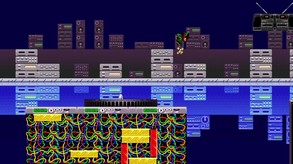
Zool Redimensioned, developed by Sumo Digital Academy and published by Secret Mode, is a faithful yet revitalized remake of the 1992 Amiga classic Zool: Ninja of the Nth Dimension. The original game was a defining relic of the early ’90s platformer boom—a time when mascot characters were competing for the spotlight once dominated by Sonic and Mario. This modern reimagining preserves much of that nostalgic charm while layering in smoother controls, refined visuals, and thoughtful quality-of-life updates. It is less a reinvention than a careful restoration, crafted by a new generation of developers learning the craft of game design, and the result is an experience that respects its roots while striving to feel accessible to modern players.
From the first level, it becomes clear that the spirit of the original has been carefully preserved. Zool remains a fast, acrobatic alien ninja whose agility defines the flow of the game. The responsive jump arcs, rapid momentum, and signature wall-climbing return with a newfound fluidity, now enhanced by tighter input handling and improved collision detection. The most notable addition is the double jump, which opens up new possibilities for movement and platforming precision. Levels that once required careful timing now encourage improvisation, as players dart across platforms, vault over enemies, and collect items with a satisfying rhythm. It captures that essential “flow” that classic platformers live and die by—simple to understand but endlessly rewarding to master.
Visually, the remaster embraces modern clarity while retaining the bold, candy-colored energy that defined Zool’s world. Every environment bursts with color and life: candy-coated landscapes, musical realms filled with instruments and notes, and industrial zones buzzing with robotic hazards. The developers have wisely resisted the temptation to overdesign; instead, they polish the existing art style into high-definition smoothness. The presentation feels nostalgic but fresh, evoking memories of the 16-bit era while delivering crisp detail and fluid animation that make movement and exploration more intuitive. The camera is now more generous, giving players better visibility of the terrain and reducing the cheap pitfalls that plagued the original. Combined with stable performance and a bright, clean user interface, the game feels like an authentic modernization of an old classic rather than a simple emulation.
The structure of Zool Redimensioned remains true to its arcade-style roots. Players journey through a series of themed worlds—each with its own aesthetic and hazards—while collecting items, dispatching enemies, and racing against time to reach the goal. The game offers two primary ways to play: the “Redimensioned” mode, which features updated controls, adjustable difficulty, and forgiving checkpoints, and the “Ultimate Ninja” mode, which recreates the original game’s tougher, more punishing design. This dual approach works brilliantly, allowing nostalgic veterans to relive the intensity of the 1990s version while giving newcomers a smoother entry point. The inclusion of save systems, accessibility toggles, and assist features such as infinite lives helps to modernize the pacing without compromising challenge. It’s a model example of how to make a retro experience approachable without diluting its essence.
Combat and level design adhere to the same pick-up-and-play philosophy as before. Zool’s primary attack—his spinning kick—remains fast and satisfying, but timing and positioning are key. The enemy designs are quirky and varied, though their patterns are simple by modern standards. The emphasis remains on movement rather than combat, and the game encourages speedrunning as much as careful exploration. Levels are filled with collectibles, which are not merely for score but also act as breadcrumbs leading the player through the chaos. The pacing between action, platforming, and item collection keeps things lively, though repetition does set in after extended play. The limited variety in enemy types and hazards can make later stages feel familiar, even as the environments themselves continue to impress visually.
The sound design walks a fine line between nostalgia and reinvention. The remastered soundtrack pays homage to the bouncy, synth-heavy compositions of the Amiga era, though it has been refined to sound fuller and cleaner. It still carries the cheerful energy that characterized early platformers, even if it doesn’t always reach the memorable heights of other 16-bit soundtracks from its era. Effects such as explosions, jumps, and item pickups have been modernized but kept faithful in spirit, helping reinforce the retro charm. The auditory feedback remains crucial to the game’s momentum—it’s the kind of soundscape that feels designed to keep you in a state of cheerful focus.
Despite its improvements, Zool Redimensioned can’t entirely escape the limitations of its source material. The level design, while lovingly recreated, occasionally reveals the linear simplicity of early platformers. Some sections feel repetitive or over-reliant on enemy placement rather than creative mechanics, and the brevity of the campaign—lasting only a few hours—means the experience ends just as it hits its stride. While completionists will enjoy replaying levels for higher scores or perfect item collection, the lack of modern incentives like unlockable content or significant progression systems may limit long-term engagement. It’s a short but concentrated dose of classic arcade fun, aimed at delivering satisfaction through tight execution rather than expansive content.
Nevertheless, the project’s heart is unmistakable. Developed by students under the mentorship of industry veterans, Zool Redimensioned serves as both a learning exercise and a tribute to gaming history. There’s a purity to its design philosophy—it doesn’t try to chase trends or transform Zool into something he’s not. Instead, it refines his legacy, offering an opportunity for new players to experience the appeal of early ’90s platforming with modern comfort. For those who grew up with the original, it’s a nostalgic return to an era of speed, color, and unpretentious fun. For newcomers, it’s a glimpse into the roots of the genre, where challenge and charm coexisted in perfect balance.
Ultimately, Zool Redimensioned succeeds as a loving restoration rather than a reinvention. It captures the enthusiasm and eccentricity of its predecessor while updating its mechanics for a modern audience. Its appeal lies not in innovation but in the joy of rediscovery—the satisfaction of mastering precise jumps, dashing through candy worlds, and reliving the energy of a bygone gaming era. It may not compete with contemporary giants in scope or complexity, but it doesn’t need to. This is a celebration of platforming’s simpler pleasures, polished and reintroduced for a generation that may have never met Zool before. In that respect, it stands as both a nostalgic time capsule and a modest triumph of preservation.
Rating: 8/10