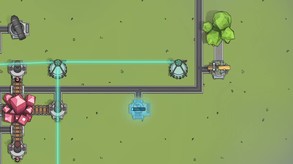
YORG.io 3 is a hybrid strategy game that merges tower defense with factory-style resource management, developed by Tobias Springer and published by tobspr Games. Released on Steam in 2019, it represents the most fully featured evolution of the YORG.io concept, which originally began as a browser-based strategy experiment. At first glance the game appears deceptively simple, presenting players with minimalist graphics and a straightforward objective: defend your base from waves of zombies. However, beneath that surface lies a surprisingly intricate strategic system where success depends not only on tower placement but also on the efficiency of complex production chains. By combining elements of base construction, logistics management, and defensive planning, YORG.io 3 creates a gameplay experience that feels closer to a blend of tower defense and automation simulators than a traditional strategy title.
The core gameplay revolves around building and maintaining an industrial network capable of supplying defensive towers with the resources they need to operate. Players begin with a central base and a small amount of space to expand outward across a grid-based map. Scattered around this map are resource deposits such as crystals, iron, coal, and wood, which must be harvested using specialized mining structures. These raw materials cannot be used directly; they must be processed in factories that transform them into more advanced resources such as ammunition, energy cells, or other specialized components. These materials are then transported through conveyor-like connections between buildings, forming supply lines that feed defensive towers. If the production chain fails or becomes inefficient, towers will run out of ammunition and become useless against incoming enemies. This interconnected system of extraction, production, and distribution gives the game its distinctive strategic depth, forcing players to think carefully about how their infrastructure is designed.
A defining mechanic in YORG.io 3 is the day-and-night cycle that governs the pacing of the game. During the daytime phase, players can expand their base, build new mines, upgrade factories, and develop their defensive infrastructure without immediate pressure. When night falls, however, waves of zombies begin to attack the base from the edges of the map. Early waves are relatively manageable, giving players time to learn the mechanics and refine their layouts. As the nights progress, enemy numbers increase and new types of zombies appear, each with unique characteristics that require specific defensive strategies. Some enemies move quickly, others possess heavy armor, and certain variants can bypass or overwhelm poorly planned defenses. Surviving these escalating attacks requires players to constantly improve both their defensive placements and their resource production chains.
The variety of towers and upgrades adds another layer of tactical decision-making. Basic defensive towers provide a steady stream of damage against incoming enemies, but later technologies introduce more specialized options such as high-powered laser towers, artillery-style cannons, and advanced defensive structures capable of handling tougher enemies. Each tower consumes specific resources to function, which means players must ensure that their factories produce the correct types of ammunition. This requirement encourages careful planning of production routes and storage capacity. Expanding the base too aggressively can stretch supply lines too thin, while overly conservative expansion can leave the player underpowered against stronger enemies. Balancing these factors becomes a central challenge throughout the game.
Compared to earlier entries in the series, YORG.io 3 significantly expands its scope by introducing competitive multiplayer modes. In these matches, players not only defend against waves of zombies but can also send enemy waves toward their opponents by constructing specialized zombie factories. This transforms the experience into a strategic duel where players must divide their attention between building their own defenses and disrupting their rivals. Multiplayer matches often become tense contests of efficiency, with victory determined by which player can build the most optimized resource network while simultaneously applying pressure to opposing bases. This addition greatly increases replayability, giving experienced players new ways to test their strategies against human opponents.
The visual design of YORG.io 3 is intentionally minimalistic. Buildings, resources, and enemies are represented by simple shapes and bright colors, giving the game a clean and functional aesthetic. While the graphics are far from technically advanced, this simplicity serves an important gameplay purpose. Because the game revolves around monitoring complex production chains and defensive layouts, visual clarity is essential. The straightforward design makes it easy to understand how resources flow through the base and where potential bottlenecks may occur. This clarity becomes particularly valuable in later stages when the map is filled with dozens of structures and large waves of enemies.
Audio design in the game remains understated but effective. The soundtrack focuses on calm, atmospheric music that supports the strategic pacing without becoming distracting. Sound effects for mining operations, tower firing, and enemy movement provide subtle feedback that helps players stay aware of what is happening across their base. While the audio presentation is not a major highlight, it complements the game’s minimalist approach and reinforces the feeling of overseeing a constantly operating industrial defense network.
Despite its strengths, YORG.io 3 does have some limitations. Because the gameplay loop centers around building supply chains and defending against increasingly large waves, extended sessions can sometimes feel repetitive once players fully understand the optimal strategies. The learning curve can also be challenging for newcomers who are unfamiliar with automation-style mechanics, as inefficient layouts can lead to sudden collapses during later waves. Additionally, experienced players may eventually discover highly efficient base designs that reduce the need for experimentation, which can lessen the long-term challenge of the single-player mode.
Even with these drawbacks, YORG.io 3 stands out as a creative and intellectually engaging strategy game that successfully merges two distinct genres. Its combination of tower defense combat and factory management creates a satisfying gameplay loop that rewards careful planning and efficient design. Every successful match feels like the result of a well-engineered system working perfectly under pressure, which can be immensely satisfying for players who enjoy optimization and strategic problem-solving.
Ultimately, YORG.io 3 proves that complex and rewarding strategy experiences do not require elaborate visuals or cinematic storytelling. Its minimalist presentation hides a deeply strategic core that challenges players to build efficient production networks while surviving relentless enemy assaults. For fans of automation games, logistics puzzles, and tower defense strategy, the game offers a unique blend of mechanics that remains engaging long after the first few matches.
Rating: 8/10