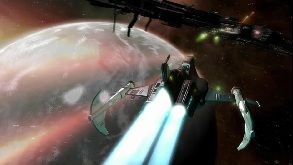
The Human Race had advanced to the point where we could travel among the stars, we developed giant automated machines to help us colonise other worlds, but there was a fault in their programming and they turned and attacked. Forcing us to lay a trap to protect Earth and exiling the Human race to stay on Earth once again.
Modeled estimate, not a reported figure. How we estimate →
Media

About
Genres
Stats
All-time low is the lowest price we've recorded for this game since we started tracking it.
Languages: English*, German**languages with full audio support
Engagement
Hours played at review time, across 40 reviews with recorded playtime.
Reviews
Themes across 40 recent reviews and how positive each mention is. A keyword signal, not full sentiment analysis.
positive critical· bar length = how often the theme comes up
Reviews
I played the game X while watching the movie X (2022).
Good Game
Радиоактивный космос.
X: Beyond the Frontier, developed and published by Egosoft, marks the beginning of a long-running space simulation series that would go on to define a particular niche of sandbox-driven, economy-focused gameplay. Released at the end of the 1990s, it arrived at a time when space simulators were either heavily combat-oriented or fading in popularity. Instead of following the fast-paced dogfighting model of many contemporaries, X: Beyond the Frontier chose a slower, more methodical path, emphasizing trading, economic systems, and open-ended exploration. The result is a game that feels less like a traditional action title and more like a living simulation of a complex interstellar society. The narrative premise is straightforward but effective. Players assume the role of Kyle Brennan, a test pilot who becomes stranded in an unfamiliar region of space after an experimental jump drive malfunctions. Cut off from Earth and without immediate means of return, he must survive and adapt within a network of alien-controlled star systems. This setup provides context, but the story never aggressively dictates the pace of play. Instead, it functions as a loose thread woven into a much larger sandbox. The player is free to pursue narrative objectives or ignore them entirely, carving out their own path through commerce, exploration, and gradual expansion. The true heart of X: Beyond the Frontier lies in its economic model. Each star system contains stations and factories that produce and consume specific resources, creating a dynamic supply-and-demand network. Players can buy goods where they are abundant and cheap, then transport them to sectors where they are scarce and valuable. Over time, profits allow for ship upgrades, better equipment, and eventually the construction of player-owned factories that generate income autonomously. This progression transforms the experience from a lone pilot scraping together credits into a budding industrial magnate influencing entire trade routes. The economic layer is surprisingly deep for its era, demanding attention to market fluctuations and logistical efficiency. Combat exists but is not the primary focus. Encounters with pirates or hostile factions can occur, and upgrading shields and weapons becomes necessary for survival. However, dogfighting lacks the arcade immediacy found in more action-oriented space games. Battles tend to feel deliberate rather than frantic, reinforcing the broader theme that preparation and investment are more important than reflexes alone. In many cases, avoiding conflict or building enough economic power to outpace threats proves more rewarding than direct confrontation. This design choice underscores the simulation-driven philosophy at the game’s core. Exploration plays a significant role in shaping the player’s journey. The universe is composed of numerous interconnected sectors linked by jump gates, each with distinct layouts and economic profiles. Discovering new systems often means uncovering fresh trading opportunities or encountering different factions with their own technologies and ships. The scale of the universe fosters a sense of isolation and curiosity, enhanced by ambient sound design and the quiet vastness of space. Unlike tightly scripted games, X: Beyond the Frontier allows long stretches of peaceful travel punctuated by moments of tension, mirroring the rhythms of real commerce and exploration. Technically and visually, the game reflects its late-1990s origins. Ship models and station designs are simple by modern standards, and the interface can feel clunky to newcomers. Navigating menus, managing cargo, and issuing commands require patience, particularly for players accustomed to streamlined contemporary design. However, beneath the dated presentation lies a robust simulation that rewards dedication. The learning curve is steep, and early hours can feel slow or even confusing. Yet for those willing to invest time, the gradual mastery of systems and accumulation of wealth becomes deeply satisfying. One of the game’s defining qualities is its emphasis on player autonomy. There are no rigid mission structures forcing progression, no scripted sequences dictating every action. Instead, X: Beyond the Frontier trusts players to set their own goals. Some may focus entirely on trading, others on exploration or incremental military strength. The emergent stories that arise—from narrowly escaping pirate ambushes to watching a newly built factory begin generating profit—often feel more personal and memorable than scripted events. In retrospect, X: Beyond the Frontier stands as a foundational entry in the space simulation genre. It established the economic and sandbox framework that later entries in the X series would refine and expand upon. While its age is evident in both visuals and interface design, its ambition and systemic depth remain noteworthy. For players who appreciate open-ended progression, complex economic networks, and the quiet satisfaction of building an interstellar enterprise from humble beginnings, it offers a uniquely immersive experience. It is not a game of instant gratification, but rather one of patience, planning, and steady growth in a vast and indifferent universe. Rating: 7/10
It's old but it's fun. Took a while to get some tweaks going but it looks great.
building growing fighting with a little trading
A pesar del tiempo he disfrutado la simpleza de sus mecánicas. Encontré este título como la base para empezar a familiarizarte con el X-Universe.
X系列开山作。 代码水平很高,实时宇宙与动态经济很有趣。 购买工厂赚够钱,把飞船升级得很强后,摧毁敌舰有点满足感,前十几小时的努力算是得到一点点回报了。 我喜欢挑战有难度的载具操控,但是这作的空战手感简直是灾难级的,后面几作的就好很多。 第一部通关的X系列游戏,通了2次,玩了这么久,给个好评吧。
Классика, что тут говорить. Жаль только рудник завис у меня.
Шикарная игра 1999 года
Related
Related
Trends
Modeled estimate over time, reconstructed from Steam's monthly review histogram.
Momentum
Pace estimated from the game's recent review growth (our daily snapshots) at its own sales-per-review ratio — a momentum signal, not booked sales.
Audience
Estimated from the language of this game's reviews — a proxy for where players are, not official Steam demographics.
Related
| Attack at Dawn: North Africa | $70.2K | 103 | 88% | $29.99 |
| Trials 2: Second Edition | $70.2K | 278 | 85% | $9.99 |
| Kill to Collect | $70.2K | 296 | 69% | $9.99 |
| Miami Hotel Simulator | $70.3K | 164 | 75% | $11.99 |
| Vending Dokan!: Kozy Kiosk | $70.2K | 154 | 90% | $11.99 |
| Volkolak: The Will of Gods | $70.2K | 252 | 92% | $10.99 |