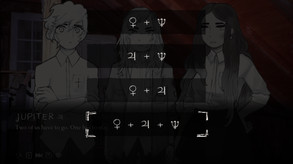
WE KNOW THE DEVIL is a visual novel about teens reluctantly fighting the devil at summer camp. Follow meangirl Neptune, tomboy Jupiter, and shy shy Venus as they get to know each other--but one always gets left out.
Modeled estimate, not a reported figure. How we estimate →
Media
About
Genres
Stats
All-time low is the lowest price we've recorded for this game since we started tracking it.
Languages: English
Engagement
Hours played at review time, across 41 reviews with recorded playtime.
Reviews
watched a playthrough of this when i was a freshman in high school. its been seven years and i just played through it with my girlfriend. i used to relate to venus a lot more, now im being told i remind her of neptune. im happy, shes trying to find a jupiter profile picture. a lot has changed in 7 years, a lot has made this game only more meaningful to me. this game has been a love of mine since i first experienced it and every time i reexperience it it means even more to me. i had a wonderful talk with my other girlfriend today. im happy. a lot has changed in 7 years.
already trans and queer, but the true ending got me at the verge of tears venus, you will always be the brightest to me <3 [b]some tips before buying/playing?[/b] - the writing may stutter or be... [i]abstract[/i]... at times. the dialogue feels realistic considering the characters but it may be a put-off for some, especially because the lore is left mostly unexplained and the dialogue can seem trivial or inconsecuential, [b]but i assure you it's not[/b]. - [b]don't play wktd expecting a fully-fleshed pierced-together story with a narrative that will accompany you from beginning to end[/b]. it's told like a string of events that happen in the end of a summer camp and the relationship between 3 girls and their peers. you'll have to make assumptions for what isn't directly said, and your first playthrough may feel rushed since you still won't know much about the characters' struggles and stuff. - [b]the ost is amazing for building the atmosphere[/b], be wary of sudden noises and radio static, play at low volume if needed. - [b]the game is slightly short and pretty straightforward to 100%[/b], but if you relate to the message [b]it will stay with you[/b]. it's like seeing a tv glow. a lil rant, since i've seen other people share their experiences i didnt grow up in a religious household, but seeing other people my age do i knew i wasnt immune. being "bad" without knowing [i]why[/i] or [i]how[/i] it's bad is horrible, it's crushing, and the worst is at that time you probably didnt even know what it was, but you [b]knew[/b] you had it. being told something is "bad", and that "bad" thing being inside you, even if you couldnt put a name to it yet, or you didnt want to in fear you'd be shunned by the people you think you can trust. so you tone yourself down. you hide. because you see people like you getting hurt when they don't hide. and it bubbles up. and when you come to terms with yourself you realise you deserve love and respect and there was never anything wrong with you but it was the THOUGHT that it was wrong that held you back, that made you think you were "bad", and the promise of how "goodness" would come if you hid your "bad" parts. being too nice, being too mean, being too responsible, being too irresponsible, being good at something, being bad at something, which is "bad"? which is "good"? does it depend entirely on whoever is telling you how you should behave? can you ever be "good" like this? shouldn't you just embrace being "bad" instead, since you may never be considered "good"? maybe you'll even be the worst girl since eve btw happy late transgender visibility day !! 🏳️⚧️🏳️⚧️🏳️⚧️ i wouldn't call this [i]horror[/i], but as they say, every "having a body" is body horror :D👍 if you buy this game do it for the queer/religious trauma and the conflict between what is "good" or "bad", not because of the horror aspect
I think I would have liked if there was more time showing everyone's dynamics with the other people in the camp instead of just telling it to us later. I think it would have been better for storytelling and also just given us more time to bond with the main cast. That being said I do like the characters and their dynamics and the story we get once we finally make it to the true end. I am so so curious about the world their in though. In my first playthrough I kept getting distracted wondering about all the worldbuilding stuff, hoping for an explanation somewhere. But in the end I think the confusion adds to the overall vibe. I'm still curious though. 7/10, I like it, I want more. Would make a killer movie I think. EDIT: There's a demo on itchio that gives pre-game scenes with more time to bond with the cast AND some nice info about the lore without explaining too much. I wish it was in the final game, or at least something similar.
It's a short experience, but an impactful one. I can't say I relate much to the characters, but there's a degree of warmth in We Know the Devil that just brings you into its story and makes you feel all fuzzy all over as you see these characters go through their ♥♥♥♥ and grow a bit closer together. I appreciate the general sentiment of the game, people being weighed down by the need forced upon them to be "good," that idea of good being whatever the enforcers say it is. In this case, the message about religion is overt and clear. Clunky, to be sure, but not an uninteresting one. Mostly, though, it's interesting for the very odd, untold story that rests at the heart of We Know the Devil. The world of We Know the Devil is not like ours, at least it probably isn't. It's a world where the Devil is real and God is too, but God's the one our characters turn their backs on in the true ending (a worthwhile ending as it's the only one that feels particularly complete of the four endings). I dislike the need to replay the game to go through each ending and I think the writing is generally too haphazard for my tastes. I also feel that the characters would feel better if they had more air to breathe, i.e., if the game were longer and not focused on just this one night. But, again, there's that warmth I was talking about. Seeing the characters talk, you grow to care for them quickly even if you don't know them as well as you'd like by the end. And every moment, I was happy with them when they were happy. There's a song from the game, Growing Poppies. It's beautiful, my favorite part of the game, and I would say it holds in it everything the game wants to talk and be about. There's beauty, warmth and comfort in its main piano line, and yet behind it there is this constant, shimmering drone. It's easy to think of it as a sort of discomfiting background that always paints the backdrop behind the main characters, but I cannot help but see some positive value in it. I don't know how to interpret that drone, though. The image I get in my head is of these three characters on the precipice of something and that the drone is the apocalypse coming to wash the characters away. And it's like these characters have only really been brought together and self-actualized because that apocalypse put them there in the first place. It's not that it was best this way. It would be better if the characters were able to become the selves they really want to be, not the selves they're made to be, simply without that threat looming over them. But, I guess there's beauty to be recognized in a bad situation, a good miracle in that of a bad thing. I guess it's just inexplicable to me. I'm sat here thinking it through and trying to figure out what it is this song is doing and why it feels so meaningful to me, but all my metaphors seem to lean towards painting that noise as a bad, ugly thing. And it's not ugly to me, it's just as beautiful as that piano is. Maybe it's that in isolation, the two would create a different experience, but in coming together, there's a sort of sheer beauty that either individually would never have been able to realize. Maybe the drone represents "evil," or the opposite of goodliness. Jupiter talks at one point, in her individual ending, about this sensation of having started evil and trying so hard to be good only to find by the end that it was for nothing. And yet, as we find in the true ending, these characters and their happiest ending comes with their decisions to turn their backs on God, to become three Eves. The song, Growing Poppies, starts and ends with this drone, fades in and fades out. Maybe that's all it is? The recognition that what appears to be evil never really was, despite everything we were told. The summer heat becomes overbearing with time. The warmth turns to discomfort which turns to a desire for the shade. It's as if the sun, in beating us down, wants to push us into the shade. We know the devil, for it lies in the shadow of man. So, maybe it's best to rest in the shadows when the heat of light gets to be too much. If nothing else, you know you'll have company.
I did not particularly like this particular visual novel. I disagree heavily with some of the overarching themes, I felt it overall communicated its messages in far too overbearing a manner, and one character's arc actually made me quite upset for reasons entirely unrelated to the ones I was supposed to be upset over. However, observing good art one disagrees with now and then is good for the soul, and this is quite good art. Very well written. I can't not recommend it, although I personally will not be playing it again. (two endings was plenty for me, though admittedly I am a little curious as to how the ones I haven't seen go.)
"But we can't wait to see what they'll do against the three worst girls since Eve." Not a perfect game, but I connected to it heavily. You ever feel thankful for a game being made? That's what I'm feeling right now...
Loved the visual, sound design is interesting. Story wants to talk about true LGBTQ+ struggles and truths, but with a very messy spirtual/supernatural metaphor that just doesn't land.
This is perfect for someone who loves watching hour+ video essays on interpersonal relationships in their favorite form of media, and the overarching political and social implications behind them, and the ways people who don't fit the norm are forced into a mold despite their earnest protests. [i]Or they like to read Halimede's substack twice a week[/i]. Overall, it was a pretty interesting read with lovely art and slightly confusing replayability.
why did pray the gay away camp simulator make me weep 10/10
We Know the Devil is an unconventional visual novel that blends psychological horror, coming-of-age drama, and supernatural themes into a compact yet remarkably memorable experience. Developed by Pillow Fight and Worst Girls Games and published by Pillow Fight, the game takes place at a mysterious Christian summer camp where three teenagers—Neptune, Jupiter, and Venus—are assigned a strange task: spend a night in an isolated cabin and confront the Devil. While the premise initially suggests a traditional horror story, the game quickly reveals itself to be far more interested in exploring human relationships, loneliness, and the emotional struggles of adolescence. The narrative stands out because of how it approaches character interaction. Rather than following a fixed route, players decide which two girls spend time together during key moments. This simple mechanic creates a powerful sense of tension because one character is always left out. The resulting feelings of exclusion and imbalance become central to the story, reflecting the difficulties of maintaining friendships within a trio. Every choice subtly changes the emotional landscape, allowing different sides of each character to emerge and encouraging multiple playthroughs to fully understand their perspectives. The writing is easily one of the game's greatest strengths. Each protagonist possesses a distinct personality and emotional baggage that influences how they relate to one another. Neptune masks vulnerability behind confidence and sarcasm, Jupiter struggles with responsibility and expectations, while Venus constantly searches for acceptance and belonging. Their conversations feel natural and emotionally charged, shifting between humor, awkwardness, affection, and fear. Despite the game's relatively short length, the characters develop enough depth to leave a lasting impression, and their personal insecurities become the true driving force behind the story. Although marketed as a horror experience, the game relies less on traditional scares and more on psychological unease. The Devil functions as both a supernatural threat and a symbolic representation of fear, shame, and alienation. Strange events occur throughout the night, but the most unsettling moments often stem from the characters' emotional conflicts rather than any visible monster. This approach creates a lingering atmosphere of discomfort that remains effective long after the story ends. The game uses horror as a lens through which to examine identity and social anxiety, giving it a unique voice within the genre. The visual presentation reinforces this tone exceptionally well. Character portraits are expressive and distinctive, while the backgrounds utilize a faded photographic style that resembles old snapshots from a forgotten summer. This artistic direction gives the game a dreamlike quality, making the camp feel both familiar and unnerving. The contrast between realistic environments and stylized character art contributes to the feeling that reality is slowly unraveling around the protagonists. The overall aesthetic is memorable and perfectly suited to the story's themes. Sound design also plays an important role in establishing the mood. The soundtrack features atmospheric electronic compositions that quietly build tension throughout the experience. Rather than relying on dramatic musical cues, the audio remains subtle and haunting, complementing the emotional weight of the dialogue and supernatural events. Together, the visuals and music create an immersive environment that feels isolated, melancholic, and occasionally surreal. Replayability is stronger than expected thanks to the branching narrative structure. Different combinations of character interactions unlock alternate scenes, new insights, and multiple endings. Players who invest time in exploring every route gain a much fuller understanding of the story and its themes. This design ensures that the experience remains engaging beyond a single playthrough and rewards those willing to examine every perspective. We Know the Devil is not a game designed for everyone. Its storytelling embraces ambiguity, symbolism, and emotional subtext, often leaving certain details open to interpretation. Players seeking straightforward horror or fast-paced gameplay may find its approach unusual. However, those interested in character-driven narratives, experimental storytelling, and meaningful thematic exploration will discover a thoughtful and emotionally resonant experience. It succeeds as both a supernatural tale and a reflection on adolescence, identity, and the fear of being excluded from the people who matter most. Rating: 9/10
Related
Related
Trends
Concurrent players on Steam, sampled daily since tracking started.
Audience
Estimated from the language of this game's reviews — a proxy for where players are, not official Steam demographics.
Related
| Enter The Backrooms | $139.5K | 1.1K | 87% | $9.99 |
| Polyball | $139.4K | 1.2K | 69% | $3.99 |
| Syn-Chorus 01: The New Life | $139.4K | 355 | 83% | $10.99 |
| LAST EMBRYO -EITHER OF BRAVE TO STORY- | $139.7K | 611 | 93% | $12.99 |
| Crowns and Pawns: Kingdom of Deceit | $139.4K | 477 | 81% | $19.99 |
| Dwelvers | $139.4K | 318 | 69% | $14.99 |